
magnetic field tagged posts

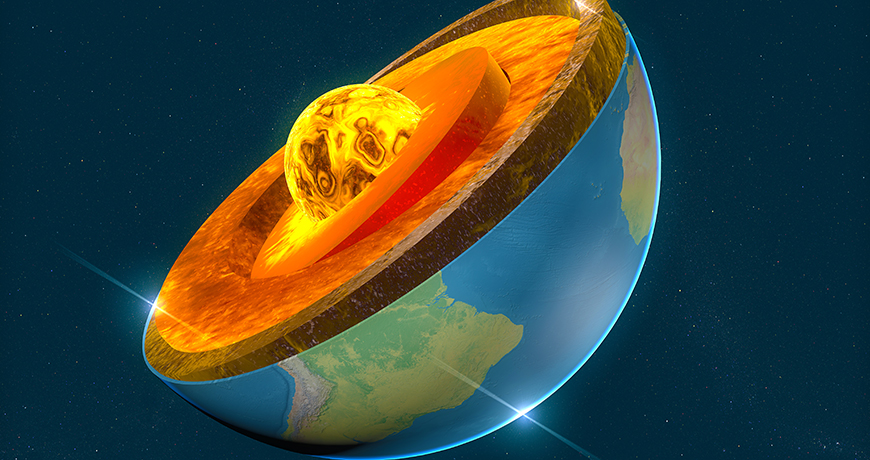
Earth’s Mantle, not its core, may have generated planet’s early Magnetic Field

Illustration: Naeblys/istockphoto

New research lends credence to an unorthodox retelling of the story of early Earth first proposed by a geophysicist at Scripps Institution of Oceanography at UC San Diego.

In a study appearing March 15 in the journal Earth and Planetary Science Letters, Scripps Oceanography researchers Dave Stegman, Leah Ziegler, and Nicolas Blanc provide new estimates for the thermodynamics of magnetic field generation within the liquid portion of the early Earth’s mantle and show how long that field was available.

The paper provides a “door-opening opportunity” to resolve inconsistencies in the narrative of the planet’s early days...

Read More

A year of surprising Science from NASA’s InSight Mars mission

In this artist’s concept of NASA’s InSight lander on Mars, layers of the planet’s subsurface can be seen below and dust devils can be seen in the background.Credit: IPGP/Nicolas Sarter

New papers summarize the lander’s findings above and below the surface of the Red Planet. A new understanding of Mars is beginning to emerge, thanks to the first year of NASA’s InSight lander mission. Findings described in a set of six papers published today reveal a planet alive with quakes, dust devils and strange magnetic pulses.

Five of the papers were published in Nature Geoscience. An additional paper in Nature Communications details the InSight spacecraft’s landing site, a shallow crater nicknamed “Homestead hollow” in a region called Elysium Planitia.

InSight is the first mission dedicate...

Read More

The Occurrence of Magnetism in the Universe

A precession driven flow is supposed to power magnetic field self-excitation in a planned liquid metal dynamo experiment at HZDR. Credit: HZDR

A precession driven flow is supposed to power magnetic field self-excitation in a planned liquid metal dynamo experiment at HZDR. Credit: HZDR

Precession sufficient to generate a magnetic field. Flows of molten metal can generate magnetic fields. This dynamo effect creates cosmic magnetic fields, like those found on planets, moons and even asteroids. Over the coming years, a globally unique experiment, in which a steel drum containing several tons of liquid sodium rotates around two axes, is intended to demonstrate this effect. It will be carried out in the new DRESDYN facility at the Helmholtz-Zentrum Dresden-Rossendorf (HZDR), an independent German research laboratory.

Similarly to how a bicycle dynamo converts motion into electricity, moving conductive fluids can generate magnetic field...

Read More

Why is Massive Star Formation Quenched in Galaxy Centers?

Magnetic fields control the collapse of the molecular clouds in the nuclear ring of the galaxy NGC 1097. As a result, formation of massive stars is suppressed in zones of strong magnetic fields (contours). Credit: Gabriel Pérez, SMM (IAC)

Magnetic fields control the collapse of the molecular clouds in the nuclear ring of the galaxy NGC 1097. As a result, formation of massive stars is suppressed in zones of strong magnetic fields (contours). Credit: Gabriel Pérez, SMM (IAC)

Study points to the role of the magnetic field as responsible for decelerating the formation of massive stars in the center of galaxies. Without this process the Big Bang would be questioned. Research has revealed that this process occurs around the center of the galaxy NGC 1097.

The current cosmological model to explain our universe, the “Big Bang” model, aims to describe all the phenomena we observe, which includes the galaxies and their evolution from earliest times to the present day...

Read More