
Magnetosphere tagged posts

Solar Storms can Destroy Satellites with ease: A Space Weather expert explains the science

On Feb. 4, 2022, SpaceX launched 49 satellites as part of Elon Musk’s Starlink internet project, most of which burned up in the atmosphere days later. The cause of this more than US$50 million failure was a geomagnetic storm caused by the sun.

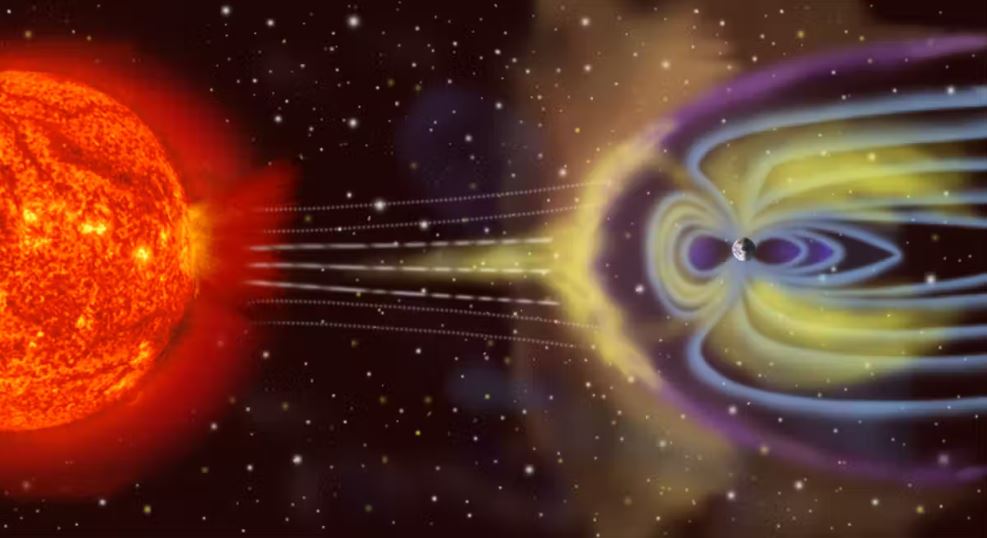
Geomagnetic storms occur when space weather hits and interacts with the Earth. Space weather is caused by fluctuations within the sun that blast electrons, protons and other particles into space. When space weather reaches Earth, it triggers many complicated processes that can cause a lot of trouble for anything in orbit. And engineers are working to better understand these risks and defend satellites against them.

What causes space weather?

The sun is always releasing a steady amount of charged particles into space...

Read More

Old data, New Tricks: Fresh results from NASA’s Galileo Spacecraft 20 years on

Newly analyzed data from the Galileo spacecraft’s flybys of one of Jupiter’s moons two decades ago is yielding fresh insights: the magnetic field around the moon Ganymede makes it unlike any other in the solar system. Far across the solar system, from where Earth appears merely as a pale blue dot, NASA’s Galileo spacecraft spent eight years orbiting Jupiter. During that time, the hearty spacecraft – slightly larger than a full-grown giraffe – sent back spates of discoveries on the gas giant’s moons, including the observation of a magnetic environment around Ganymede that was distinct from Jupiter’s own magnetic field...

Read More

Implications for Slow Solar Wind Formation by Solar Reconnection

This image from the ESA/NASA Solar and Heliospheric Observatory on June 15, 1999, shows streaks of bright light. This represents material streaming out from the sun (which is obscured in this picture by the central red disk so that it cannot overwhelm the image of the fainter material around it). Two other NASA spacecraft measured this material closer to Earth to better understand what causes this regular outflow, known as the solar wind, from the sun. Credit: NASA/SOHO

This image from the ESA/NASA Solar and Heliospheric Observatory on June 15, 1999, shows streaks of bright light. This represents material streaming out from the sun (which is obscured in this picture by the central red disk so that it cannot overwhelm the image of the fainter material around it). Two other NASA spacecraft measured this material closer to Earth to better understand what causes this regular outflow, known as the solar wind, from the sun. Credit: NASA/SOHO

Solar flares and coronal mass ejections explode in the sun’s hot atmosphere, the corona, sending light and high energy particles out into space. The corona is also constantly releasing a stream of charged particles, aka solar wind. Even the slowest moving solar wind can reach speeds of ~700,000 mph...

Read More

Solar Storms Trigger Jupiter’s ‘Northern Lights’ by generating a new X-ray Aurora 8X brighter than normal

Artistic rendering of Jupiter's magnetosphere. Credit: JAXA

Artistic rendering of Jupiter’s magnetosphere. Credit: JAXA

It is hundreds of times more energetic than Earth’s aurora borealis, finds new UCL-led research using NASA’s Chandra X-Ray Observatory. It is the first time that Jupiter’s X-ray aurora has been studied when a giant storm from the Sun has arrived at the planet. The dramatic findings complement NASA’s Juno mission this summer which aims to understand the relationship between the two biggest structures in the solar system – the region of space controlled by Jupiter’s magnetic field (i.e. its magnetosphere) and that controlled by the solar wind.

“There’s a constant power struggle between the solar wind and Jupiter’s magnetosphere. We want to understand this interaction and what effect it has on the planet...

Read More