Mars tagged posts

Fossilized Rivers suggest Warm, Wet Ancient Mars

Fossilized rivers suggest warm, wet ancient Mars

Perspective view of Aram Dorsum, an inverted channel on Mars and candidate landing site for the ExoMars rover. Credit: NASA/JPL/MSSS

Extensive systems of fossilised riverbeds have been discovered on an ancient region of the Martian surface, supporting the idea that the now cold and dry Red Planet had a warm and wet climate about 4 billion years ago, according to UCL-led research. The study identified over 17,000km of former river channels on a northern plain called Arabia Terra, providing further evidence of water once flowing on Mars.

“Climate models of early Mars predict rain in Arabia Terra and until now there was little geological evidence on the surface to support this theory...

Read More

Digging Deeper into Mars

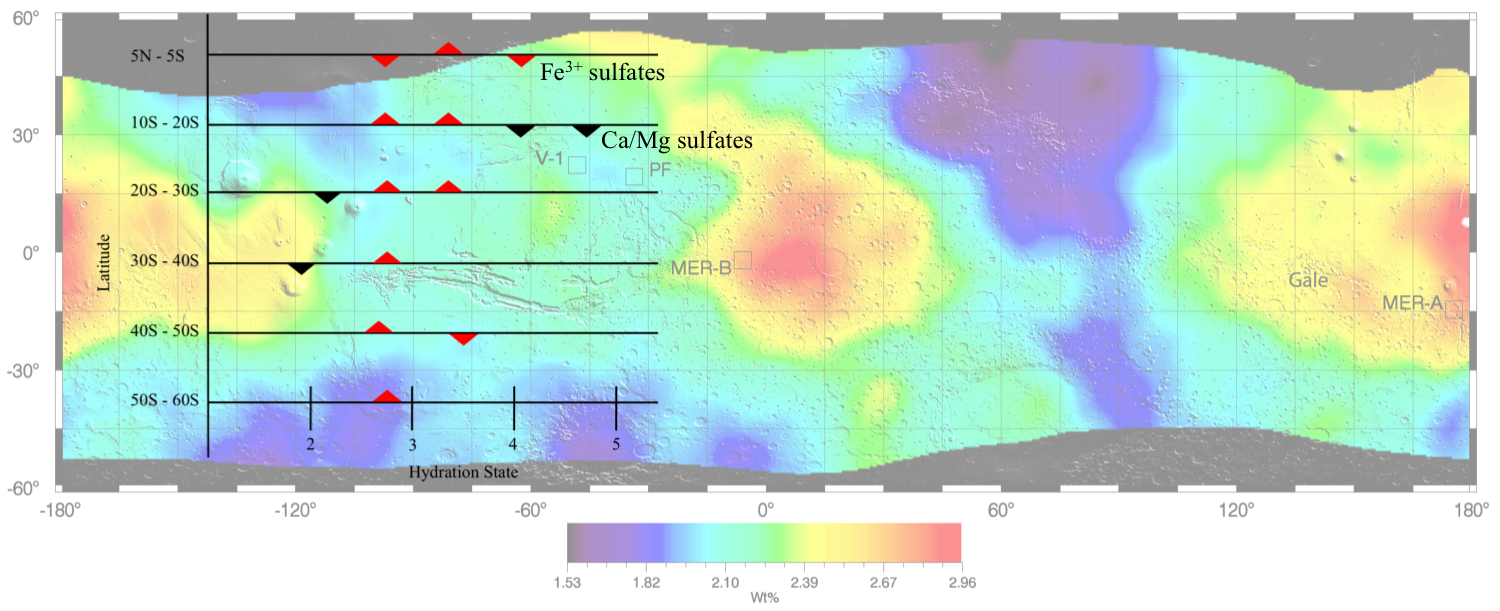
Global map of Mars

This is a global map of Mars sulfur concentration (as percentage by mass) derived from the 2001: Mars Odyssey Gamma Ray Spectrometer spectra. Overlay shows qualitatively what types of hydrated sulfates are consistent with the variations seen in sulfur and water across the latitudes. Upright triangles indicate peaks in possible sulfate type abundance while the inverted triangles show less prominent values. Credit: Nicole Button, LSU Planetary Science Lab

New findings on the chemical composition of hydrated soil at regional scales. Previous observations of soil observed along crater slopes on Mars showed a significant amount of perchlorate salts, which tend to be associated with brines with a moderate pH level...

Read More

Frosty Cold Nights year-round on Mars may stir Dust

Frosty Cold Nights Year-Round on Mars May Stir Dust

This map shows the frequency of carbon dioxide frost’s presence at sunrise on Mars, as a percentage of days year-round. Carbon dioxide ice more often covers the ground at night in some mid-latitude regions than in polar regions, where it is generally absent for much of summer and fall. Image Credit: NASA/JPL-Caltech

Some dusty parts of Mars get as cold at night year-round as the planet’s poles do in winter, even regions near the equator in summer, according to new NASA findings based on Mars Reconnaissance Orbiter observations. The surface in these regions becomes so frigid overnight that an extremely thin layer of CO2 frost appears to form. The frost then vaporizes in the morning...

Read More

A Bewildering Form of Sand Dune discovered on Mars

Two sizes of ripples are evident in this Dec. 13, 2015, view of a top of a Martian sand dune, from NASA's Curiosity Mars rover. Sand dunes and the smaller type of ripples also exist on Earth. Credit: NASA/JPL-Caltech/MSSS

Two sizes of ripples are evident in this Dec. 13, 2015, view of a top of a Martian sand dune, from NASA’s Curiosity Mars rover. Sand dunes and the smaller type of ripples also exist on Earth. Credit: NASA/JPL-Caltech/MSSS

Some of the wind-sculpted sand ripples on Mars are a type not seen on Earth, and their relationship to the thin Martian atmosphere today provides new clues about the atmosphere’s history. The determination that these mid-size ripples are a distinct type resulted from observations by NASA’s Curiosity Mars rover. 6 months ago, Curiosity made the first up-close study of active sand dunes anywhere other than Earth, at”Bagnold Dunes” on the NW flank of Mount Sharp.

“Earth and Mars both have big sand dunes and small sand ripples, but on Mars, there’s something in between that w...

Read More