
maser tagged posts

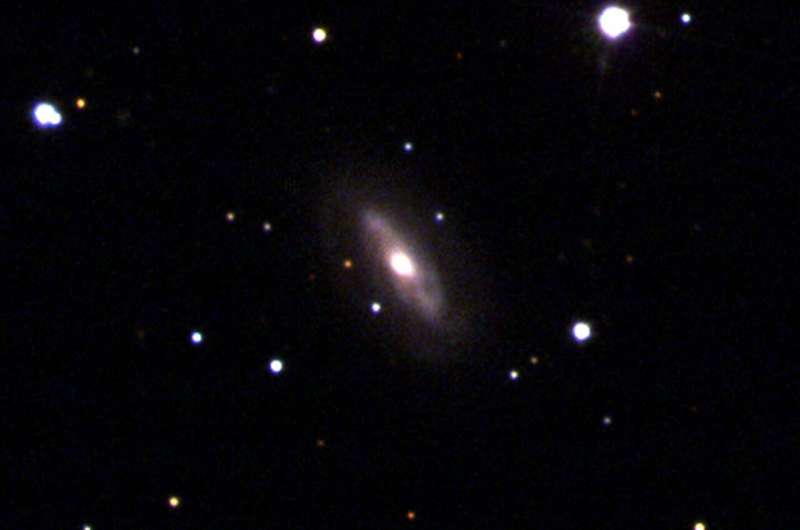
Astronomers have detected a Moving Supermassive Black Hole

Astronomers detect a black hole on the move
Galaxy J0437+2456 is thought to be home to a supermassive, moving black hole. Credit: Sloan Digital Sky Survey (SDSS).

Scientists have long theorized that supermassive black holes can wander through space – but catching them in the act has proven difficult. Now, researchers at the Center for Astrophysics | Harvard & Smithsonian have identified the clearest case to date of a supermassive black hole in motion. Their results are published today in the Astrophysical Journal.

“We don’t expect the majority of supermassive black holes to be moving; they’re usually content to just sit around,” says Dominic Pesce, an astronomer at the Center for Astrophysics who led the study. “They’re just so heavy that it’s tough to get them going...

Read More

World’s 1st Continuous Room-temperature solid-state Maser built using diamond

The diamond is held inside a sapphire ring and illuminated by 532-nm green laser. The red light is fluorescence from the NV centres. Credit: Jonathan Breeze, Imperial College London

The diamond is held inside a sapphire ring and illuminated by 532-nm green laser. The red light is fluorescence from the NV centres. Credit: Jonathan Breeze, Imperial College London

The breakthrough means masers – the microwave version of lasers – could now be used more widely in a range of applications. The maser (microwave amplification by stimulated emission of radiation), the older microwave frequency sibling of the laser, was invented in 1954. However unlike lasers, which have become widespread, masers are much less widely used because in order to function they must be cooled to temperatures close to absolute zero (-273°C).

In 2012, scientists demonstrated that a maser could operate at room temperature using the organic molecule pentacene...

Read More