Microlensing tagged posts

Peering into the Milky Way’s far side, Roman could unveil 100,000 worlds

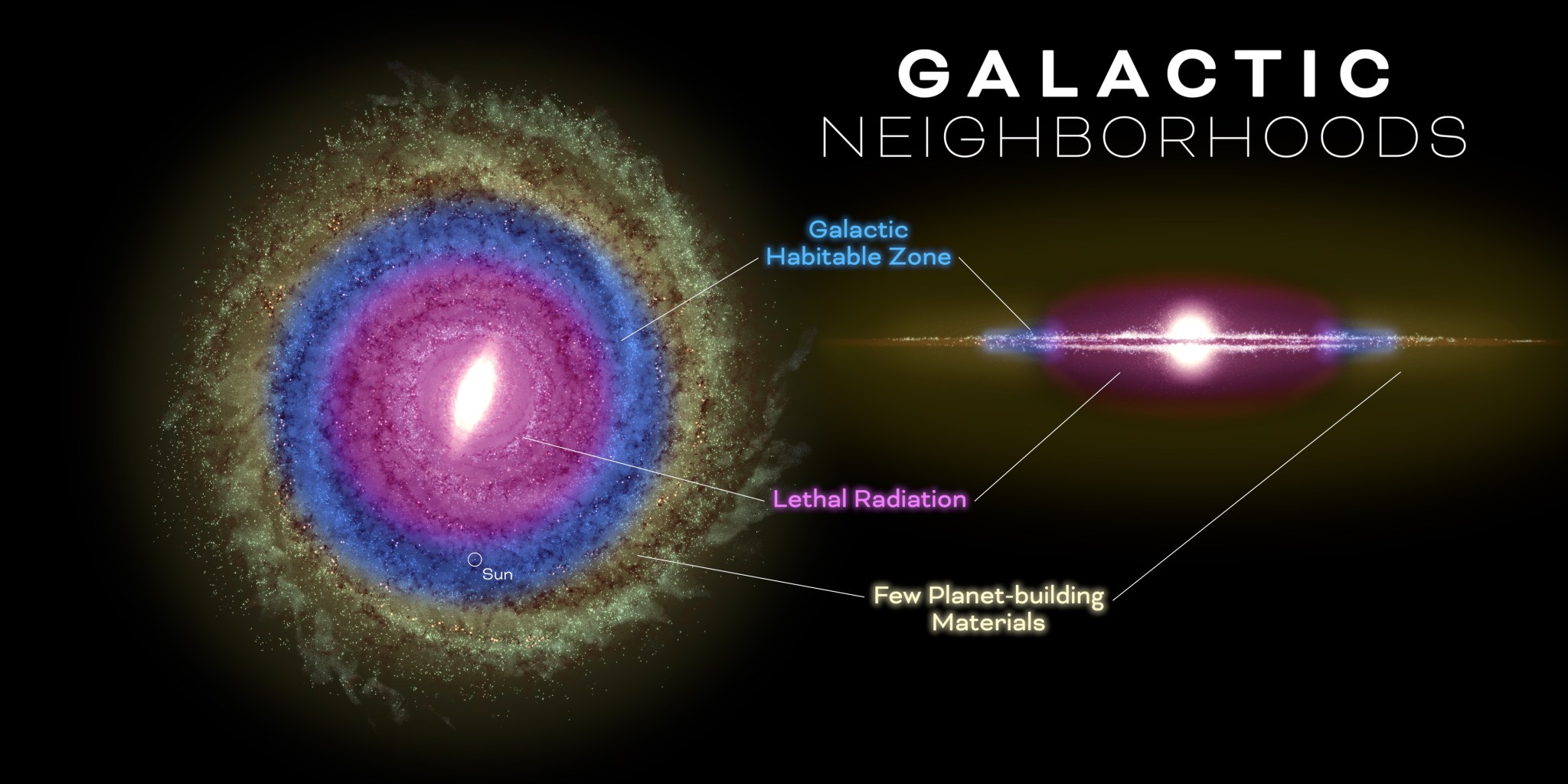
Galactic Neighborhoods infographic
This infographic features artist’s concept views of our Milky Way galaxy: face-on at the left and edge-on at the right. It highlights different galactic environments that could influence the development of planets and potentially life. The center of the galaxy is rich in the elements that form planets (like silicon, oxygen, and magnesium), which are forged by multiple generations of stars and supernova explosions. Planets there may be more common or larger, but they would also be flooded with radiation from densely packed stars (including massive ones that emit enormous amounts of high-energy ultraviolet light and X-rays). In the outskirts of the galaxy, where stars are much more spread out, radiation is far milder but there are also smaller amounts of planet-building materials...
Read More

Astronomers measure both mass and distance of a rogue planet for the first time

rogue planet in space
Image generated by the editorial team using DALL·E for illustrative purposes.

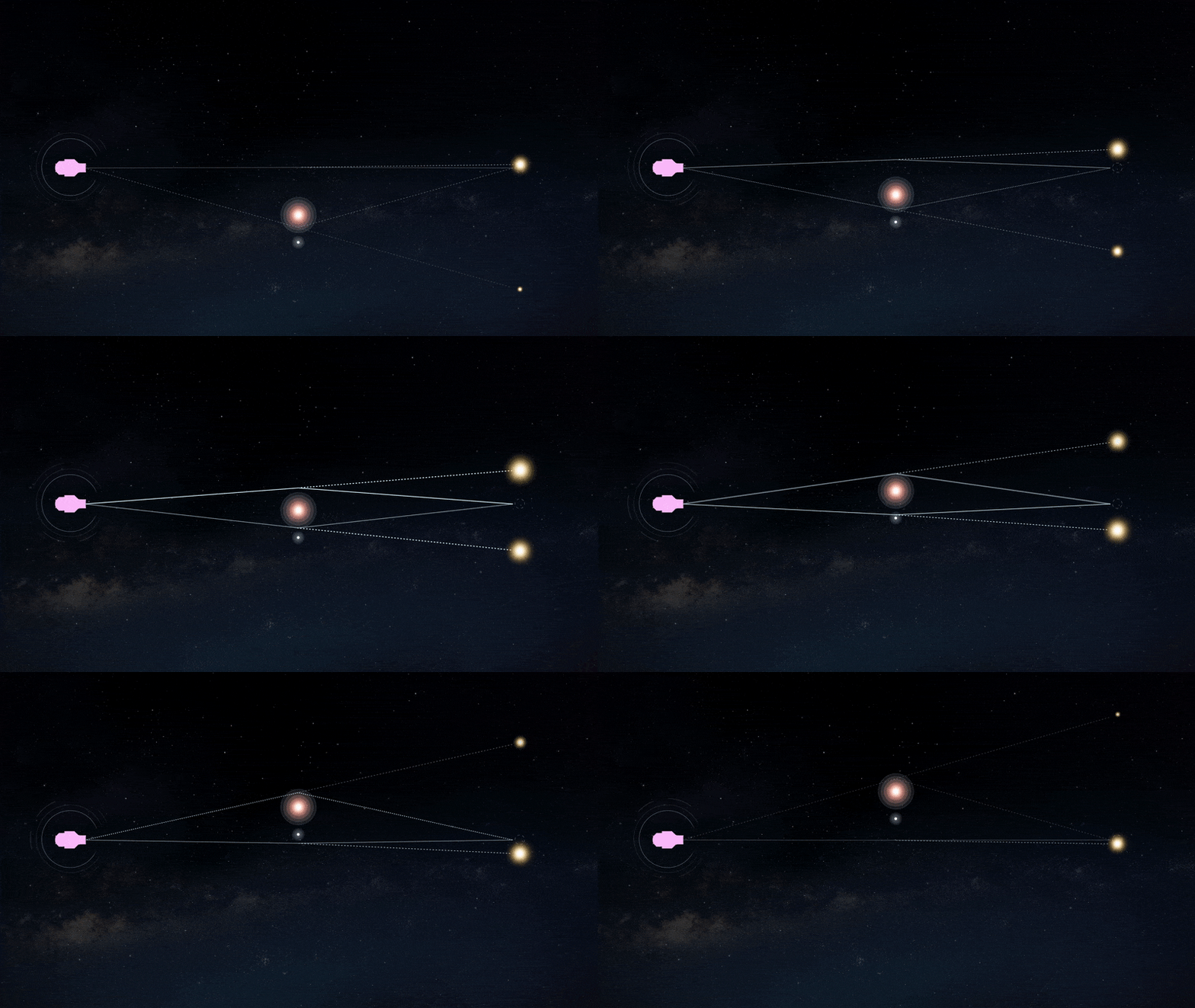
The only way astronomers have been able to detect rogue planets is through microlensing events caused by the slight gravitational effect of an object on background light. This occurs when the light from a distant star suddenly appears magnified to an observer (telescopes on Earth), as if a lens were placed in front of it. The magnification of light lets astronomers know that something has passed in front of the distant star.

Theoretically, microlensing can allow for the calculation of the mass of the object passing in front of the star by analyzing how much the light was bent and thus magnified...

Read More
AI reveals unsuspected Math underlying Search for Exoplanets

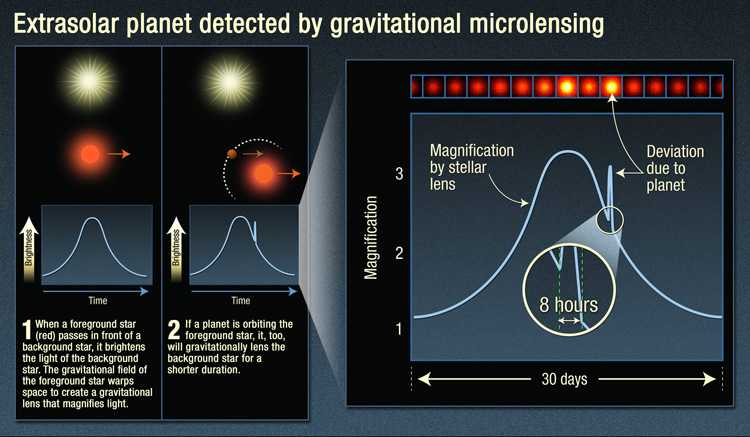
chart explaining gravitational microlensing
This infographic explains the light curve astronomers detect when viewing a microlensing event, and the signature of an exoplanet: an additional uptick in brightness when the exoplanet lenses the background star. (Image Credit: NASA / ESA / K. Sahu / STScI)

Artificial intelligence (AI) algorithms trained on real astronomical observations now outperform astronomers in sifting through massive amounts of data to find new exploding stars, identify new types of galaxies and detect the mergers of massive stars, accelerating the rate of new discovery in the world’s oldest science.

But AI, also called machine learning, can reveal something deeper, University of California, Berkeley, astronomers found: Unsuspected connections hidden in the complex mathematics arising from general relativity—...

Read More

Astrophysicists discover Planets in Extragalactic Galaxies using Microlensing

Image of the gravitational lens RX J1131-1231 galaxy with the lens galaxy at the center and four lensed background quasars. It is estimated that there are trillions of planets in the center elliptical galaxy in this image. Credit: University of Oklahoma

Image of the gravitational lens RX J1131-1231 galaxy with the lens galaxy at the center and four lensed background quasars. It is estimated that there are trillions of planets in the center elliptical galaxy in this image. Credit: University of Oklahoma

A University of Oklahoma astrophysics team has discovered for the first time a population of planets beyond the Milky Way galaxy. Using microlensing – an astronomical phenomenon and the only known method capable of discovering planets at truly great distances from the Earth among other detection techniques – OU researchers were able to detect objects in extragalactic galaxies that range from the mass of the Moon to the mass of Jupiter.

Xinyu Dai, professor in the Homer L...

Read More