Milky Way tagged posts

XMM-Newton discovers Scorching Gas in Milky Way’s Halo

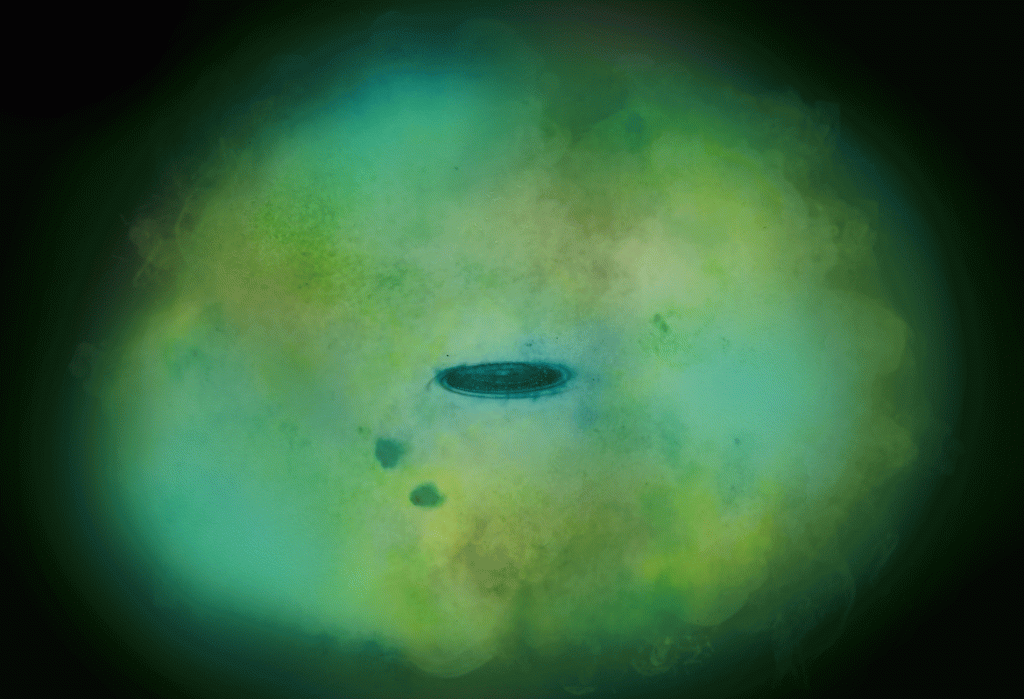
Milky Way halo – artist’s impression

ESA’s XMM-Newton has discovered that gas lurking within the Milky Way’s halo reaches far hotter temperatures than previously thought and has a different chemical make-up than predicted, challenging our understanding of our galactic home.

A halo is a vast region of gas, stars and invisible dark matter surrounding a galaxy. It is a key component of a galaxy, connecting it to wider intergalactic space, and is thus thought to play an important role in galactic evolution.

Until now, a galaxy’s halo was thought to contain hot gas at a single temperature, with the exact temperature of this gas dependent on the mass of the galaxy.

However, a new study using ESA’s XMM-Newton X-ray space observatory now shows that the Milky Way’s halo contains no...

Read More

Gaia starts Mapping the Galactic Bar in the Milky Way

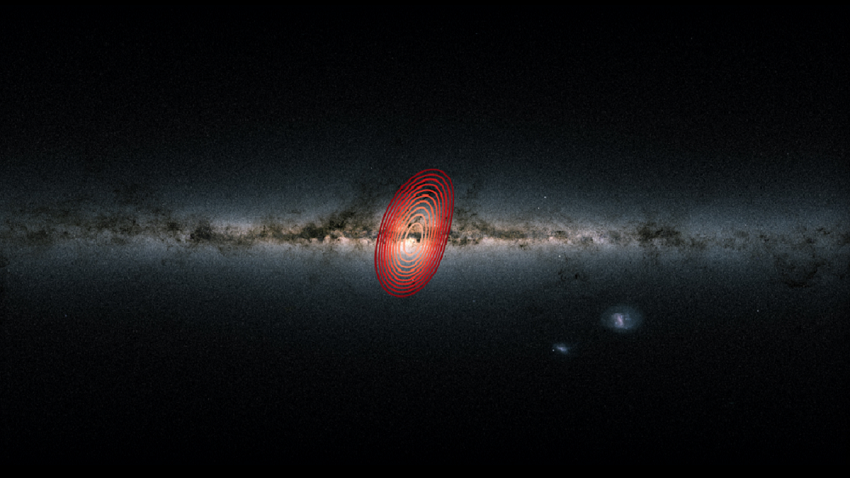
This colour chart, superimposed on an artistic representation of the galaxy, shows the distribution of 150 million stars in the Milky Way probed using data from the second release of ESA’s Gaia mission in combination with infrared and optical surveys, with orange/yellow hues indicating greater density of stars. Most of these stars are red giants. While the majority of charted stars are located closer to the Sun (the larger orange/yellow blob in the lower part of the image), a large and elongated feature populated by many stars is also visible in the central region of the galaxy: this is the first geometric indication of the galactic bar. Credit: ESA/Gaia/DPAC, A. Khalatyan (AIP) & StarHorse Team; mapa artístic de la Galaxia: NASA/JPL-Caltech/R. Hurt (SSC/Caltech)

The first direct ...

Read More

Giant X-ray ‘Chimneys’ are Exhaust Vents for Vast Energies produced at Milky Way’s center

Galactic chimneys (yellow-orange areas) are centered on the supermassive black hole at the center of our galaxy. (This is a false-color image; white patches indicate spots where unrelated, bright X-ray sources have been removed from the image.)
Credit: Gabriele Ponti/MPE/INAF and Mark Morris/UCLA

Close look at what might be happening in other, more energetic galaxies. The center of our galaxy is a frenzy of activity. A behemoth black hole – 4 million times as massive as the sun – blasts out energy as it chows down on interstellar detritus while neighboring stars burst to life and subsequently explode.

Now, an international team of astronomers has discovered two exhaust channels – dubbed “galactic center chimneys” – that appear to funnel matter and energy away from the cosmic firewo...

Read More

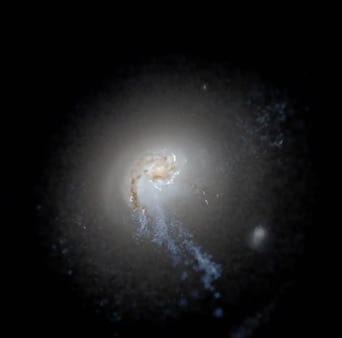
Stars around the Milky Way: Cosmic space invaders or victims of galactic eviction?

Figure 1: The Milky Way galaxy, perturbed by the tidal interaction with a dwarf galaxy, as predicted by N-body simulations. The locations of the observed stars above and below the disk, which are used to test the perturbation scenario, are indicated.

Figure 1: The Milky Way galaxy, perturbed by the tidal interaction with a dwarf galaxy, as predicted by N-body simulations. The locations of the observed stars above and below the disk, which are used to test the perturbation scenario, are indicated.

An international team of astronomers led by the Max Planck Institute for Astronomy (MPIA) has made a surprising discovery about the birthplace of groups of stars located in the halo of our Milky Way galaxy. These halo stars are grouped together in giant structures that orbit the center of our galaxy, above and below the flat disk of the Milky Way. Researchers thought they may have formed from debris left behind by smaller galaxies that invaded the Milky Way in the past.

But astronomers now have compelling evidence showing that some of these ha...

Read More