



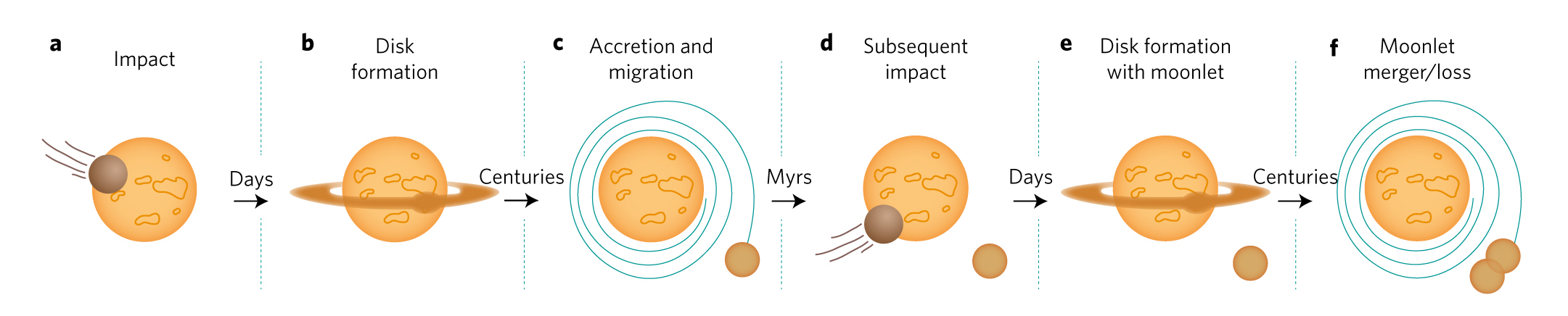
Lunar formation in the multiple-impact scenario. Moon- to Mars-sized impactors strike the Earth and leave a disk of debris orbiting the planet. The debris forms “moonlets” and migrate farther away from the Earth due to a tidal interaction, but eventually settle at a distance known as the Hill radius. Here, the moonlets merge to eventually form the moon..
The Moon, and the question of how it was formed, has long been a source of fascination and wonder. Now, a team of Israeli researchers suggests that the Moon we see every night is not Earth’s first moon, but rather the last in a series of moons that orbited Earth in the past. The newly proposed theory by Prof. Hagai Perets, of Technion, and Weizmann Institute Profs...
Read More

Recent Comments