
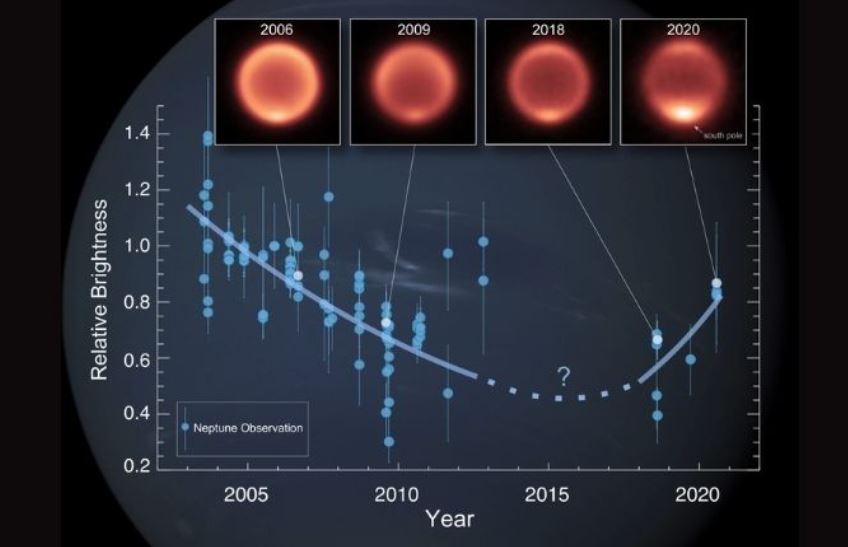
New research led by space scientists at the University of Leice...
Read More

April 14, 2022,
 Astronomy/Space
New research led by space scientists at the University of Leice...
Read More
August 19, 2018,
Astronomy/Space

Exoplanets similar to Earth.
Credit: NASA
Scientists have shown that water is likely to be a major component of those exoplanets (planets orbiting other stars) which are between 2 to 4X the size of Earth. It will have implications for the search of life in our Galaxy. The work is presented at the Goldschmidt conference in Boston.
The 1992 discovery of exoplanets orbiting other stars has sparked interest in understanding the composition of these planets to determine, among other goals, whether they are suitable for the development of life. Now a new evaluation of data from the exoplanet-hunting Kepler Space Telescope and the Gaia mission indicates that many of the known planets may contain as much as 50% water. This is much more than the Earth’s 0.02% (by weight) water content...
Read More
July 19, 2018,
Astronomy/Space

The image of the planet Neptune on the left was obtained during the testing of the Narrow-Field adaptive optics mode of the MUSE instrument on ESO’s Very Large Telescope. The image on the right is a comparable image from the NASA/ESA Hubble Space Telescope. Note that the two images were not taken at the same time so do not show identical surface features.
ESO’s Very Large Telescope (VLT) has achieved first light with a new adaptive optics mode called laser tomography – and has captured remarkably sharp test images of the planet Neptune and other objects. The MUSE instrument working with the GALACSI adaptive optics module, can now use this new technique to correct for turbulence at different altitudes in the atmosphere...
Read More
December 17, 2016,
Astronomy/Space

Neptune-mass exoplanets like the one shown in this artist’s rendering may be the most common in the icy regions of planetary systems. Beyond a certain distance from a young star, water and other substances remain frozen, leading to an abundant population of icy objects that can collide and form the cores of new planets. In the foreground, an icy body left over from this period drifts past the planet. Credit: NASA/Goddard/Francis Reddy
A new statistical study of planets found by gravitational microlensing suggests that Neptune-mass worlds are likely the most common type of planet to form in the icy outer realms of planetary systems...
Read More
Recent Comments