neural network tagged posts

Significant Energy Savings using Neuromorphic Hardware

One of Intel’s Nahuku boards, each of which contains eight to 32 Intel Loihi neuromorphic chips. © Tim Herman/Intel Corporation

For the first time TU Graz’s Institute of Theoretical Computer Science and Intel Labs demonstrated experimentally that a large neural network can process sequences such as sentences while consuming 4X – 16X less energy while running on neuromorphic hardware than non-neuromorphic hardware. The new research based on Intel Labs’ Loihi neuromorphic research chip that draws on insights from neuroscience to create chips that function similar to those in the biological brain.

The research was funded by The Human Brain Project (HBP), one of the largest research projects in the world with more than 500 scientists and engineers across Europe studying the human bra...

Read More

New study allows Brain and Artificial Neurons to Link up over the Web

Virtual Lab

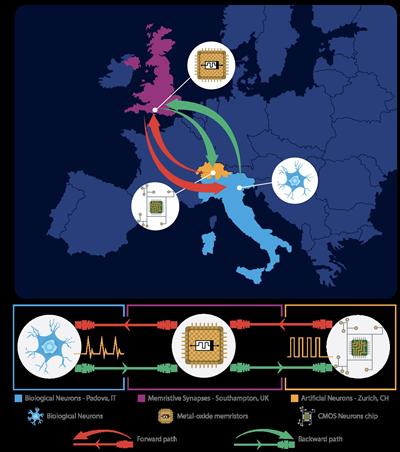
Research on novel nanoelectronics devices has enabled brain neurons and artificial neurons to communicate with each other over the Internet. Brain functions are made possible by circuits of spiking neurons, connected together by microscopic, but highly complex links called synapses. In this new study, published in the scientific journal Nature Scientific Reports, the scientists created a hybrid neural network where biological and artificial neurons in different parts of the world were able to communicate with each other over the internet through a hub of artificial synapses made using cutting-edge nanotechnology. This is the first time the three components have come together in a unified network.

During the study, researchers based at the University of Padova in Italy cultivate...

Read More

The Next Phase: Using Neural Networks to Identify Gas-Phase Molecules

This schematic of a neural network shows the assignment of rotational spectra (red bars at left) by an algorithm (center) to identify the structure of a molecule in the gas phase (right). (Image by Argonne National Laboratory.)

This schematic of a neural network shows the assignment of rotational spectra (red bars at left) by an algorithm (center) to identify the structure of a molecule in the gas phase (right). (Image by Argonne National Laboratory.)

Scientists at the U.S. Department of Energy’s (DOE) Argonne National Laboratory have begun to use neural networks to identify the structural signatures of molecular gases, potentially providing new and more accurate sensing techniques for researchers, the defense industry and drug manufacturers.

This breakthrough work has been recognized as a finalist for a 2018 R&D 100 award. R&D 100 awards, called the “Oscars of Innovation,” are given out by R&D Magazine to the most significant innovations developed in a given year.

Neural networks – so named because they operate ...

Read More

Living Computers: RNA circuits Transform Cells into Nanodevices

Alexander A. Green, Jongmin Kim, Duo Ma, Pamela A. Silver, James J. Collins, Peng Yin. Complex cellular logic computation using ribocomputing devices. Nature, 2017; DOI: 10.1038/nature23271

Alexander A. Green, Jongmin Kim, Duo Ma, Pamela A. Silver, James J. Collins, Peng Yin. Complex cellular logic computation using ribocomputing devices. Nature, 2017; DOI: 10.1038/nature23271

The interdisciplinary nexus of biology and engineering, known as synthetic biology, is growing at a rapid pace, opening new vistas that could scarcely be imagined a short time ago. In new research, Alex Green, a professor at ASU’s Biodesign Institute, demonstrates how living cells can be induced to carry out computations in the manner of tiny robots or computers...

Read More