
Neutron Spectrometer tagged posts

NASA’s Psyche mission delivers Mars flyby data, time-lapse video

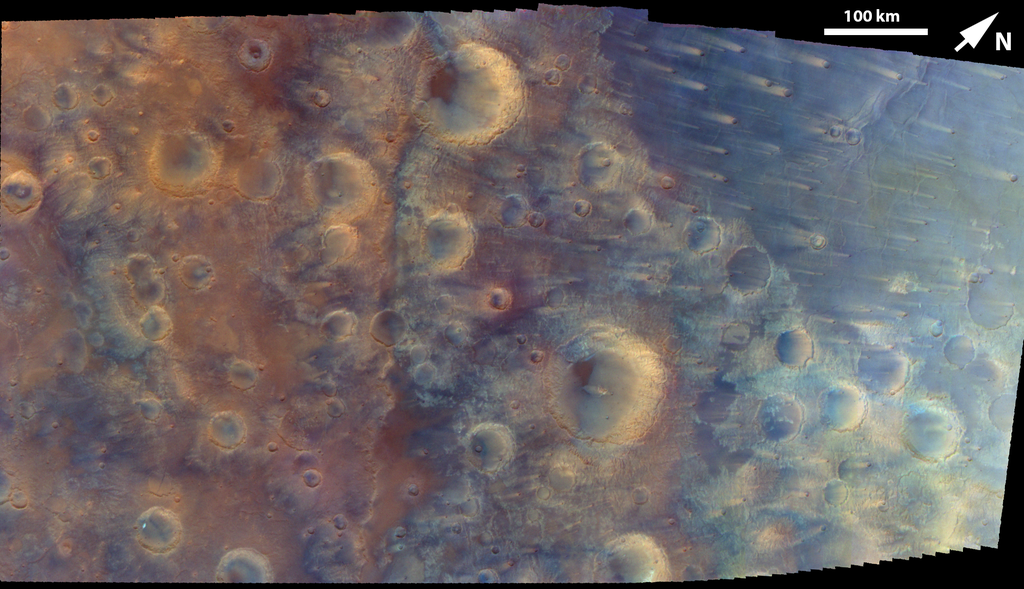
An overhead satellite mosaic of the Martian surface, showing numerous impact craters in a transition zone of reddish-brown and dusty blue terrain, with streaks stretching across the blue region.
Captured by the multispectral imager instrument on NASA’s Psyche mission, this is an enhanced-color mosaic created from four individual images acquired on May 15, 2026, during the spacecraft’s flyby of Mars. 
Credit: NASA/JPL-Caltech/ASU

The spacecraft aced its encounter with Mars. Now, mission scientists are studying a trove of data from the flyby in preparation for its arrival at asteroid Psyche in 2029.

NASA’s Psyche spacecraft flew by Mars on May 15, using the planet’s gravity to gain speed and slightly tilt its trajectory. The flyby also gave the team an opportunity to prepare for the science they will conduct when they reach the metal-rich asteroid Psyche in 2029.

Using Mars as a stand-in for the asteroid during the flyby, the team could test the spacecraft’s science i...

Read More

New design of Neutron Spectrometer being tested for Manned Spaceflight

The Fast Neutron Spectrometer with a cover removed to show the circuitry inside. Credit: Image courtesy of University of Alabama Huntsville

The Fast Neutron Spectrometer with a cover removed to show the circuitry inside. Credit: Image courtesy of University of Alabama Huntsville

The Fast Neutron Spectrometer (FNS) is now aboard the International Space Station. Neutrons contribute to crew radiation exposure and must be measured to assess exposure levels. The FNS, developed by NASA’s Marshall Space Flight Center (MSFC) and Johnson Space Center (JSC), uses a new instrument design that can significantly improve the reliability of identifying neutrons in the mixed radiation field found in deep space. The MSFC principle investigator and team lead is Mark Christl. The NASA JSC project manager is Catherine Mcleod and the technical lead is Eddie Semones at NASA JSC.

“Our technique improves upon the well-establish ‘capture-gated’ method...

Read More

Mercury’s Mysterious ‘Darkness’ Explained

This oblique image of Basho shows the distinctive dark halo that encircles the crater. The halo is composed of so-called Low Reflectance Material (LRM), which was excavated from depth when the crater was formed. Basho is also renowned for its bright ray craters, which render the crater easily visible even from very far away. Credit: Courtesy NASA/Johns Hopkins University Applied Physics Laboratory/Carnegie Institution of Washington

This oblique image of Basho shows the distinctive dark halo that encircles the crater. The halo is composed of so-called Low Reflectance Material (LRM), which was excavated from depth when the crater was formed. Basho is also renowned for its bright ray craters, which render the crater easily visible even from very far away. Credit: Courtesy NASA/Johns Hopkins University Applied Physics Laboratory/Carnegie Institution of Washington

Scientists have long been puzzled about what makes Mercury’s surface so dark. The innermost planet reflects much less sunlight than the Moon, a body on which surface darkness is controlled by the abundance of iron-rich minerals. These are known to be rare at Mercury’s surface, so what is the “darkening agent” there?

About a year ago, scientists proposed that Mer...

Read More