NIRCam tagged posts

Webb reveals New Structures within Ionic Supernova

A pale red ring made up of small white circles surrounds a bright blue spot in the center. Three bright spots are on the outside of the ring, all against a black background speckled with stars.
Webb’s NIRCam (Near-Infrared Camera) captured this detailed image of SN 1987A (Supernova 1987A). At the center, material ejected from the supernova forms a keyhole shape. Just to its left and right are faint crescents newly discovered by Webb. Beyond them an equatorial ring, formed from material ejected tens of thousands of years before the supernova explosion, contains bright hot spots. Exterior to that is diffuse emission and two faint outer rings. In this image blue represents light at 1.5 microns (F150W), cyan 1.64 and 2.0 microns (F164N, F200W), yellow 3.23 microns (F323N), orange 4.05 microns (F405N), and red 4.44 microns (F444W).
Credits: NASA, ESA, CSA, M. Matsuura (Cardiff University), R. Arendt (NASA’s Goddard Spaceflight Center & University of Maryland, Baltimore County), C...
Read More

Webb reveals Intricate Details in the Remains of a Dying Star

Side-by-side images of the Ring Nebula where the nebula appears as a distorted doughnut. On the right, the nebula’s inner cavity hosts shades of blue and green, while the detailed ring transitions through shades of orange in the inner regions and pink in the outer region. On the left, the nebula’s inner cavity hosts shades of red and orange, while the detailed ring transitions through shades of yellow in the inner regions and blue/purple in the outer region. The ring’s inner region has distinct filament elements.
New images from NASA’s James Webb Space Telescope of the well-known Ring Nebula provide unprecedented spatial resolution and spectral sensitivity. In the NIRCam (Near-Infrared Camera) image on the left, the intricate details of the filament structure of the inner ring are particularly visible in this dataset. On the right, the MIRI (Mid-InfraRed Instrument) image reveals particular details in the concentric features in the outer regions of the nebulae’s ring. Download the full-resolution NIRCam image and the full-resolution MIRI image from the Image gallery. Credit: ESA/Webb, NASA, CSA, M. Barlow (University College London), N. Cox (ACRI-ST), R. Wesson (Cardiff University).

NASA’s James Webb Space Telescope obtained images of the Ring Nebula, one of the best-known examples of a pla...

Read More

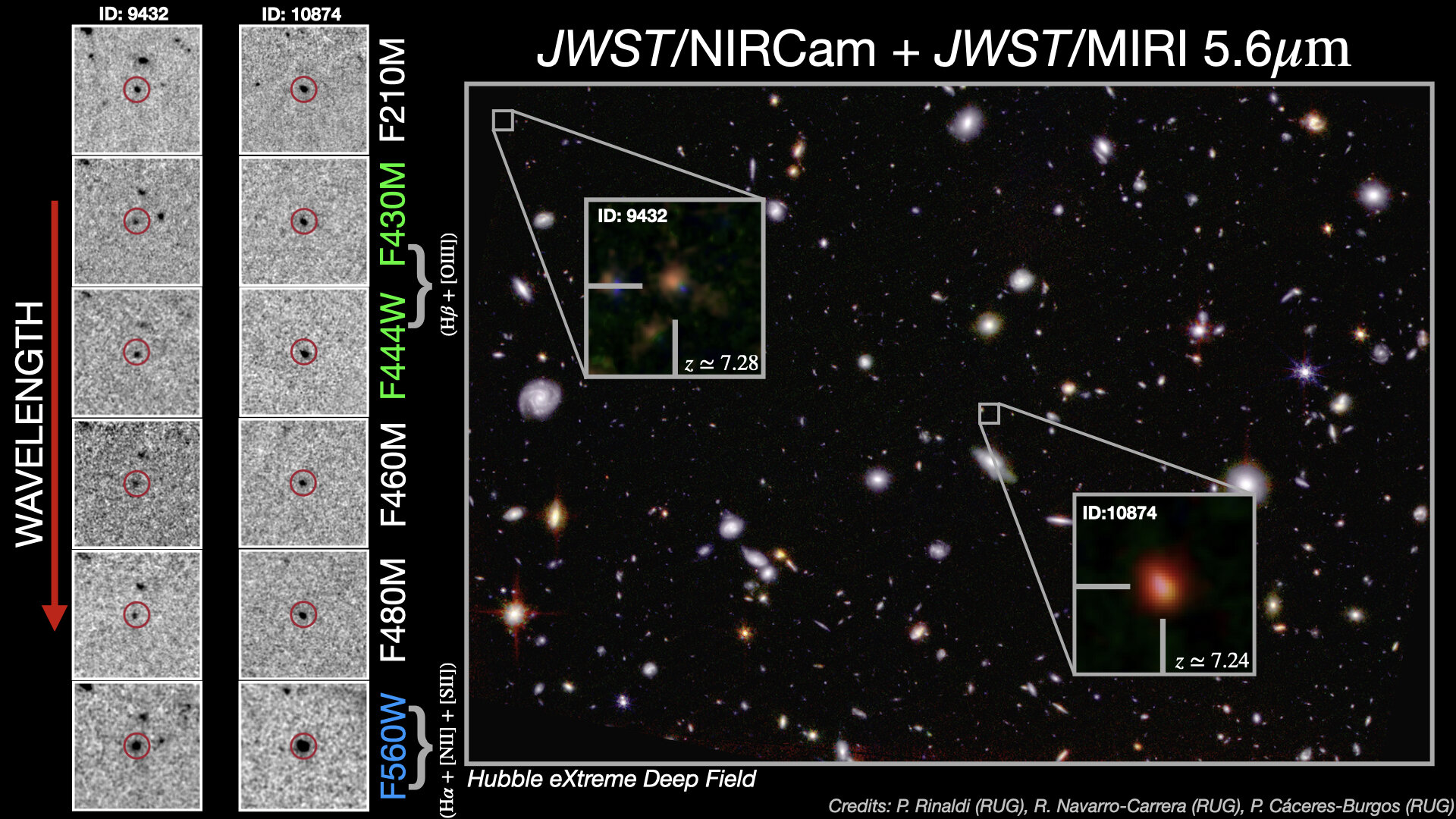
MIRI instrument on JWST detects H-alpha emission during the Epoch of Reionization for the first time

MIRI instrument on JWST detects H-alpha emission during the Epoch of Reionization for the first time

An international team of astronomers led by Pierluigi Rinaldi of the University of Groningen has detected for the first time H-alpha emission in individual galaxies during the so-called Epoch of Reionization, or cosmic dawn. To do so, they used the deepest images taken so far by the MIRI instrument on the James Webb Space Telescope. The result has been accepted for publication in The Astrophysical Journal, and is currently published on the arXiv preprint server.

Star-forming galaxies produce a large amount of UV photons, but during the Epoch of Reionization these photons are absorbed by the intergalactic medium. The best tracer to measure the level of star formation is the H-alpha emission line in the optical spectrum...

Read More

Astrophysicists confirm the Faintest Galaxy ever seen in the Early Universe

Guido Roberts-Borsani/UCLA); original images: NASA, ESA, CSA, Swinburne University of Technology, University of Pittsburgh, STScI

An international research team led by UCLA astrophysicists has confirmed the existence of the faintest galaxy ever seen in the early universe. The galaxy, called JD1, is one of the most distant identified to date, and it is typical of the kinds of galaxies that burned through the fog of hydrogen atoms left over from the Big Bang, letting light shine through the universe and shaping it into what exists today.

The discovery was made using NASA’s James Webb Space Telescope, and the findings are published in the journal Nature.

The first billion years of the universe’s life were a crucial period in its evolution. After the Big Bang, approximately 13...

Read More