
NIRSpec tagged posts

Unlocking the Secrets of a ‘Hot Saturn’ and its Spotted Star

Led by researchers from Université de Montréal’s Trottier Institute for Research on Exoplanets (iREx), a team of astronomers has harnessed the power of the revolutionary James Webb Space Webb Telescope (JWST) to study the “hot Saturn” exoplanet HAT-P-18 b.

Their findings, published last month in the journal Monthly Notices of the Royal Astronomical Society, paint a complete picture of the HAT-P-18 b’s atmosphere while exploring the great challenge of distinguishing its atmospheric signals from the activity of its star.

HAT-P-18 b is located over 500 light-years away with a mass similar to Saturn’s but a size closer to that the larger planet Jupiter. As a result, the exoplanet has a “puffed-up” atmosphere that is especially ideal for analysis.

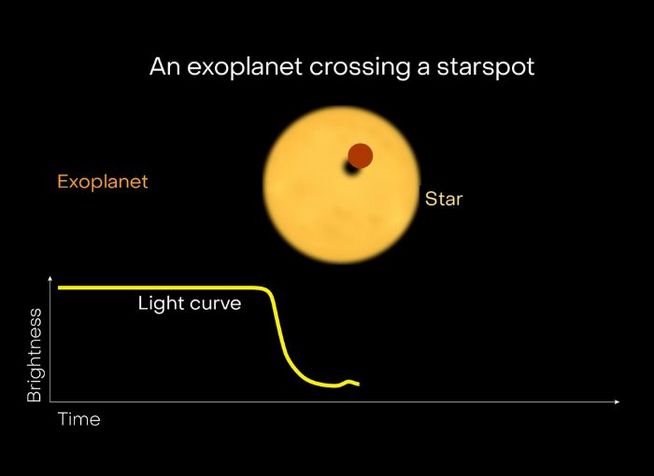
Passing over a spotted star

Read More

Webb finds Water Vapor, but is it from a Rocky Planet or its Star?

Graph showing the transmission spectrum of exoplanet GJ486b. The X-axis shows amount of light blocked, and the Y-axis shows wavelength of light. An orange wave begins at the upper left and a blue at the lower left. White dots show Webb data.
This graphic shows the transmission spectrum obtained by Webb observations of rocky exoplanet GJ 486 b. The science team’s analysis shows hints of water vapor; however, computer models show that the signal could be from a water-rich planetary atmosphere (indicated by the blue line) or from starspots from the red dwarf host star (indicated by the yellow line). The two models diverge noticeably at shorter infrared wavelengths, indicating that additional observations with other Webb instruments will be needed to constrain the source of the water signal.
Credits: NASA, ESA, CSA, Joseph Olmsted (STScI)

GJ486b is about 30% larger than the Earth and three times as massive, which means it is a rocky world with stronger gravity than Earth. It orbits a red dwarf star in just under 1...

Read More

NASA’s Webb Telescope reveals Links between Galaxies Near and Far

A trio of faint objects (circled) captured in the James Webb Space Telescope’s deep image of the galaxy cluster SMACS 0723 exhibit properties remarkably similar to rare, small galaxies called “green peas” found much closer to home. The cluster’s mass makes it a gravitational lens, which both magnifies and distorts the appearance of background galaxies. We view these early peas as they existed when the universe was about 5% its current age of 13.8 billion years. The farthest pea, at left, contains just 2% the oxygen abundance of a galaxy like our own and might be the most chemically primitive galaxy yet identified.
Credit: NASA, ESA, CSA, and STScI

A new analysis of distant galaxies imaged by NASA’s James Webb Space Telescope shows that they are extremely young and share some rem...

Read More