
nitrogen tagged posts

Scientists discover the “Goldilocks” secret behind life on Earth

Earth may be habitable because it got unbelievably lucky with its chemistry from the very start.

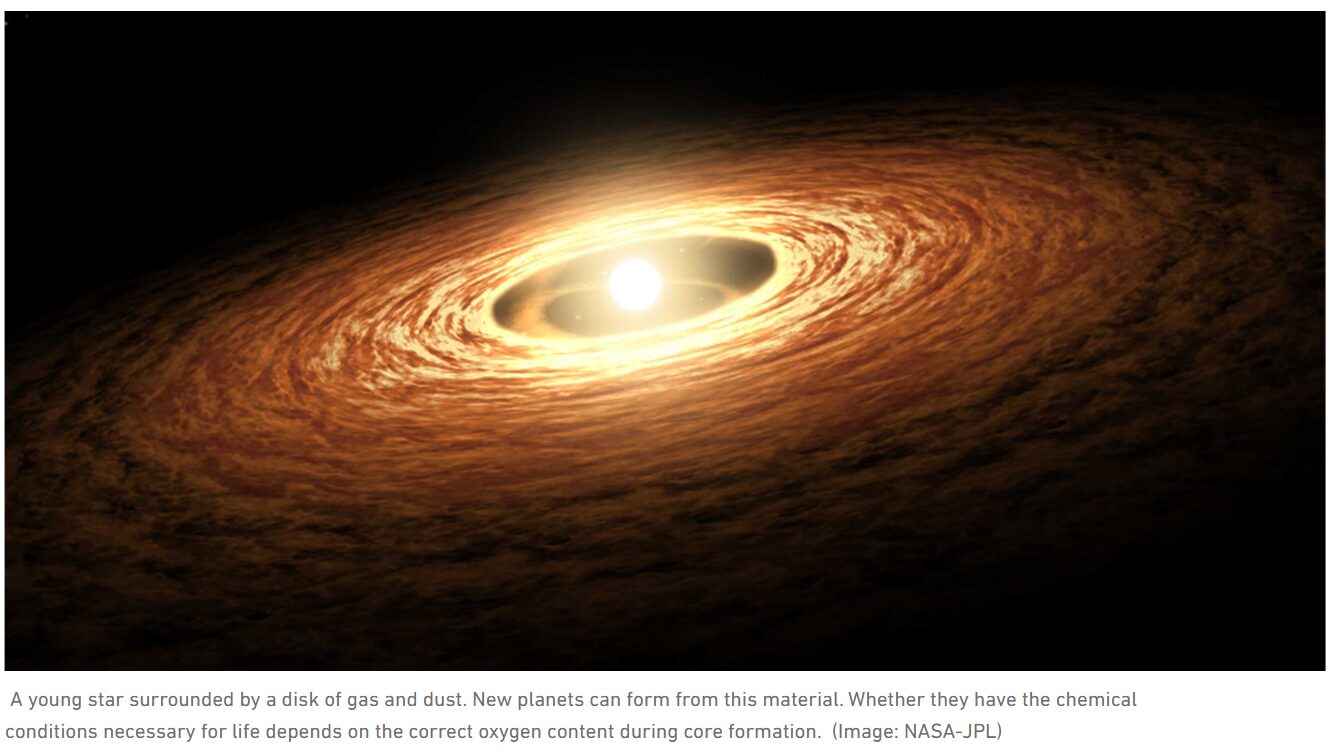
Earth may have won a cosmic chemistry lottery. Researchers found that during the planet’s earliest formation, oxygen had to be in an extremely narrow “Goldilocks zone” for two life-essential elements, phosphorus and nitrogen, to stay where life could use them. Too much or too little oxygen, and those ingredients could be lost or trapped deep inside the planet. This could reshape the search for life by showing that water alone is not enough.

Life cannot begin on a planet unless certain chemical elements are available in large enough amounts. Two of the most important are phosphorus and nitrogen...

Read More

Icy planetesimal with high nitrogen and water content discovered in white dwarf’s atmosphere

Cosmic crime scene: White dwarf found devouring Pluto-like icy world
Artist’s impression of white dwarf WD 1647+375 accreting icy planetary fragments from a pluto-like world, creating the chemical signature idenfitifed in this study. Credit: Snehalata Sahu / University of Warwick

University of Warwick astronomers have uncovered the chemical fingerprint of a frozen, water-rich planetary fragment being consumed by a white dwarf star outside our solar system.

In our solar system, it is thought that comets and icy planetesimals (small solid objects in space) were responsible for delivering water to Earth. The existence of these icy objects is a requirement for the development of life on other worlds, but it is incredibly difficult to identify them outside our solar system as icy objects are small, faint and require chemical analysis.

In a study publis...

Read More

A Stormy, Active Sun may have Kickstarted Life on Earth

An animation of the sun shows a bright spot, from which erupts a cloud of solar material and burst of bright particles.
A close up of a solar eruption, including a solar flare, a coronal mass ejection, and a solar energetic particle event.
Credits: NASA’s Goddard Space Flight Center

The first building blocks of life on Earth may have formed thanks to eruptions from our sun, a new study finds.

A series of chemical experiments show how solar particles, colliding with gases in Earth’s early atmosphere, can form amino acids and carboxylic acids, the basic building blocks of proteins and organic life. The findings were published in the journal Life.

To understand the origins of life, many scientists try to explain how amino acids, the raw materials from which proteins and all cellular life, were formed...

Read More

How Planets Form Controls Elements Essential for Life

How planets form controls elements essential for life
Nitrogen-bearing, Earth-like planets can be formed if their feedstock material grows quickly to around moon- and Mars-sized planetary embryos before separating into core-mantle-crust-atmosphere, according to Rice University scientists. If metal-silicate differentiation is faster than the growth of planetary embryo-sized bodies, then solid reservoirs fail to retain much nitrogen and planets growing from such feedstock become extremely nitrogen-poor. Credit: Amrita P. Vyas/Rice University

The prospects for life on a given planet depend not only on where it forms but also how, according to Rice University scientists.

Planets like Earth that orbit within a solar system’s Goldilocks zone, with conditions supporting liquid water and a rich atmosphere, are more likely to harbor life...

Read More