
NuSTAR tagged posts

Powerful UFO spotted blasting from a distant black hole

Powerful UFO spotted blasting from a distant black hole
Artistic view of multiphase AGN-driven winds highlighting the different phases and scales that are involved in the outflow. Credit: University of Bologna

Astronomers have detected one of the most powerful ultrafast outflows ever seen from a distant supermassive black hole. Using XMM-Newton and NuSTAR, a team studied a hyper-luminous quasar at cosmic noon and found two distinct wind components blasting away from the black hole, details of which are outlined in a paper submitted to the arXiv preprint server on June 3. The study has been submitted to the journal Astronomy & Astrophysics and is currently under minor revision.

Killer winds
Black holes consuming large amounts of material tend to lash out, driving powerful winds of gas outward from the vicinity of the accretion disk...
Read More

First-ever Detection of a Mid-Infrared Flare in SagittariusA*, the Milky Way’s supermassive black hole

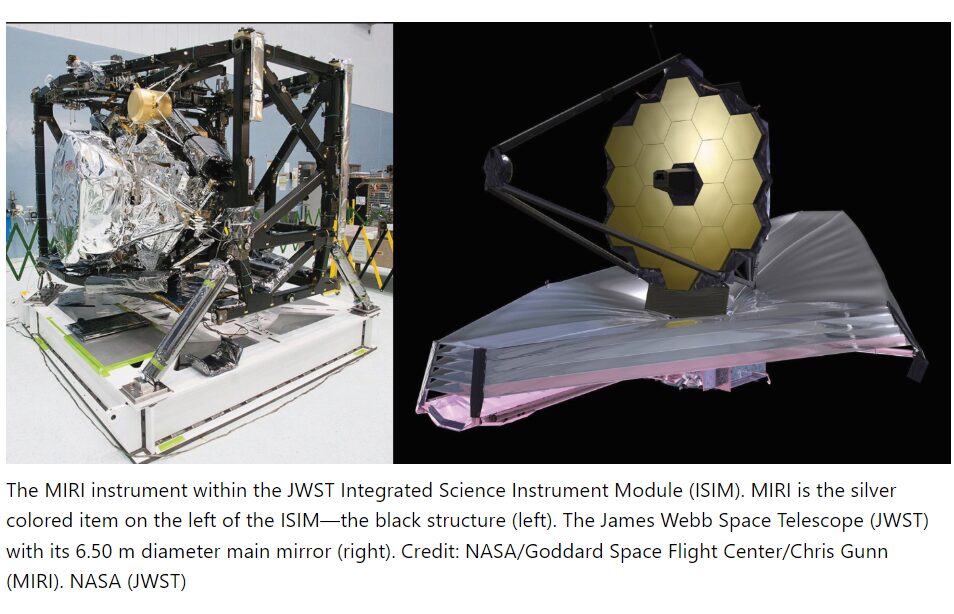
Using the MIRI instrument onboard the James Webb Space Telescope, an international team of scientists made the first-ever detection of a mid-IR flare from Sagittarius A*, the supermassive blackhole at the heart of the Milky Way. In simultaneous radio observations, the team found a radio counterpart of the flare lagging behind in time. The paper is published on the arXiv preprint server.

Scientists have been actively observing Sagittarius A* (Sgr A)—a supermassive black hole roughly 4 million times the mass of the sun— since the early 1990s. Sgr A regularly exhibits flares that can be observed in multiple wavelengths, allowing scientists to see different views of the same flare and better understand how it emits light and how the emission is generated...

Read More

Young Magnetar Likely the Slowest Pulsar Ever Detected

Supernova Remnant RCW 103

This composite image shows RCW 103 and its central source, known officially as 1E 161348-5055 (1E 1613, for short), in three bands of X-ray light detected by Chandra. In this image, the lowest energy X-rays from Chandra are red, the medium band is green, and the highest energy X-rays are blue. The bright blue X-ray source in the middle of RCW 103 is 1E 1613. The X-ray data have been combined with an optical image from the Digitized Sky Survey.

Using NASA’s Chandra X-ray Observatory and other X-ray observatories, astronomers have found evidence for what is likely one of the most extreme pulsars, or rotating neutron stars, ever detected...

Read More

Avoiding ‘Traffic Jam’ creates impossibly bright ‘Lighthouse’

Artist’s impression of the “New Lighthouse Model.” Credit: NAOJ

Artist’s impression of the “New Lighthouse Model.” Credit: NAOJ

A supercomputer recreated a blinking impossibly bright “monster pulsar.” The central energy source of enigmatic pulsating Ultra Luminous X-ray sources (ULX) could be a neutron star according to numerical simulations performed by a research group led by Tomohisa Kawashima at the National Astronomical Observatory of Japan (NAOJ). ULXs, which are remarkably bright X-ray sources, were thought to be powered by black holes. But in 2014, the X-ray space telescope “NuSTAR” detected unexpected periodic pulsed emissions in a ULX named M82 X-2. The discovery of this object named “ULX-pulsar” has puzzled astrophysicists...

Read More