
Opal tagged posts

Webb and Hubble share the most comprehensive view of Saturn to date

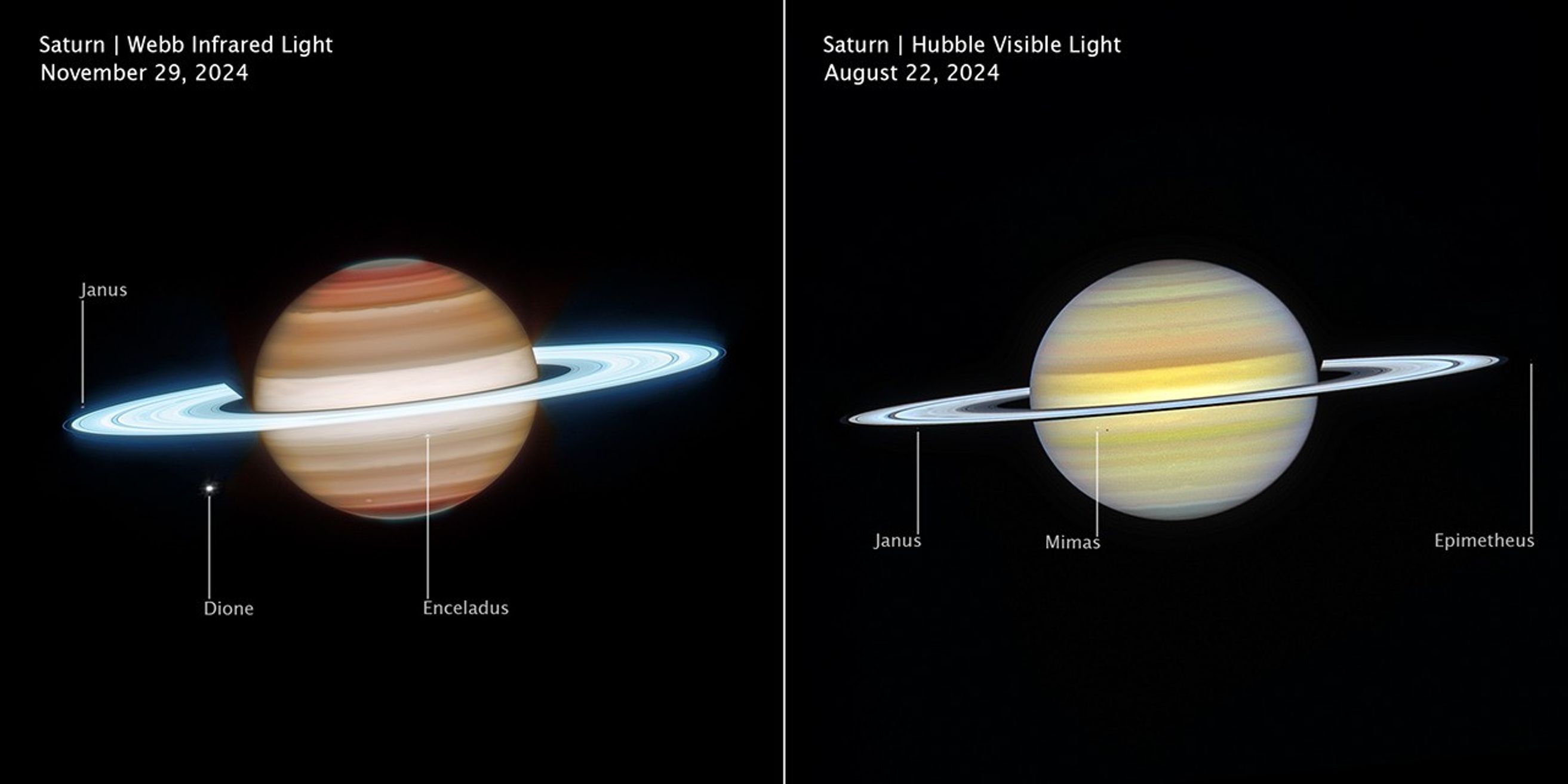
Side-by-side comparison of Saturn observed at different wavelengths and times show how differently it appears in infrared, on the left, versus visible light, on the right. Left image is labeled Saturn, Webb Infrared Light, November 29, 2024. Right image is labeled Saturn, Hubble Visible Light, August 22, 2024.
In infrared, Saturn has horizontal bands, with bands at the north and south poles appearing darker orange and lightening to tan as they approach the equator. The north and south poles glow a greenish-grey. The rings appear in an icy neon white. White dots, representing several of Saturn’s moons, are labeled Janus, Dione, and Enceladus.
In visible, Saturn’s horizontal bands appear pale yellow, with some bands towards the north and south pole having a light blue hue. The rings appear bright white, glowing slightly less than Webb’s infrared image. White dots, representing several of Saturn’s moons, are labeled Janus, Mimas, and Epimetheus.
Complementary views of Saturn from NASA’s James Webb Space Telescope and Hubble Space Telescope show a dynamic planet with atmospheric features, orbiting moons, and bright rings.
Image: NASA, ESA, CSA, STScI, Amy Simon (NASA-GSFC), Michael Wong (UC Berkeley); Image Processing: Joseph DePasquale (STScI)

NASA’s James Webb Space Telescope and Hubble Space Telescope have teamed up to capture new views of Saturn, revealing the planet in strikingly different ways. Observing in complementary wavelengths of light, the two space observatories provide scientists with a richer, more layered understanding of the gas giant’s atmosphere.

Both sense sunlight reflected from Saturn’s banded clouds and hazes, but where Hubble reveals subtle color variations across the planet, Webb’s infrared view se...

Read More

Opal discovered in Antarctic Meteorite

Images of one of the many pieces of opal found in meteorite EET 83309. At top right is a backscattered electron image (the long thin dark object is opal). At bottom left is an image of silica concentrations in opal and surrounding meteoritic minerals. At top left is an image of oxygen concentrations in opal and surrounding minerals. At bottom right is an image nickel concentrations in opal and surrounding minerals. Credit: H. Downes

Images of one of the many pieces of opal found in meteorite EET 83309. At top right is a backscattered electron image (the long thin dark object is opal). At bottom left is an image of silica concentrations in opal and surrounding meteoritic minerals. At top left is an image of oxygen concentrations in opal and surrounding minerals. At bottom right is an image nickel concentrations in opal and surrounding minerals. Credit: H. Downes

Planetary scientists have discovered pieces of opal in a meteorite found in Antarctica, a result that demonstrates that meteorites delivered water ice to asteroids early in the history of the solar system. Led by Professor Hilary Downes of Birkbeck College London, the team announce their results at the National Astronomy Meeting in Nottingham on Monday 27 June.

Read More