Optical Computing tagged posts

Photon-driven synapse advances low-power neuromorphic systems

Photon-driven synapse advances low-power neuromorphic systems
A photon-modulated synaptic device based on a rare-earth-doped long-afterglow crystal facilitates excitatory (UV-induced) and inhibitory (near-infrared induced) plasticity. This schematic depicts the excitatory impulse with luminescence as the optical output. Credit: Y. Yan et al.

Modern artificial intelligence systems rely on moving large amounts of data between memory and processors, a design that limits speed and increases energy use. The human brain works differently: it combines memory and computation within synapses, allowing fast, efficient learning and perception. Replicating this approach in hardware is a central goal of neuromorphic computing, especially for tasks like vision, where most real-world information is gathered and processed.

A fully optical artificial synapse
In...
Read More

Logic with Light: Introducing Diffraction Casting, Optical-based Parallel Computing

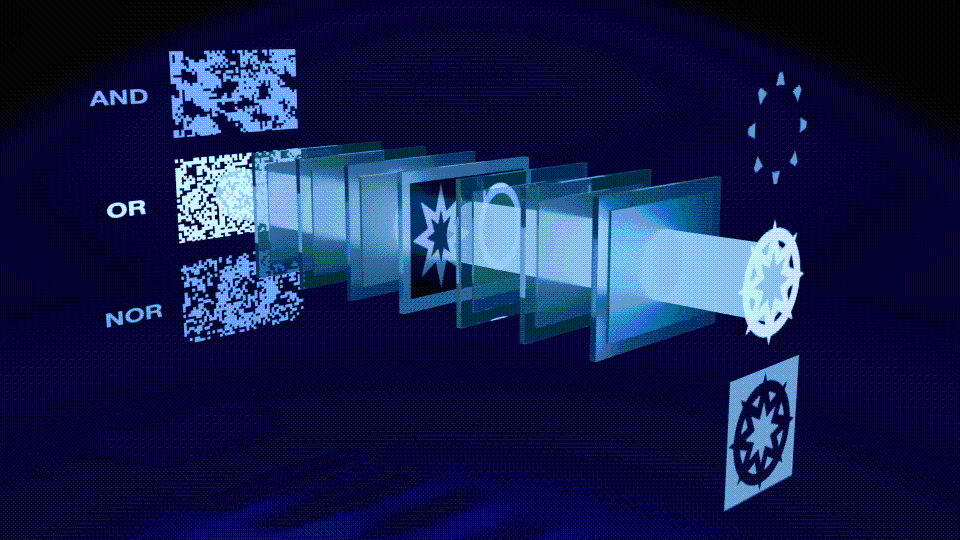
Dark background with pale 3D diagrams hovering in front showing multiple square layers with slightly different cutout shapes on them.
Diffraction casting. An overview of the proposed system showing an input image layer placed amongst other layers which combine in different ways to perform logical operations when light is passed through the stack. ©2024 Mashiko et al. CC-BY-ND

Increasingly complex applications such as artificial intelligence require ever more powerful and power-hungry computers to run. Optical computing is a proposed solution to increase speed and power efficiency but has yet to be realized due to constraints and drawbacks. A new design architecture, called diffraction casting, seeks to address these shortcomings. It introduces some concepts to the field of optical computing that might make it more appealing for implementation in next-generation computing devices.

Whether it’s the smartphone in y...

Read More

A Novel All-Optical Switching Method makes Optical Computing and Communication Systems more Power-Efficient

Photo: Tampere University

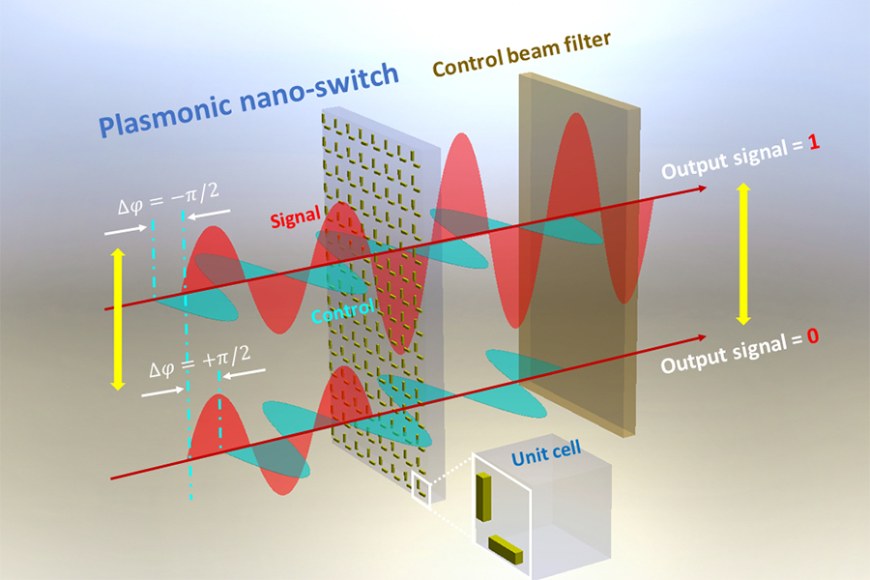
Photonics researchers have introduced a novel method to control a light beam with another beam through a unique plasmonic metasurface in a linear medium at ultralow power. This simple linear switching method makes nanophotonic devices such as optical computing and communication systems more sustainable requiring low intensity of light.

All-optical switching is the modulation of signal light due to control light in such a way that it possesses the ON/OFF conversion function. In general, a light beam can be modulated with another intense laser beam in the presence of a nonlinear medium.

The switching method developed by the researchers is fundamentally based on the quantum optical phenomenon known as Enhancementof Index of Refraction (EIR).

“Our work is...

Read More

Research team makes Breakthrough Discovery in Light Interactions with Nanoparticles, paving the way for Advances in Optical Computing

Scattered waves from a nanoscale object encode the solution of a complex mathematical problem when interrogated by tailored input signals (Credit: Heedong Goh)

Computers are an indispensable part of our daily lives, and the need for ones that can work faster, solve complex problems more efficiently, and leave smaller environmental footprints by minimizing the required energy for computation is increasingly urgent. Recent progress in photonics has shown that it’s possible to achieve more efficient computing through optical devices that use interactions between metamaterials and light waves to apply mathematical operations of interest on the input signals, and even solve complex mathematical problems...

Read More