
Optical frequency combs tagged posts

Microcombs unlock 112Gbps wireless link at 560GHz for 6G

Photonic wireless transmission reaches 112 Gbps at 560 GHz using soliton microcombs
Conceptual illustration of microcomb-driven terahertz wireless communication. Optical frequency combs generated in a microresonator are used to produce low-noise terahertz signals via photomixing, enabling high-speed wireless transmission at 112 Gbps in the 560 GHz band for future 6G systems. Credit: Tokushima University

Researchers at Tokushima University have demonstrated single-channel wireless transmission at 112 Gbps in the 560 GHz band using soliton microcombs, marking a significant step toward next-generation 6G communications.

Conventional electronic technologies face fundamental limitations in generating stable high-frequency signals beyond 350 GHz, including reduced output power and increased phase noise...

Read More
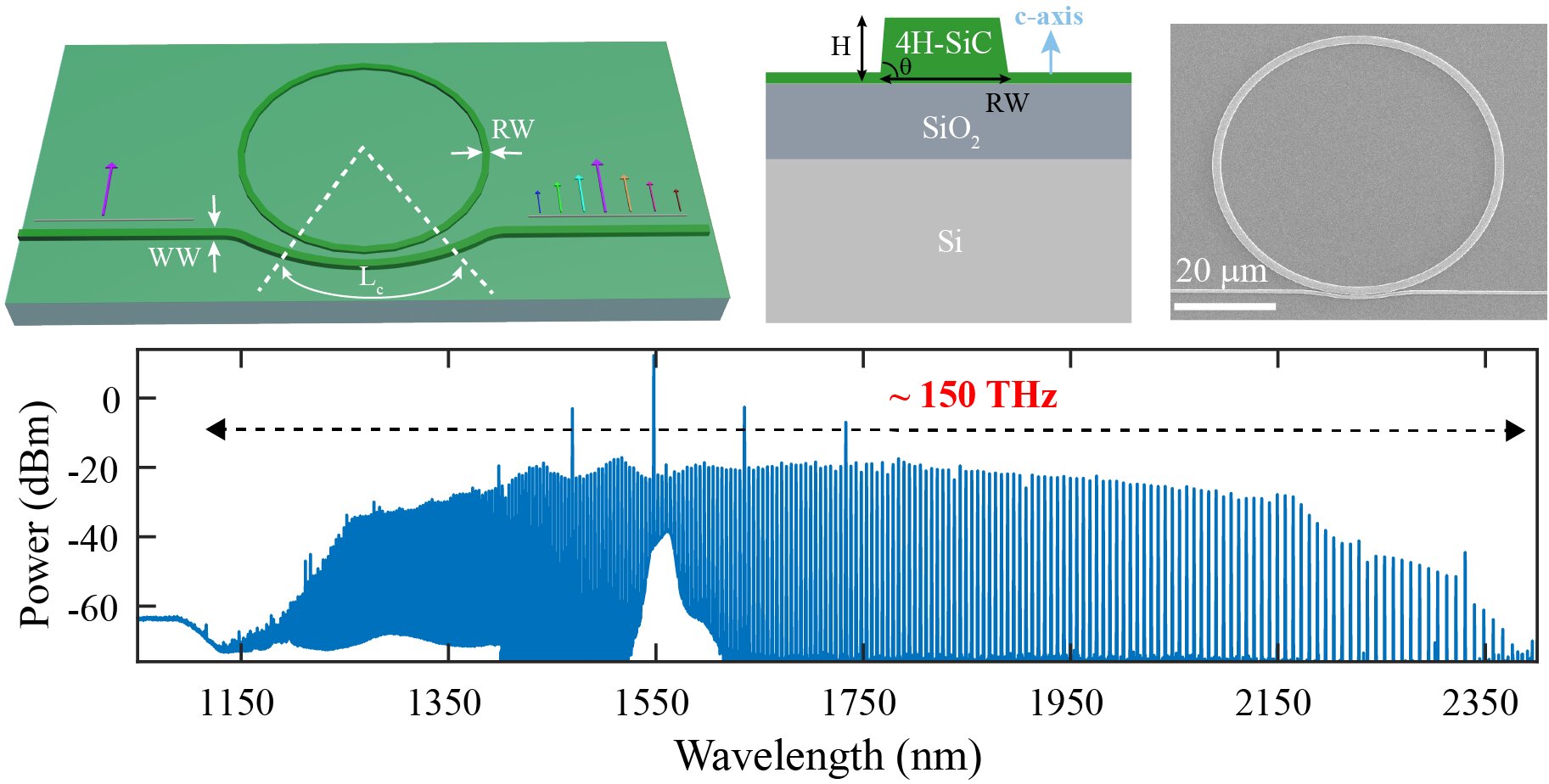
A Chip-Scale Broadband Light Source in Silicon Carbide

(a) Schematic top view (left) and cross section (right) of the 4H-silicon-carbide-on-insulator platform for frequency comb generation based on compact microring resonators. The sidewall angle (θ) is estimated near 80–85 deg in our nanofabrication. Dispersion engineering is carried out by varying the ring waveguide width (RW). In addition, efficient coupling is realized using the pulley structure where the access waveguide width and coupling length are adjusted to achieve phase matching to the desired resonant mode families. (b) Scanning electron micrograph of a 36-μm-radius SiC microring. In this work, the SiC thickness is fixed at 500 nm with a pedestal layer of 50 nm. (c) Simulated integrated dispersion [Dint; see its definition in Eq. (1)] for the fundamental transverse-electric (i.e...
Read More