Perseverance Rover tagged posts

High nickel concentrations in Martian bedrock point to potential biosignatures

High nickel concentrations in Martian bedrock point to potential biosignatures
In Beaver Falls, Ni was detected in both the primary mudstone and within cross-cutting Ca-sulfate veins. Credit: Nature Communications (2026). DOI: 10.1038/s41467-026-70081-3

In 2024, NASA’s Perseverance rover found surprising levels of Nickel in the Martian bedrock of an ancient river channel, called Neretva Vallis, which flowed into the Jezero crater. A new study, published in Nature Communications, has taken a closer look at the data collected from the region and researchers are seeing what could be remnants of ancient Martian life.

Nickel as a biosignature
Although nickel is not typically thought of as a major component of human life, it is important in many microbial metabolism functions...

Read More

Mars Perseverance rover data suggests presence of past microbial life

Researchers uncover potential biosignatures on Mars
Perseverance rover reached the Bright Angel site on Mars by navigating through a dune field, bypassing large boulders. The rover is now investigating this area’s unique geological features to understand Mars’ past environmental conditions and support future human exploration. Credit: NASA/JPL-Caltech

A new study co-authored by Texas A&M University geologist Dr. Michael Tice has revealed potential chemical signatures of ancient Martian microbial life in rocks examined by NASA’s Perseverance rover.

The findings, published by a large international team of scientists, focus on a region of Jezero Crater known as the Bright Angel formation—a name chosen from locations in Grand Canyon National Park because of the light-colored Martian rocks...

Read More

How to make metals from Martian dirt

Swinburne and CSIRO researchers have successfully made iron under Mars-like conditions, opening to door to off-world metal production.

The idea of building settlements on Mars is a popular goal of billionaires, space agencies and interplanetary enthusiasts.

But construction demands materials, and we can’t ship it all from Earth: it cost US$243 million just to send NASA’s one ton Perseverance Rover to the Red Planet.

Unless we’re building a settlement for ants, we’ll need much, much more stuff. So how do we get it there?

CSIRO Postdoctoral Fellow and Swinburne alum Dr. Deddy Nababan has been pondering this question for years. His answer lies in the Martian dirt, known as regolith.

“Sending metals to Mars from Earth might be feasible, but it’s not economical...

Read More

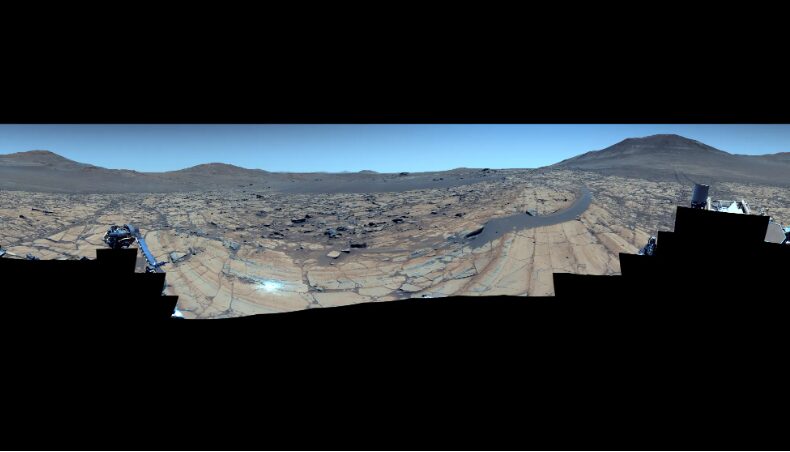
Perseverance rover captures Mars vista as clear as day

Captured at a location called “Falbreen,” this enhanced-color mosaic features deceptively blue skies and the 43rd rock abrasion (the white patch at center-left) of the NASA Perseverance rover’s mission at Mars. The 96 images stitched together to create this 360-degree view were acquired May 26, 2025.

The imaging team of NASA’s Perseverance Mars rover has taken advantage of clear skies on the red planet to capture one of the sharpest panoramas of its mission so far. Visible in the mosaic, which was stitched together from 96 images taken at a location the science team calls “Falbreen,” are a rock that appears to lie on top of a sand ripple, a boundary line between two geologic units, and hills as distant as 40 miles (65 kilometers) away...

Read More