
phosphorus tagged posts

Scientists discover the “Goldilocks” secret behind life on Earth

Earth may be habitable because it got unbelievably lucky with its chemistry from the very start.

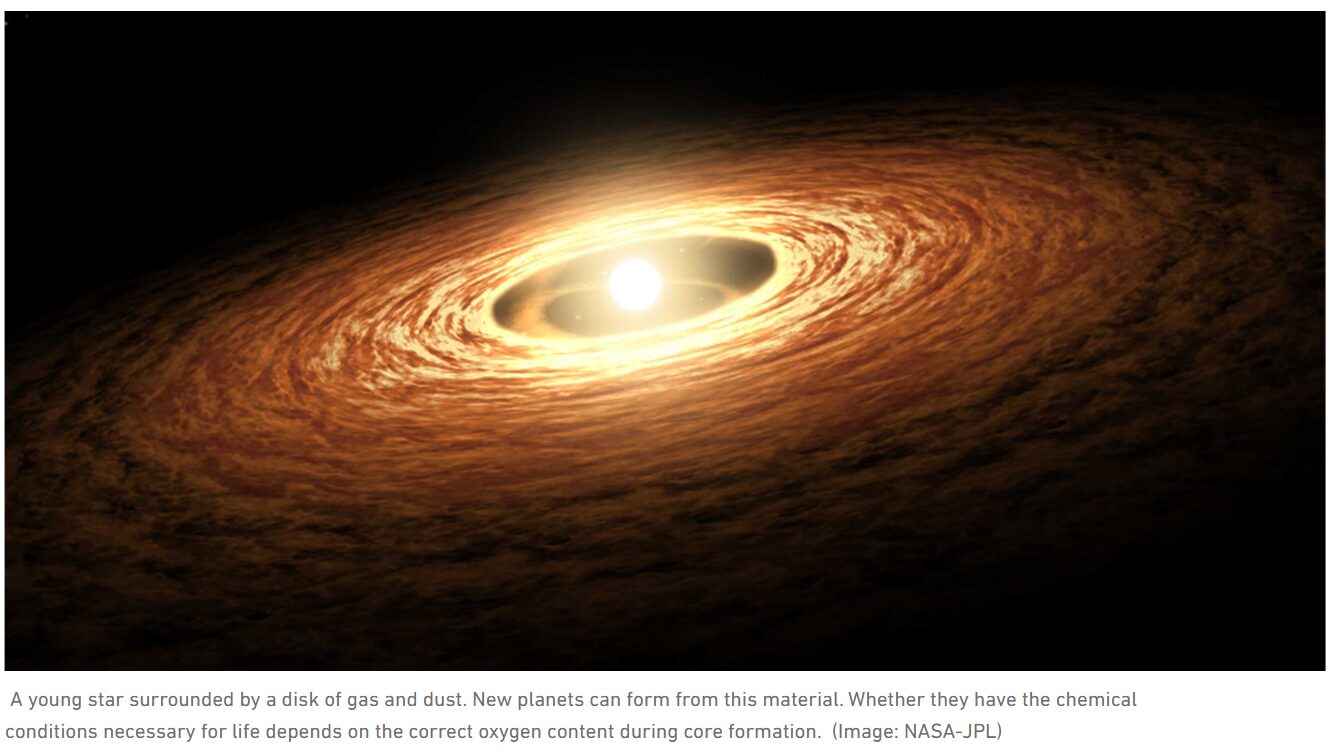
Earth may have won a cosmic chemistry lottery. Researchers found that during the planet’s earliest formation, oxygen had to be in an extremely narrow “Goldilocks zone” for two life-essential elements, phosphorus and nitrogen, to stay where life could use them. Too much or too little oxygen, and those ingredients could be lost or trapped deep inside the planet. This could reshape the search for life by showing that water alone is not enough.

Life cannot begin on a planet unless certain chemical elements are available in large enough amounts. Two of the most important are phosphorus and nitrogen...

Read More
Saturn’s icy moon may host a stable ocean fit for life

Enceladus heat transfer infographic
A new study has constrained the Enceladus’ global conductive heat flow by studying its seasonal temperature variations at its north pole (yellow). These results, when combined with existing ones of its highly active south polar region (red) provide the first observational constraint of Enceladus’ energy loss budget (<54 GW) – which is consistent with the predicted energy input (50 to 55 GW) from tidal heating. This implies Enceladus’ current activity is sustainable in the long term – an important prerequisite for the evolution of life, which is thought possible to exist in its global sub-surface ocean. Image credit: University of Oxford/NASA/JPL-CalTech/Space Science Institute (PIA19656 and PIA11141)

A new study led by researchers from Oxford University, Southwest Research I...

Read More

Cosmic Dust may be Key Source of Phosphorus for Life on Earth

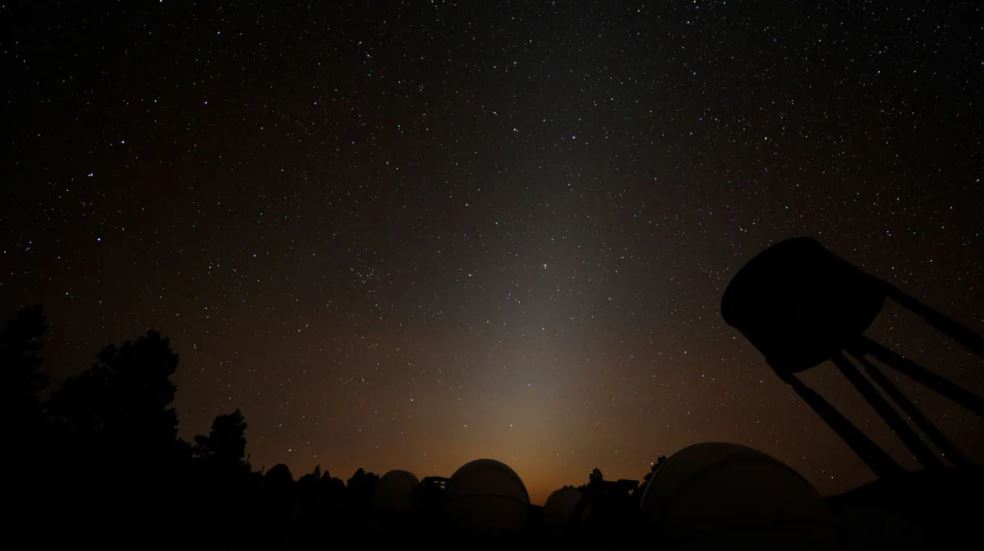
Sunlight reflects off tiny, interplanetary dust particles, creating the faint column of glowing light seen against the stars in this image. New research suggests that cosmic dust might be an important source of phosphorus for life on Earth. Credit: MalcolCC BY 3.0
Source: Journal of Geophysical Research: Space Physics

When Earth formed 4.5 billion years ago, any phosphorus that was present likely sank into the molten core because of the element’s distinct chemical properties. However, phosphorus is essential for life; it is found in DNA, RNA, and other important biological molecules. So it is probable that the phosphorus that made life possible was delivered to Earth’s surface from extraterrestrial origins, and previous studies have suggested meteorites as potential sources.

Now, P...

Read More

Rosetta’s Comet contains Ingredients for Life

Rosetta's comet in August 2015, when it was closest to the sun and when most of the glycine was detected. Credit: ESA

Rosetta’s comet in August 2015, when it was closest to the sun and when most of the glycine was detected. Credit: ESA

Ingredients crucial for the origin of life on Earth, including the simple amino acid glycine and phosphorus, key components of DNA and cell membranes, have been discovered at Comet 67P/Churyumov-Gerasimenko. The possibility that water and organic molecules were brought to the early Earth through impacts of objects like asteroids and comets have long been the subject of important debate...

Read More