
photoelectric effect tagged posts

Einstein’s Photoelectric Effect: The time it takes for an electron to be released

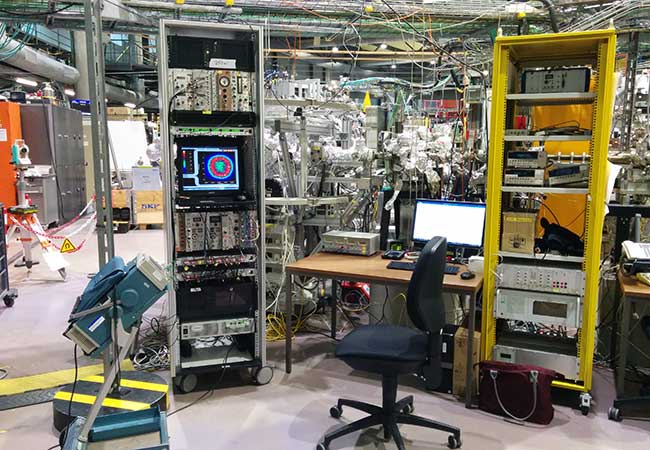
High-tech: COLTRIMS reaction microscope at electron storage ring BESSY II, Helmholtz-Zentrum Berlin für Materialien und Energie (HZB). Photo: Miriam Weller, Goethe University Frankfurt

Researchers examine photoelectric effect with the aid of a COLTRIMS reaction microscope. It is now one hundred years ago that Albert Einstein was awarded the Nobel Prize in Physics for his work on the photoelectric effect. The jury had not yet really understood his revolutionary theory of relativity — but Einstein had also conducted ground-breaking work on the photoelectric effect. With his analysis he was able to demonstrate that light comprises individual packets of energy — photons...

Read More

How long does a quantum jump take?

A laser pulse hits a tungsten surface on which iodine atoms have been depositied. Both the tungsten atoms and the iodine atoms lose electrons, which can then be measured.
Credit: TU Wien

Quantum jumps are usually regarded to be instantaneous. However, new measurement methods are so precise that it has now become possible to observe such a process and to measure its duration precisely – for example the famous ‘photoelectric effect’, first described by Albert Einstein.

It was one of the crucial experiments in quantum physics: when light falls on certain materials, electrons are released from the surface. Albert Einstein was the first to explain this phenomenon in 1905, when he spoke of “light quanta” – the smallest units of light that we call photons today.

In tiny fractions of a second, an e...

Read More