Researchers designed and fabricated a double-sided structure collimation film (DSSCF) with better collimation characteristics thanks to additional trapezoidal microstructures that prevent the large-angle leakage light seen with single-sided structure collimation film (SSSCF). The DSSCF also improves the light intensity uniformity when combined with a diffuser module. Credit: Ding-Zheng Lin, National Taiwan University of Science and Technology
Researchers have developed an ultra-thin optical film that improves the quality of the light used in LCD resin-based 3D printers. The advance helps ensure that tiny details are reproduced with precision, which could make it possible to 3D-print medical-grade or industrial-grade products at a lower cost.
University of Minnesota Twin Cities researchers have developed a plant-inspired extrusion process that allows soft robots to build their own solid bodies from liquid to navigate hard-to-reach places and complicated terrain.
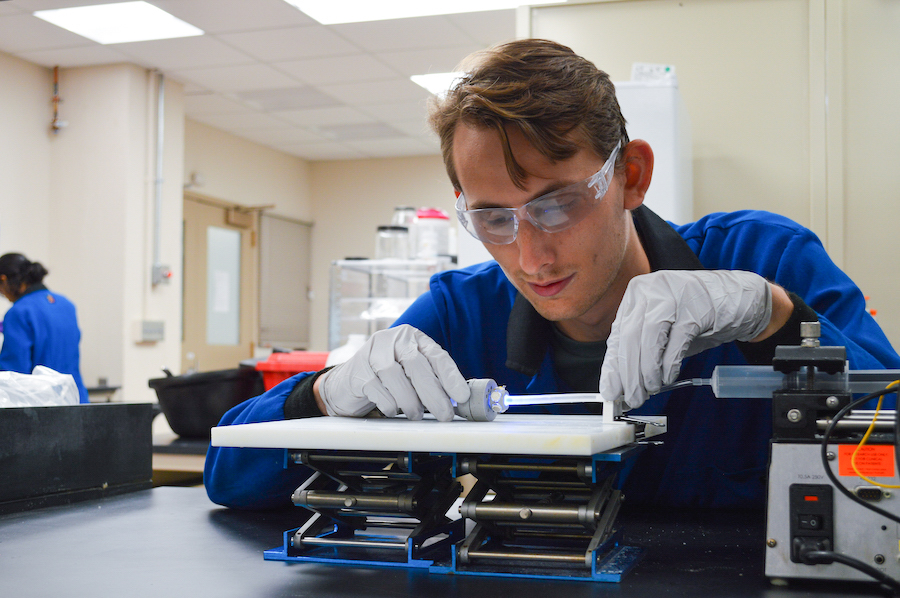
Soft robots can navigate hard-to-reach places like pipes or inside the human body. An interdisciplinary team of University of Minnesota Twin Cities scientists and engineers has developed a first-of-its-kind, plant-inspired extrusion process that enables synthetic material growth. The new approach will allow researchers to build better soft robots that can navigate hard-to-reach places, complicated terrain, and potentially areas within the human body.
The paper is published in the Proceedings of the National Academy of Sciences (PNAS).





Recent Comments