An image of the star-forming region NGC 6357 with the young star XUE 10. Observations with JWST/MIRI reveal a planet-forming disk whose spectrum shows clear detections of four distinct forms of carbon dioxide (CO2), but only little water, providing new insights into the chemical environment where planets are taking shape. Credit: Stockholm University (SU) and MarÃa Claudia RamÃrez-Tannus, Max Planck Institute for Astronomy (MPIA).
A study led by Jenny Frediani at Stockholm University has revealed a planet-forming disk with a strikingly unusual chemical composition: an unexpectedly high abundance of carbon dioxide (CO2) in regions where Earth-like planets may one day form.
The discovery, made using the James Webb Space Telescope (JWST), challenges long-standing assumptions about th...
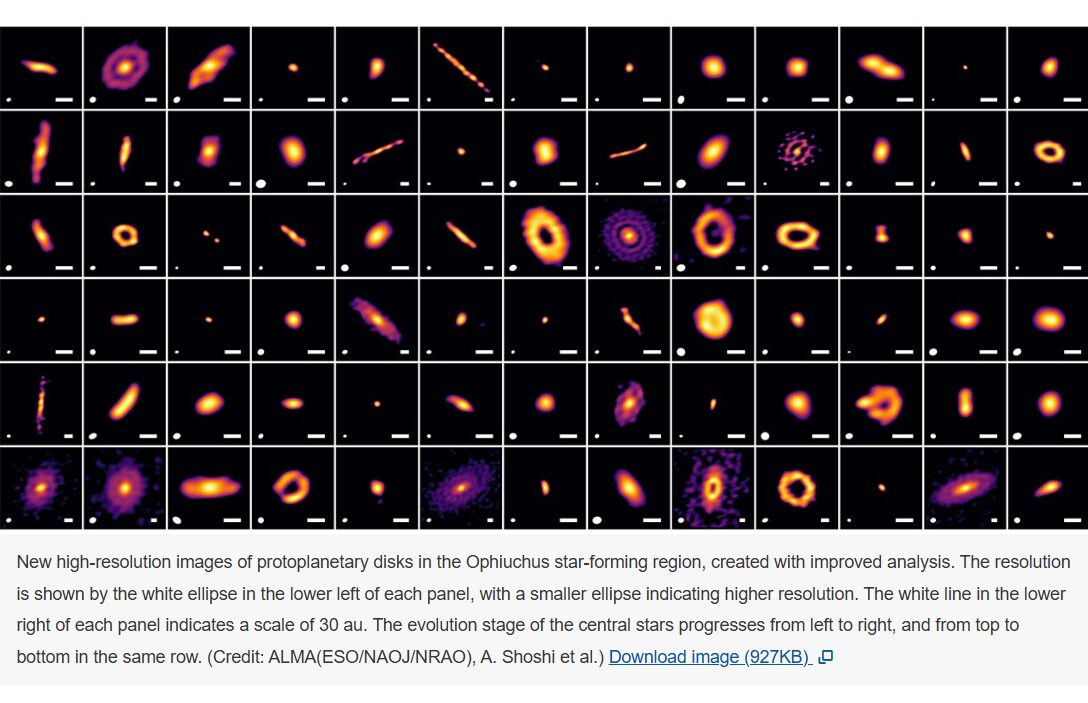
New high-resolution images of protoplanetary disks in the Ophiuchus star-forming region, created with improved analysis. The resolution is shown by the white ellipse in the lower left of each panel, with a smaller ellipse indicating higher resolution. The white line in the lower right of each panel indicates a scale of 30 au. The evolution stage of the central stars progresses from left to right, and from top to bottom in the same row. (Credit: ALMA(ESO/NAOJ/NRAO), A. Shoshi et al.)
In a stellar nursery 460 light-years away, astronomers sharpened old ALMA data and spotted crisp rings and spirals swirling around 27 infant stars—evidence that planets start taking shape just a few hundred thousand years after their suns ignite, far earlier than anyone expected.
1.3 mm (Left panels) and 12CO (2-1) moment zero images (Right panels) of the AGE-PRO sample. Credit: arXiv (2025). DOI: 10.48550/arxiv.2506.10719
An international team of scientists led by astronomers from the University of Wisconsin–Madison has produced the most accurate measurement of the gases swirling around young stars and how their mass changes over time. The discovery joins many pieces of a puzzle that may reveal which kinds of planets form—rocky Earth-types, gas giants like Jupiter, or balls of ice in the Neptune mold—as star systems mature.
The researchers used an array of 66 massive radio telescopes, the Atacama Large Millimeter/submillimeter Array, perched at 16,000 feet in the Chilean Andes Mountains, to study the disks of gas spinning in the gravity of each of 3...
New radio astronomy observations of a planetary system in the process of forming show that once the first planets form close to the central star, these planets can help shepherd the material to form new planets farther out. In this way each planet helps to form the next, like a line of falling dominos each triggering the next in turn.
To date over 5000 planetary systems have been identified. More than 1000 of those systems have been confirmed to host multiple planets. Planets form in clouds of gas and dust known as protoplanetary disks around young stars. But the formation process of multi-planet systems, like our own Solar System, is still poorly understood.
The best example object to study multi-planet system formation is a young star known as PDS 70, located 367 light years a...
Recent Comments