
planetesimals tagged posts

Astronomers show how Planets Form in Binary Systems Without getting Crushed

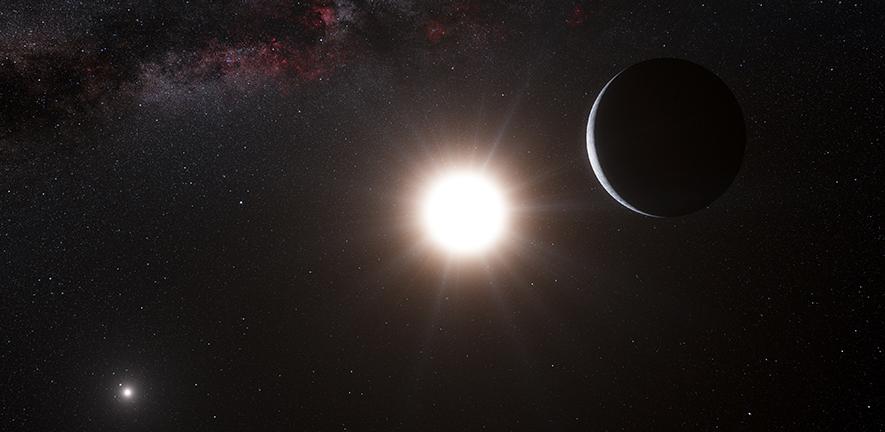
Artist’s impression of the planet around Alpha Centauri B

Astronomers have developed the most realistic model to date of planet formation in binary star systems.

The researchers, from the University of Cambridge and the Max Planck Institute for Extra-terrestrial Physics, have shown how exoplanets in binary star systems—such as the ‘Tatooine’ planets spotted by NASA’s Kepler Space Telescope—came into being without being destroyed in their chaotic birth environment.

They studied a type of binary system where the smaller companion star orbits the larger parent star approximately once every 100 years—our nearest neighbour, Alpha Centauri, is an example of such a system.

“A system like this would be the equivalent of a second Sun where Uranus is, which would have made our own solar system look very different,” said co-author Dr...

Read More
A Martian mash up: Meteorites tell story of Mars’ water history

A Martian Mash Up: Meteorites Tell Story of Mars’ Water History

University of Arizona researchers probed Martian meteorites to reconstruct Mars’ chaotic history. Their findings suggest that Mars might not have had a global magma ocean.

Researchers probed Martian meteorites to reconstruct Mars’ chaotic history. Their findings suggest that Mars might not have had a global magma ocean.

In Jessica Barnes’ palm is an ancient, coin-sized mosaic of glass, minerals and rocks as thick as a strand of wool fiber. It is a slice of Martian meteorite, known as Northwest Africa 7034 or Black Beauty, that was formed when a huge impact cemented together various pieces of Martian crust.

Barnes is an assistant professor of planetary sciences in the University of Arizona Lunar and Planetary Labo...

Read More

Mars: Simulations of Early Impacts produce a Mixed Mars Mantle

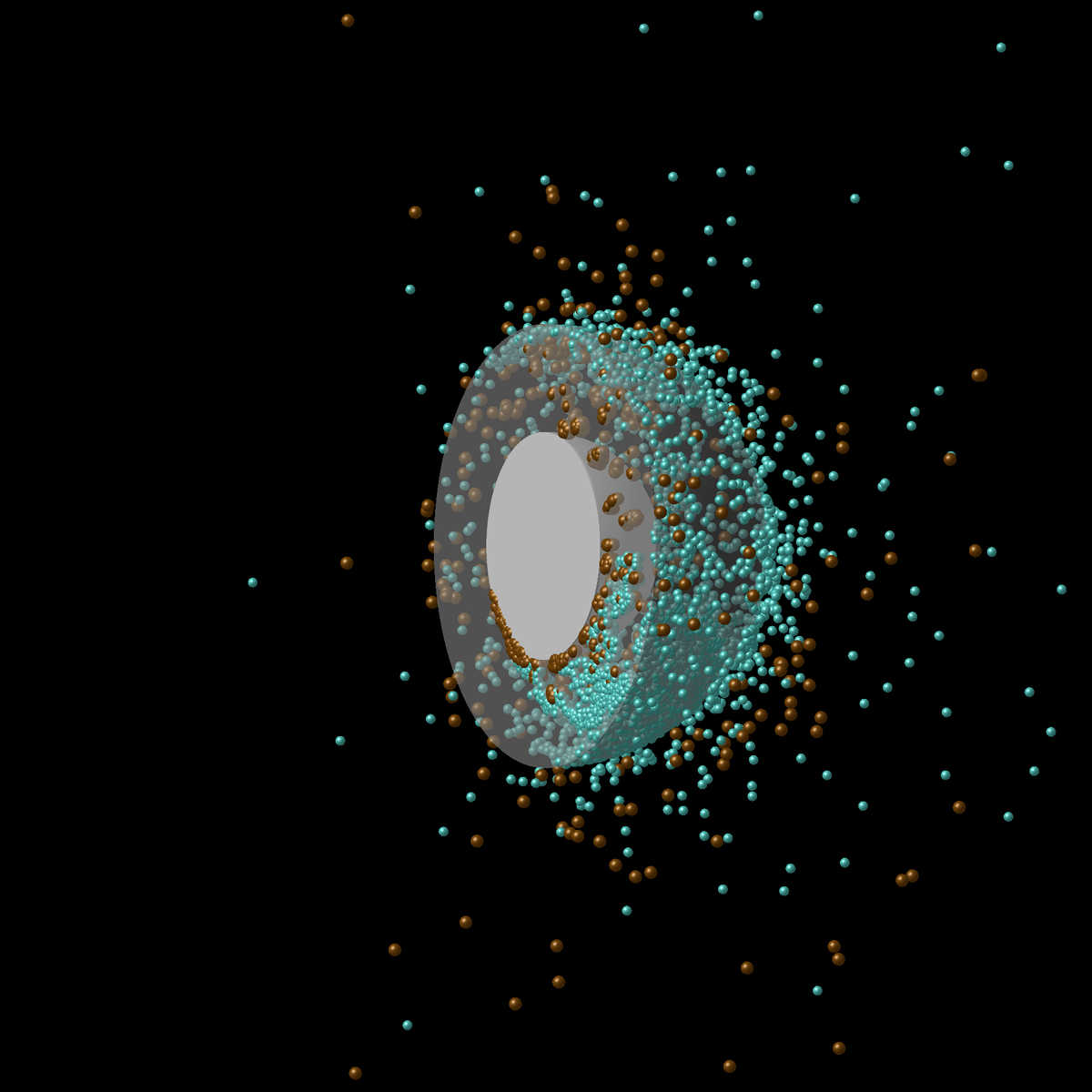
Early Mars after impact, showing projectile materials leaving the planet
Courtesy of Southwest Research Institute A Southwest Research Institute team performed high-resolution, smoothed-particle simulations of a large, differentiated projectile hitting early Mars after its core and mantle had formed. The projectile’s core and mantle particles are indicated by brown and green spheres respectively, showing local concentrations of the projectile materials assimilated into the Martian mantle.

The early solar system was a chaotic place, with evidence indicating that Mars was likely struck by planetesimals, small protoplanets up to 1,200 miles in diameter, early in its history...

Read More

New Horizons Team uncovers a Critical Piece of the Planetary Formation puzzle

The uniform color and composition of Arrokoth’s surface shows the Kuiper Belt object formed from a small, uniform, cloud of material in the solar nebula, rather than a mishmash of matter from more separated parts of the nebula. The former supports the idea that Arrokoth formed in a local collapse of a cloud in the solar nebula.
Credits: NASA/Johns Hopkins University Applied Physics Laboratory/Southwest Research Institute/Roman Tkachenko

Data from NASA’s New Horizons mission are providing new insights into how planets and planetesimals – the building blocks of the planets – were formed.

The New Horizons spacecraft flew past the ancient Kuiper Belt object Arrokoth (2014 MU69) on Jan...

Read More