polymers tagged posts

This ‘living plastic’ activates and self-care destructs on command

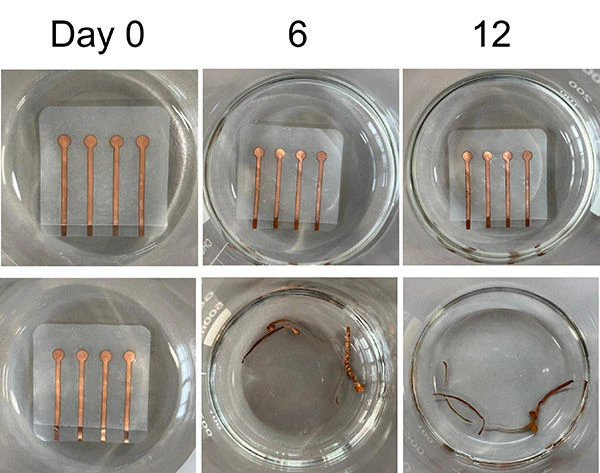
When built on the living plastic, a prototype wearable electrode readily degrades (bottom row), while one built on a commercially available plastic persists (top row).
Adapted from ACS Applied Polymer Materials 2026, DOI: 10.1021/acsapm.5c04611

Many plastic products are designed to be used only once, yet the material itself lasts for years. But a new strategy is addressing this problem by creating products that self-destruct on command, known as living plastics. These materials incorporate activatable, plastic-degrading microbes alongside the polymers. One team reporting in ACS Applied Polymer Materials used two bacterial strains that worked together and completely broke down the material within just six days, without making microplastics.

Why scientists are rethinking plastics
Zhuoju...
Read More

Researchers Create New Class of Materials called ‘Glassy Gels’

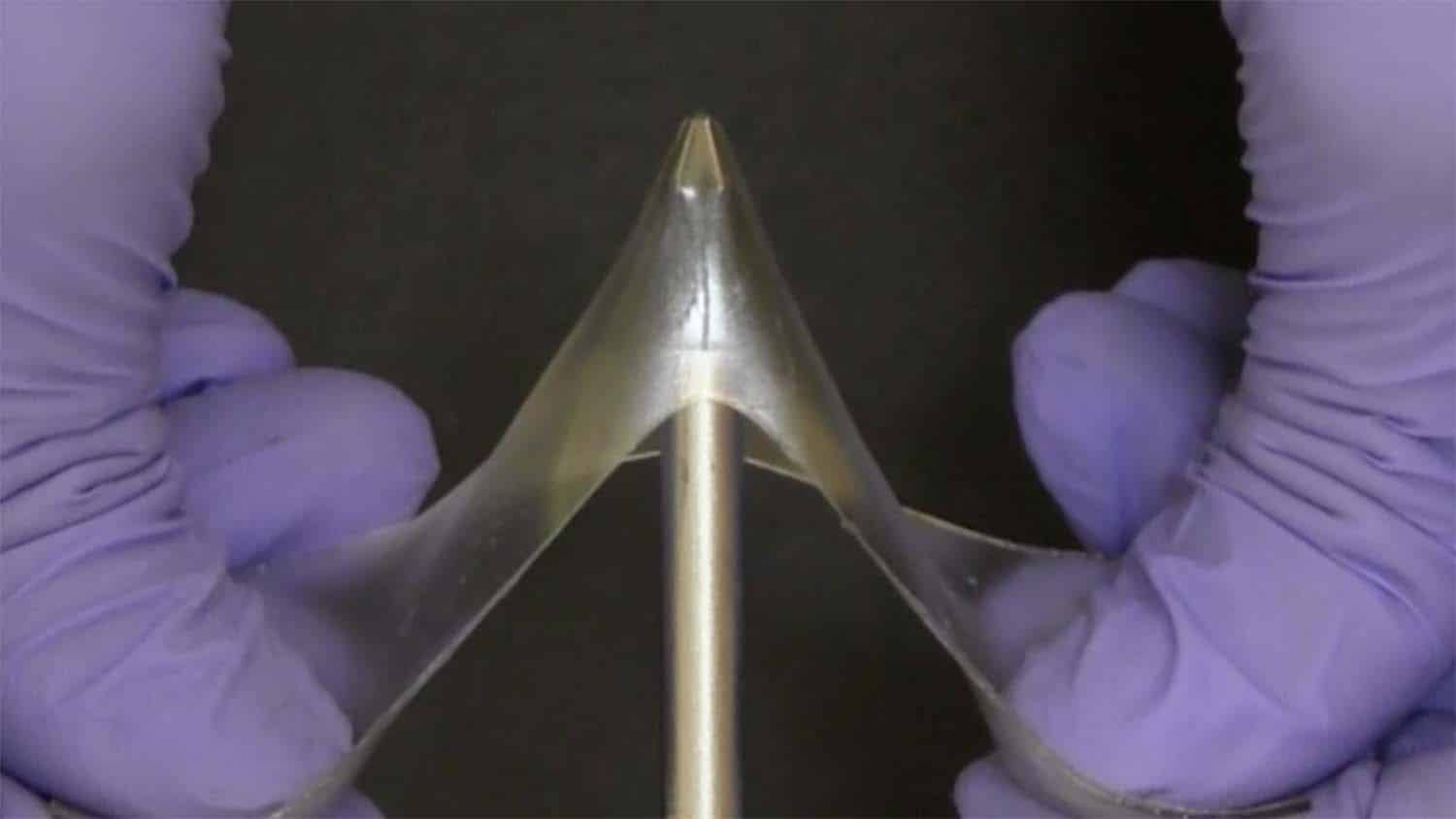
gloved hands are stretching a thin sheet of clear material over a nail; the material is stretching over the sharp nail without breaking
Image credit: Meixiang Wang.

Researchers have created a new class of materials called “glassy gels” that are very hard and difficult to break despite containing more than 50% liquid. Coupled with the fact that glassy gels are simple to produce, the material holds promise for a variety of applications.

Gels and glassy polymers are classes of materials that have historically been viewed as distinct from one another. Glassy polymers are hard, stiff and often brittle. They’re used to make things like water bottles or airplane windows. Gels – such as contact lenses – contain liquid and are soft and stretchy.

“We’ve created a class of materials that we’ve termed glassy gels, which are as hard as glassy polymers, but – if you apply enough force – can stretch up to five times t...

Read More

Faster-degrading Plastic could promise Cleaner Seas

Chemists create faster-degrading plastic for marine uses | Cornell ...

To address plastic pollution plaguing the world’s seas and waterways, Cornell University chemists have developed a new polymer that can degrade by ultraviolet radiation, according to research published in the Journal of the American Chemical Society.

“We have created a new plastic that has the mechanical properties required by commercial fishing gear. If it eventually gets lost in the aquatic environment, this material can degrade on a realistic time scale,” said lead researcher Bryce Lipinski, a doctoral candidate in the laboratory of Geoff Coates, professor of chemistry and chemical biology at Cornell University. “This material could reduce persistent plastic accumulation in the environment.”

Commercial fishing contributes to about half of all floating plastic waste that ends ...

Read More

The Ink of the Future in Printed Electronics

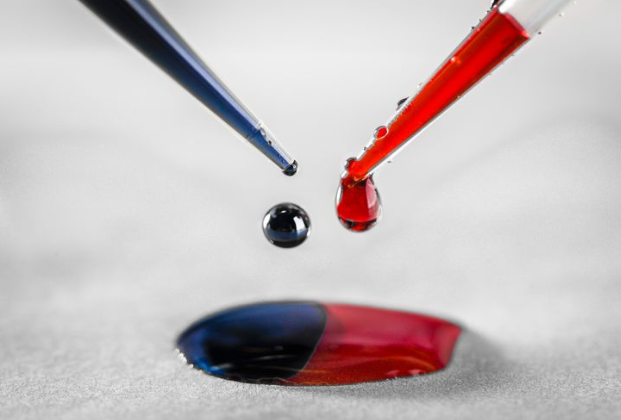
The Polymer ink. The blue one is the donor polymer solution, while the red one is the acceptor polymer solution. Both pristine polymers are non-conductive because there are no free moving charges inside the polymers. When they meet each other, electrons from the donor polymer will automatically be transferred to the acceptor polymer, leaving free moving charges on both polymers.THOR BALKHED

Ground-state electron transfer in all-polymer donor-acceptor heterojunctions. A research group led by Simone Fabiano at the Laboratory of Organic Electronics, Linköping University, has created an organic material with superb conductivity that doesn’t need to be doped. They have achieved this by mixing two polymers with different properties.

In order to increase the conductivity of polymers, ...

Read More