JWST imaging of the RPS galaxy C26 in SPT2349–56. (a) Red-green-blue image of the protocluster core (blue: NIRCam/F200W; green: NIRCam/F444W; red: MIRI/F1000W). The RPS galaxy C26 is marked by the red rectangle. The cross labels the kinematic center of the protocluster. (b–d) Zoomed images of C26 in F200W, F444W, and F1000W, respectively. credit: DOI: https://doi.org/10.48550/arXiv.2606.18229
Astronomers have spotted many “red and dead” galaxies in the early universe. These are massive systems that stopped forming stars surprisingly early in cosmic history. Now, they may have found evidence of one in the act of becoming dead: a massive galaxy being stripped of its starforming gas just 1.4 billion years after the Big Bang...
Astronomers recently discovered a group of interacting and merging galaxies in the early universe, as seen in this artist’s illustration. Credit: ESO/M. Kornmesser; Creative Commons Attribution 3.0 Unported (CC-BY)
A dense flock of 14 galaxies from 1.4 billion years after the Big Bang is destined to become one of the most massive structures in the modern universe. For the 1st time, astronomers have witnessed the birth of a colossal cluster of galaxies. Their observations reveal at least 14 galaxies packed into an area only 4 times the diameter of the Milky Way’s galactic disk. Computer simulations of the galaxies predict that over time the cluster will assemble into one of the most massive structures in the modern universe, the astronomers report in the April 26 issue of Nature.
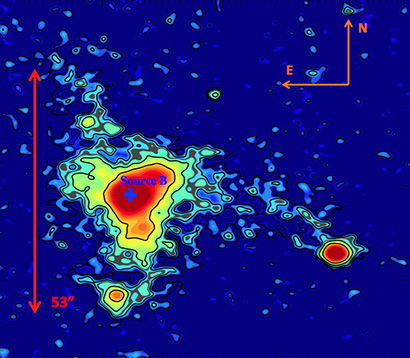
MAMMOTH-1 is an extended blob of gas in the intergalactic medium called an enormous Lyman-alpha nebula (ELAN). The color map and contours denote the surface brightness of the nebula, and the red arrows show its estimated spatial extent. (Image credit: Figure 2 of Cai et al., Astrophysical Journal)
Glowing nebula found at the heart of a huge ‘rotocluster’ of early galaxies appears to be part of the cosmic web of filaments connecting galaxies, but what’s lighting it up? Astronomers have found an enormous, glowing blob of gas in the distant universe, with no obvious source of power for the light it is emitting. Called an “enormous Lyman-alpha nebula” (ELAN), it is the brightest and among the largest of these rare objects, only a handful of which have been observed.





Recent Comments