protostars tagged posts

Protostars ‘sneeze’ and produce rings of gas and magnetic flux as they grow

Star light, star bright, baby stars blow rings alight
An artist’s rendering of the molecular cloud core of MC 27 based on observations from the ALMA telescope. The protostar and the disk surrounding it are shown in the lower right, with warm gas extending outward in a ring-like structure, with magnetic field lines penetrating the interior of the ring. Credit:The Astrophysical Journal Letters (2026). DOI: 10.3847/2041-8213/ae47ec

Researchers have uncovered new insights into the early development of baby stars...

Read More

First of its kind Detection made in Striking New Webb Image

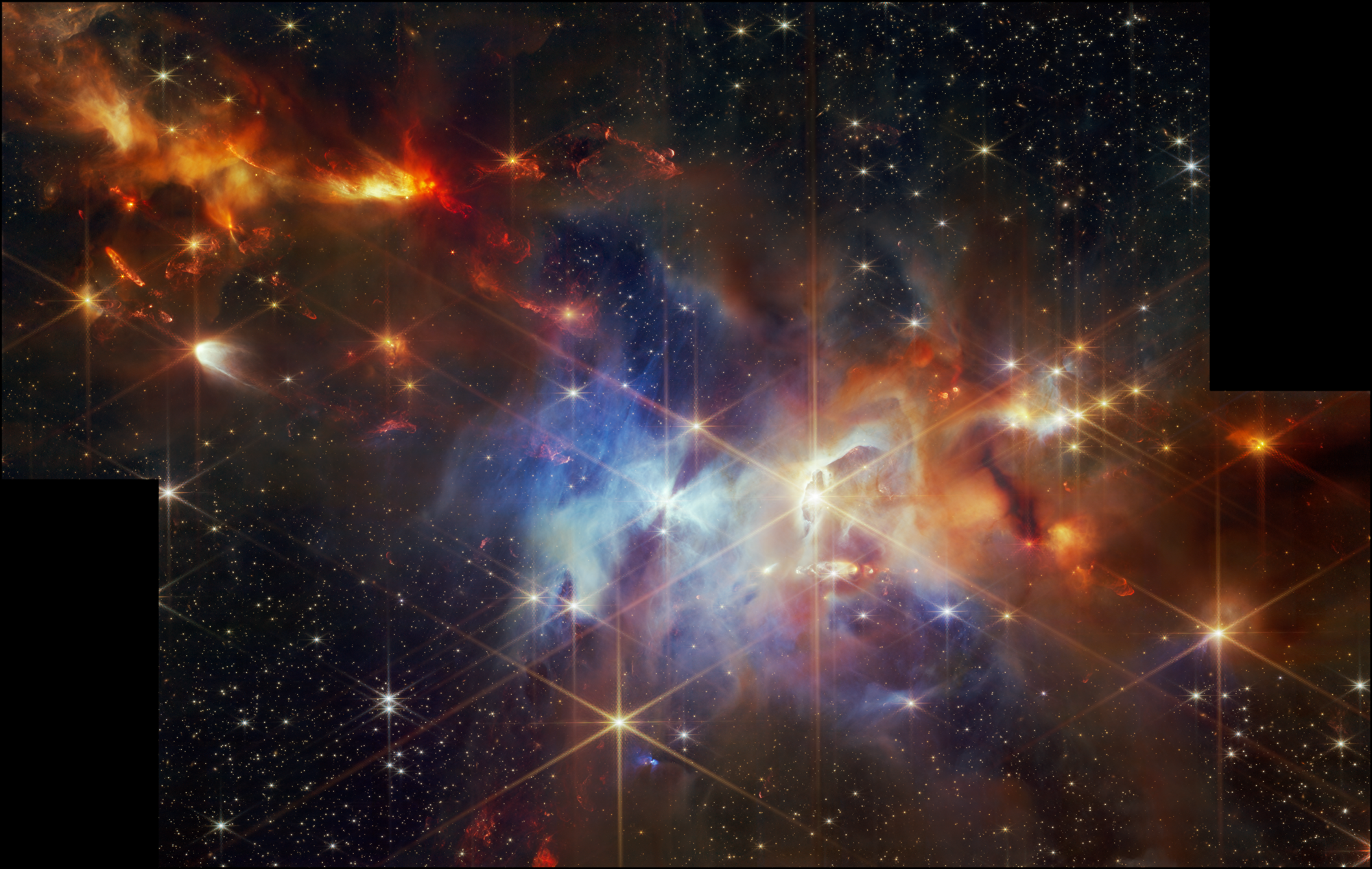
A rectangular image with black vertical rectangles at the bottle left and top right to indicate missing data. A young star-forming region is filled with wispy orange, red, and blue layers of gas and dust. The upper left corner of the image is filled with mostly orange dust, and within that orange dust, there are several small red plumes of gas that extend from the top left to the bottom right, at the same angle. The center of the image is filled with mostly blue gas. At the center, there is one particularly bright star, that has an hourglass shadow above and below it. To the right of that is what looks a vertical eye-shaped crevice with a bright star at the center. The gas to the right of the crevice is a darker orange. Small points of light are sprinkled across the field, brightest sources in the field have extensive eight-pointed diffraction spikes that are characteristic of the Webb Telescope.
In this image of the Serpens Nebula from NASA’s James Webb Space Telescope, astronomers found a grouping of aligned protostellar outflows within one small region (the top left corner). Serpens is a reflection nebula, which means it’s a cloud of gas and dust that does not create its own light, but instead shines by reflecting the light from stars close to or within the nebula.
NASA, ESA, CSA, K. Pontoppidan (NASA’s Jet Propulsion Laboratory) and J. Green (Space Telescope Science Institute).

For the first time, a phenomenon astronomers have long hoped to directly image has been captured by NASA’s James Webb Space Telescope’s Near-Infrared Camera (NIRCam)...

Read More

Gas Streamers Feed Triple Baby Stars

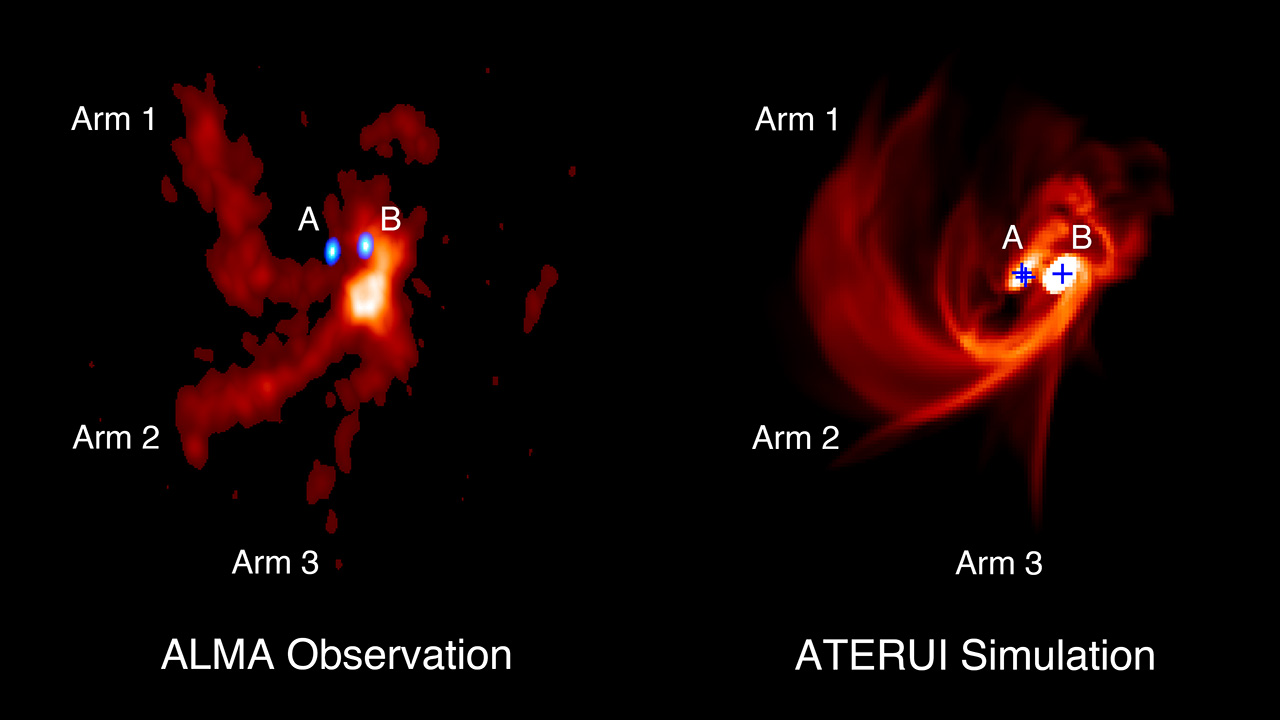
Gas distribution around the trinary protostars IRAS 04239+2436, (left) ALMA observations of SO emissions, and (right) as reproduced by the numerical simulation on the supercomputer ATERUI. In the left panel, protostars A and B, shown in blue, indicate the radio waves from the dust around the protostars. Within protostar A, two unresolved protostars are thought to exist. In the right panel, the locations of the three protostars are shown by the blue crosses. (Credit: ALMA (ESO/NAOJ/NRAO), J.-E. Lee et al.) 

New observations and simulations of three spiral arms of gas feeding material to three protostars forming in a trinary system have clarified the formation of multi-star systems.

Most stars with a mass similar to the Sun form in multi-star systems together with other stars...

Read More
ALMA digs deeper into the Mystery of Planet Formation

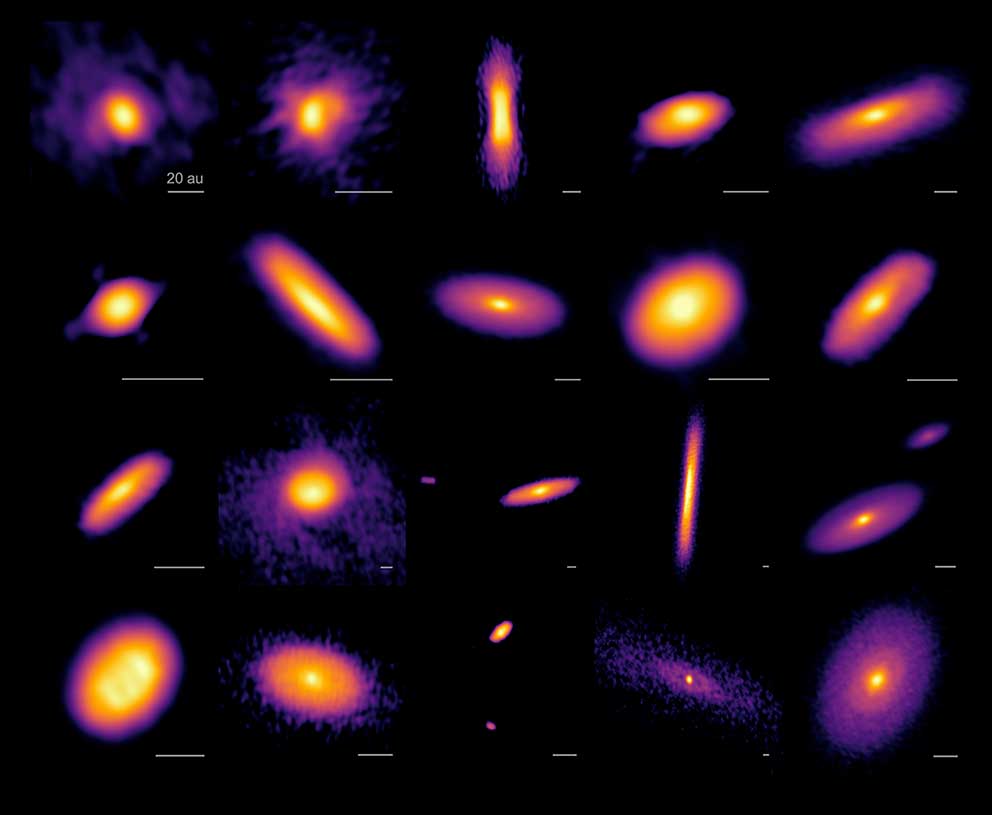
Images of disks around 19 protostars, including 4 binary systems observed with ALMA. For 1 binary system, disks around the primary and secondary are presented independently (2nd line rightmost and 3rd line leftmost). Disks are presented in the order of their evolutionary sequence (the one in the upper-left corner is the youngest while the one at the lower-right corner is the oldest). The two oldest disks show faint ring-gap structures. A scale bar of 20 au (roughly the distance between the Sun and Uranus) is shown for each disk image. (Credit: ALMA (ESO/NAOJ/NRAO), N. Ohashi et al.) Original size (1.0MB)

An international research team used the Atacama Large Millimeter/submillimeter Array (ALMA) to observe disks around 19 protostars with a very high resolution to search for the earliest...

Read More