pyroxene tagged posts

The Red Planet has a purple side

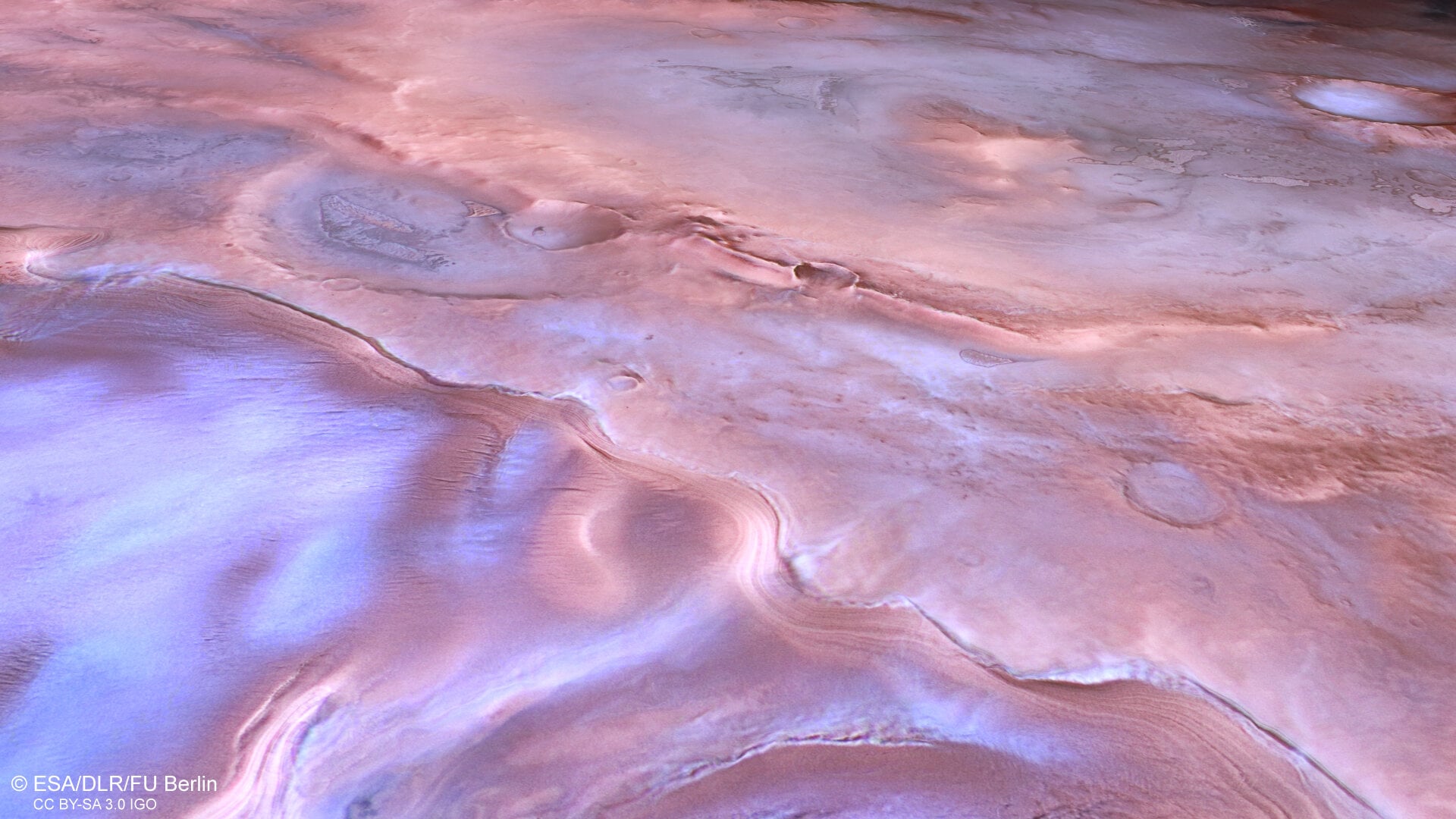
Mars is known for its reddish colour palette, a result of ancient iron oxides. But these striking pinks and purples are much different from the rest of the red planet. This orbital image shows Thyles Rupes, its cliff face, and a nearby glacier, where the atypical colours come from a mix of dust and frost. The image is from the High-Resolution Stereo Camera on the ESA's Mars Express orbiter. Image Credit: ESA/DLR/FU Berlin. Licence: CC BY-SA 3.0 IGO or ESA Standard Licence
Mars is known for its reddish colour palette, a result of ancient iron oxides. But these striking pinks and purples are much different from the rest of the red planet. This orbital image shows Thyles Rupes, its cliff face, and a nearby glacier, where the atypical colours come from a mix of dust and frost. The image is from the High-Resolution Stereo Camera on the ESA’s Mars Express orbiter. Image Credit: ESA/DLR/FU Berlin. Licence: CC BY-SA 3.0 IGO or ESA Standard Licence

Oxidized iron dominates the Martian color palette. The dusty reds, ochers, browns and tans give the planet its nickname: the Red Planet. But new images of Mars’ south polar region show something different...

Read More

Don’t Judge an Asteroid by its Cover: Mid-infrared Data from SOFIA Shows Ceres’ True Composition

The column of material at and just below the surface of dwarf planet Ceres (box) – the top layer contains anhydrous (dry) pyroxene dust accumulated from space mixed in with native hydrous (wet) dust, carbonates, and water ice. (Bottom) Cross section of Ceres showing the surface layers that are the subject of this study plus a watery mantle and a rocky-metallic core. Credits: Pierre Vernazza, LAM–CNRS/AMU

The column of material at and just below the surface of dwarf planet Ceres (box) – the top layer contains anhydrous (dry) pyroxene dust accumulated from space mixed in with native hydrous (wet) dust, carbonates, and water ice. (Bottom) Cross section of Ceres showing the surface layers that are the subject of this study plus a watery mantle and a rocky-metallic core. Credits: Pierre Vernazza, LAM–CNRS/AMU

New observations show that Ceres, the largest body in the asteroid belt, does not appear to have the carbon-rich surface composition that space- and ground-based telescopes previously indicated...

Read More