
QGP tagged posts

Scientists smash oxygen nuclei to recreate matter from the Big Bang

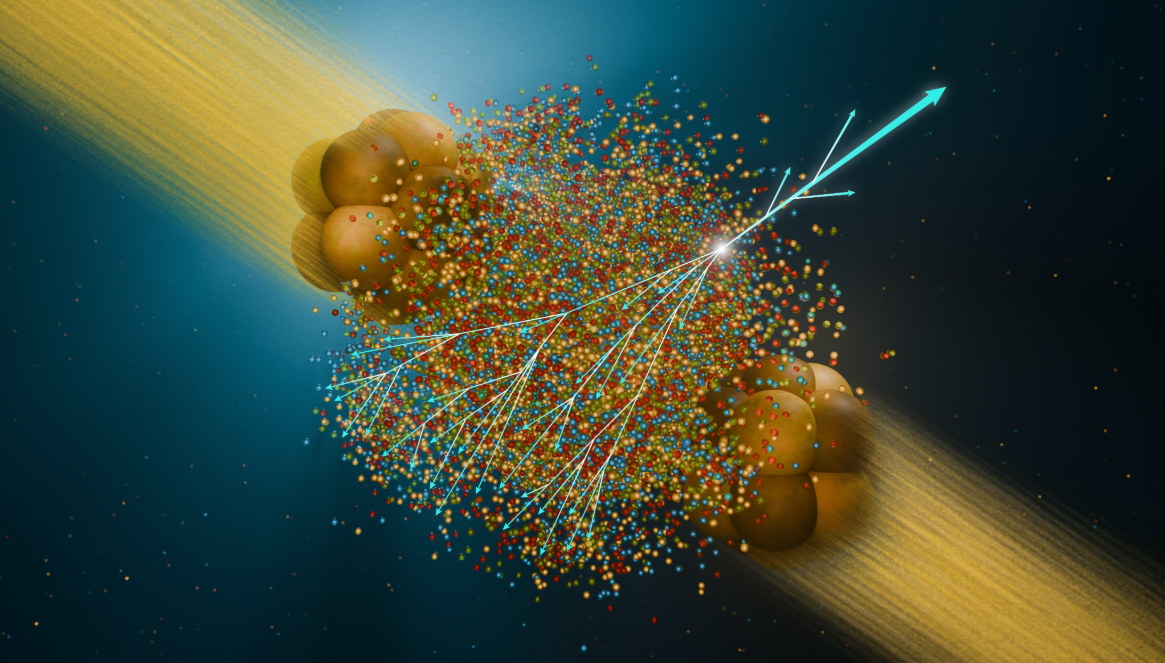
This image shows back-to-back jets produced in the quark-gluon plasma formed when two oxygen nuclei collide at the Relativistic Heavy Ion Collider (RHIC). The jet near the edge of the plasma, upper right, escapes easily while the jet moving a longer distance through the plasma loses energy, or gets “quenched,” as it interacts with the soup of quarks and gluons. (Valerie A. Lentz/Brookhaven National Laboratory)

Scientists have recreated a primordial state of matter from the dawn of the universe by colliding oxygen nuclei at nearly the speed of light. The surprising results show that this exotic substance can form in smaller, lower-energy collisions than previously demonstrated, challenging the known boundaries of early-universe physics.

New findings from the STAR experiment at the Re...

Read More

Proton-Nuclei Smashups yield clues about ‘Quark Gluon Plasma’

A visual of data collected by the Compact Muon Solenoid detector during a proton-lead collision at the Large Hadron Collider in 2016. Credit: Image courtesy of Thomas McCauley/CERN

A visual of data collected by the Compact Muon Solenoid detector during a proton-lead collision at the Large Hadron Collider in 2016. Credit: Image courtesy of Thomas McCauley/CERN

Physicists probe exotic state of nuclear matter at Europe’s LHC. Findings from Rice University physicists working at Europe’s Large Hadron Collider (LHC) are providing new insight about an exotic state of matter, “quark-gluon plasma” that occurs when protons and neutrons melt. LHC is able to smash together the nuclei of atoms at nearly the speed of the light. The energy released in these collisions is vast and allows physicists to recreate the hot, dense conditions that existed in the early universe...

Read More

Discovered: Tiny Drops of ‘Perfect’ Fluid that existed in the early Universe

Image courtesy of Brookhaven National Laboratory Initial hot spots created by collisions of one, two, and three-particle ions with much larger gold ions (top row). Expected patterns if the collisions are creating tiny hot spots of the primordial soup, or quark-gluon plasma.

Image courtesy of Brookhaven National Laboratory Initial hot spots created by collisions of one, two, and three-particle ions with much larger gold ions (top row). Expected patterns if the collisions are creating tiny hot spots of the primordial soup, or quark-gluon plasma.

Surprisingly, smaller particles colliding with large nuclei appear to produce tiny droplets of quark-gluon plasma (QGP). Recent results show that the tiny droplets behave like a liquid not the expected gas. The results support the case that these small particles produce tiny drops of the primordial soup.

Smashing large atomic nuclei, containing protons and neutrons, together at close to the speed of light re-creates the conditions of the very early universe...

Read More