
Quantum communications tagged posts

Good vibrations for quantum communications: Engineers couple single phonon to single atomic spin

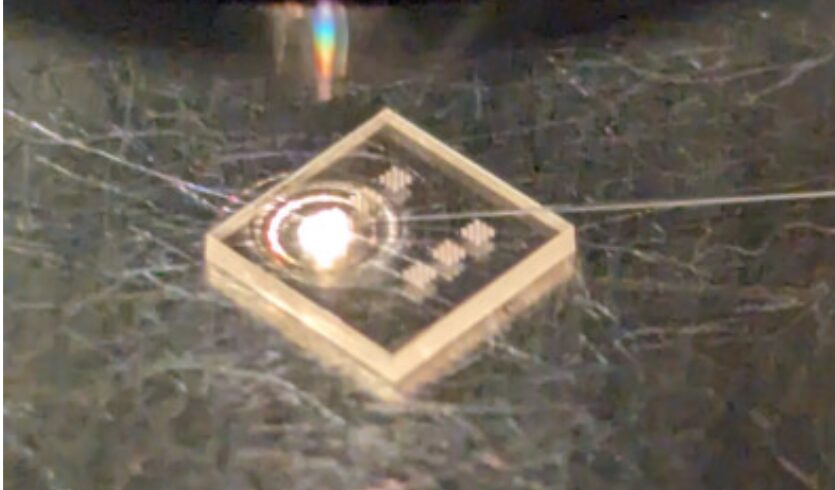
A photo of a 5 mm x 5 mm diamond chip on a room-temperature measurement setup, with arrays of mechanical resonators visible.

Researchers at the Harvard John A. Paulson School of Engineering and Applied Sciences (SEAS) have demonstrated, for the first time, a single quantum of vibrational energy interacting with a single atomic spin, seeding a pathway to quantum technologies that use sound as an information carrier, instead of light or electricity. The results are published in Nature.

Led by Marko Lončar, the Tiantsai Lin Professor of Electrical Engineering, the researchers engineered a nanometer-scale mechanical resonator around a single color-center spin qubit in diamond...

Read More

Researchers Develop World’s Smallest Quantum Light Detector on a Silicon Chip

University of Bristol researchers develop world's smallest quantum light detector on a silicon chip
The silicon ePIC quantum chip, mounted on a printed circuit board for testing and similar to a motherboard inside a personal computer. Credit: University of Bristol

Researchers at the University of Bristol have made an important breakthrough in scaling quantum technology by integrating the world’s tiniest quantum light detector onto a silicon chip. The paper, “A Bi-CMOS electronic photonic integrated circuit quantum light detector,” was published in Science Advances.

A critical moment in unlocking the information age was when scientists and engineers were first able to miniaturize transistors onto cheap micro-chips in the 1960s.

Now, for the first time, University of Bristol academics have demonstrated the integration of a quantum light detector—smaller than a human hair—onto a s...

Read More

Toward Metropolitan Free-Space Quantum Networks

Towards metropolitan free-space quantum networks
Metropolitan entanglement-based free-space network. a) A standardized centrally located entanglement server (ES, black box) is streaming entangled photons into the network. Free-space channels are used to connect distant buildings and parts of a metropolitan area, while fiber connections may still be used in a complementary way, for example, to connect to offices within the central building. Each end user owns an application-specific quantum receiver subsystem (green boxes). b) The corresponding physical layer network topology. At the quantum communication layer, the network is a pairwise connected mesh, so that every end user can communicate with any other (not shown). c) A near-term extension possibility using several ESs and a central trusted node...
Read More