quantum computers tagged posts

‘Toggle Switch’ Can Help Quantum Computers Cut Through the Noise

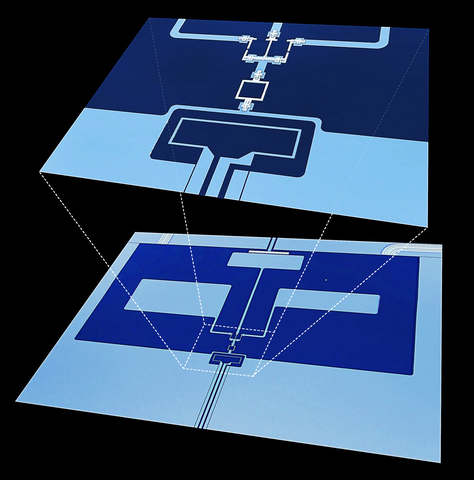
A blue-tinged drawing shows a schematic of the two qubits and resonator above a white rectangle, which represents the SQUID device that controls the connections and relationships among the qubits and resonator elements.
This photo shows the central working region of the device. In the lower section, the three large rectangles (light blue) represent the two quantum bits, or qubits, at right and left and the resonator in the center. In the upper, magnified section, driving microwaves through the antenna (large dark-blue rectangle at bottom) induces a magnetic field in the SQUID loop (smaller white square at center, whose sides are about 20 micrometers long). The magnetic field activates the toggle switch. The microwaves’ frequency and magnitude determine the switch’s position and strength of connection among the qubits and resonator.
Credit: R. Simmonds/NIST

The novel device could lead to more versatile quantum processors with clearer outputs...

Read More

Entangled Atoms Cross Quantum Network from one Lab to another

Illustration mehrerer Gebäude mit einer roten Kugel im ersten Gebäude und einer grünen Kugel im letzten, dazwischen eine strichlierte Linie.
The nodes of this network were housed in two labs at the Campus Technik to the west of Innsbruck, Austria.

Trapped ions are one of the leading systems to build quantum computers and other quantum technologies. To link multiple such quantum systems, interfaces are needed through which the quantum information can be transmitted. In recent years, researchers led by Tracy Northup and Ben Lanyon at the University of Innsbruck’s Department of Experimental Physics have developed a method for doing this by trapping atoms in optical cavities such that quantum information can be efficiently transferred to light particles. The light particles can then be sent through optical fibers to connect atoms at different locations...

Read More

Building a Better Quantum Bit: New qubit breakthrough could transform quantum computing

An illustration of the qubit platform made of a single electron on solid neon. Researchers froze neon gas into a solid at very low temperatures, sprayed electrons from a light bulb onto the solid and trapped a single electron there to create a qubit. (Courtesy of Dafei Jin/Argonne National Laboratory)

A team led by researchers at the U.S. Department of Energy’s (DOE) Argonne National Laboratory, in close collaboration with FAMU-FSU College of Engineering Associate Professor of Mechanical Engineering Wei Guo, has announced the creation of a new qubit platform that shows great promise to be developed into future quantum computers. Their work is published in Nature.

“Quantum computers could be a revolutionary tool for performing calculations that are practically impossible for classica...

Read More

Magnetism helps Electrons Vanish in High-temp Superconductors

The Fermi surface on the left shows the arrangement of electrons in a copper-oxide high temperature superconductor before the “critical point.” After the critical point, the Fermi surface on the right shows that most electrons vanish. Research by the Brad Ramshaw’s lab connects this disappearance with magnetism.

A physicist’s discovery could lead to the engineering of high-temp superconducting properties into materials useful for quantum computing, medical imaging.

Superconductors — metals in which electricity flows without resistance — hold promise as the defining material of the near future, according to physicist Brad Ramshaw, and are already used in medical imaging machines, drug discovery research and quantum computers being built by Google and IBM.

However, the super-...

Read More