quantum computers tagged posts

A Peculiar State of Matter in Layers of Semiconductors

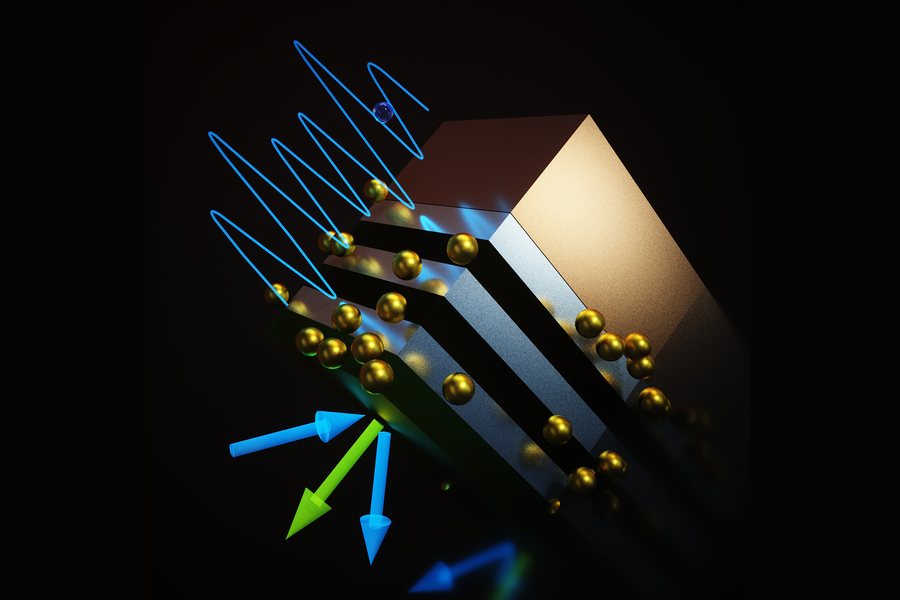
A cube with stripes representing layers of semiconductors, with clusters of gold spheres representing nanodots
The setup for the milli-electronvolt inelastic X-ray scattering that probes the many-body localization in the disordered superlattice system
Credits:Image courtesy of the researchers

Scientists around the world are developing new hardware for quantum computers, a new type of device that could accelerate drug design, financial modeling, and weather prediction. These computers rely on qubits but these are fickle, degrading into regular bits when interactions with surrounding matter interfere. But new research at MIT suggests a way to protect their states, using a phenomenon called many-body localization (MBL).

MBL is a peculiar phase of matter, proposed decades ago, that is unlike solid or liquid. Typically, matter comes to thermal equilibrium with its environment...

Read More

Engineers make Critical Advance in Quantum Computer Design

Dr Jarryd Pla and Prof. Andrew Dzurak look from behind a transparent screen showing mathematical workings
Dr Jarryd Pla and Professor Andrew Dzurak have solved the problem of how to reliably control not just a few, but millions of qubits. Photo: UNSW

Quantum engineers from UNSW Sydney have removed a major obstacle that has stood in the way of quantum computers becoming a reality. They discovered a new technique they say will be capable of controlling millions of spin qubits—the basic units of information in a silicon quantum processor.

Until now, quantum computer engineers and scientists have worked with a proof-of-concept model of quantum processors by demonstrating the control of only a handful of qubits.

But with their latest research, published today in Science Advances, the team have found what they consider “the missing jigsaw piece” in the quantum computer architecture that ...

Read More

A Speed Limit also applies in the Quantum world

A speed limit also applies in the quantum world
First author Manolo Rivera Lam (left) and principal investigator Dr. Andrea Alberti (right) at the Institute of Applied Physics at the University of Bonn. Credit: © Volker Lannert/Uni Bonn

Even in the world of the smallest particles with their own special rules, things cannot proceed infinitely fast. Physicists at the University of Bonn have now shown what the speed limit is for complex quantum operations. The study also involved scientists from MIT, the universities of Hamburg, Cologne and Padua, and the Jülich Research Center. The results are important for the realization of quantum computers, among other things. They are published in the prestigious journal Physical Review X, and covered by the Physics Magazine of the American Physical Society.

Suppose you observe a waiter (the...

Read More

New Algorithm could Unleash the Power of Quantum Computers

A new algorithm leaps past limits restricting quantum computers.

Fast-forwarding quantum calculations skips past the time limits imposed by decoherence, which plagues today’s machines. A new algorithm that fastforwards simulations could bring greater use ability to current and near-term quantum computers, opening the way for applications to run past strict time limits that hamper many quantum calculations.

“Quantum computers have a limited time to perform calculations before their useful quantum nature, which we call coherence, breaks down,” said Andrew Sornborger of the Computer, Computational, and Statistical Sciences division at Los Alamos National Laboratory, and senior author on a paper announcing the research...

Read More