quantum computers tagged posts

Complete design of a Silicon Quantum Computer Chip Unveiled

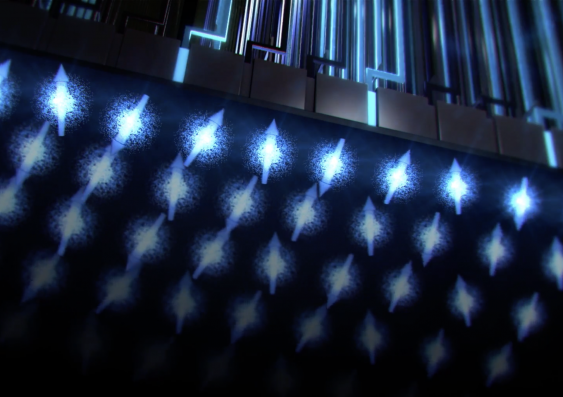
Artist's impression of the architecture of a silicon CMOS chip for a spin-based quantum computer; above is mostly standard CMOS components, and below the quantum bits in operation. (Illustration: Tony Melov)

Artist’s impression of the architecture of a silicon CMOS chip for a spin-based quantum computer; above is mostly standard CMOS components, and below the quantum bits in operation. (Illustration: Tony Melov)

A reimagining of today’s computer chips by Australian and Dutch engineers shows how a quantum computer can be manufactured – using mostly standard silicon technology. Research teams all over the world are exploring different ways to design a working computing chip that can integrate quantum interactions. Now, UNSW engineers believe they have cracked the problem, reimagining the silicon microprocessors we know to create a complete design for a quantum computer chip that can be manufactured using mostly standard industry processes and components.

The new chip design, published in the jou...

Read More

New Quantum Liquid Crystals may play Role in Future of Computers

These images show light patterns generated by a rhenium-based crystal using a laser method called optical second-harmonic rotational anisotropy. At left, the pattern comes from the atomic lattice of the crystal. At right, the crystal has become a 3-D quantum liquid crystal, showing a drastic departure from the pattern due to the atomic lattice alone. Credit: Hsieh Lab/Caltech

These images show light patterns generated by a rhenium-based crystal using a laser method called optical second-harmonic rotational anisotropy. At left, the pattern comes from the atomic lattice of the crystal. At right, the crystal has become a 3-D quantum liquid crystal, showing a drastic departure from the pattern due to the atomic lattice alone. Credit: Hsieh Lab/Caltech

Physicists at the Institute for Quantum Information and Matter at Caltech have discovered the first 3D quantum liquid crystal – a new state of matter that may have applications in ultrafast quantum computers of the future...

Read More

Atomic Clock mimics long-sought synthetic Magnetic State

JILA physicists used a strontium lattice atomic clock to simulate magnetic properties long sought in solid materials. The atoms are confined in an optical lattice, shown as an array of disk-shaped traps set at shallow depths. A laser (yellow wave) probes the atoms to couple the atoms' spins and motions. The two atomic spin states are illustrated in red and blue. Credit: Steven Burrows and Ye Group/JILA

JILA physicists used a strontium lattice atomic clock to simulate magnetic properties long sought in solid materials. The atoms are confined in an optical lattice, shown as an array of disk-shaped traps set at shallow depths. A laser (yellow wave) probes the atoms to couple the atoms’ spins and motions. The two atomic spin states are illustrated in red and blue. Credit: Steven Burrows and Ye Group/JILA

JILA physicists have caused atoms in a gas to behave as if they possess unusual magnetic properties long sought in harder-to-study solid materials. Representing a novel “off-label” use for atomic clocks, the research could lead to the creation of new materials for applications such as “spintronic” devices and quantum computers...

Read More

Quantum Computers: 10-fold Boost in Stability Achieved

Quantum computers: 10-fold boost in stability achieved

Artist”s impression of a single-atom electron spin, hosted in a silicon crystal and dressed by an oscillating electromagnetic field. Credit: Arne Laucht/UNSW

Australian engineers have created a new quantum bit which remains in a stable superposition for 10 times longer than previously achieved, dramatically expanding the time during which calculations could be performed in a future silicon quantum computer. The new quantum bit, made up of the spin of a single atom in silicon and merged with an electromagnetic field – known as ‘dressed qubit’ – retains quantum information for much longer that an ‘undressed’ atom, opening up new avenues to build and operate the superpowerful quantum computers of the future.

Andrea Morello,CQC2T, UNSW said:”Our decade-long research program had already establi...

Read More