Quantum computing tagged posts

SFU researchers find the Missing Photonic Link to enable an All-Silicon Quantum Internet

stefs-render-chemical-structure-Final01

Researchers at Simon Fraser University have made a crucial breakthrough in the development of quantum technology.

Their research, published in Nature today, describes their observations of over 150,000 silicon ‘T centre’ photon-spin qubits, an important milestone that unlocks immediate opportunities to construct massively scalable quantum computers and the quantum internet that will connect them.

Quantum computing has enormous potential to provide computing power well beyond the capabilities of today’s supercomputers, which could enable advances in many other fields, including chemistry, materials science, medicine and cybersecurity.

In order to make this a reality, it is necessary to produce both stable, long-lived qubits that provide processing power, as well as the communi...

Read More
Novel Design greatly Improves Output from Commercial Circuit Boards next to Superconducting Qubits

Green commercial circuit boards—the largest is 11.4 cm (4.5 in) by 19 cm (7.5  in)—inside a dilution refrigerator. When enclosed and pumped down, the system reaches temperatures only a few thousandths of a degree above absolute zero. Credit: NIST

Researchers at the National Institute of Standards and Technology (NIST) have constructed and tested a system that allows commercial electronic components—such as microprocessors on circuit boards—to operate in close proximity with ultracold devices employed in quantum information processing. That design allows 4X as much data to be output for the same number of connected wires.

In the rising excitement about quantum computing, it can be easy to overlook the physical fact that the data produced by manipulation of quantum bits (qubit...

Read More

A-list Candidate for Fault-Free Quantum Computing Delivers Surprise

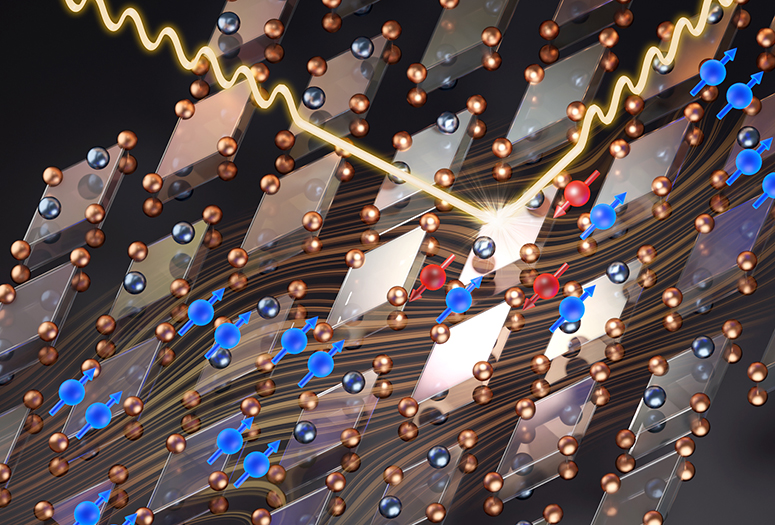
An artist’s impression of a neutron striking a sample of superconducting uranium ditelluride in experiments at Oak Ridge National Laboratory. Crystals of uranium (dark gray) and tellurium (brown) are suspected of hosting spin-triplet superconductivity, a state marked by electron pairs with spins pointed in the same direction (blue). In neutron scattering experiments, incoming neutrons disrupt pairs by flipping one spin in the opposite direction (red), revealing telltale evidence of the pair’s quantum mechanical state. (Credit: Jill Hemman/ORNL)

Puzzling result forces physicists to rethink ‘spin-triplet’ superconductivity...

Read More

Tying Quantum Computing to AI prompts a Smarter Power Grid

power grid

Fumbling to find flashlights during blackouts may soon be a distant memory, as quantum computing and artificial intelligence could learn to decipher an electric grid’s problematic quirks and solve system hiccups so fast, humans may not notice.

Rather than energy grid faults turning into giant problems—such as voltage variations or widespread blackouts—blazing fast computation blended with artificial intelligence could rapidly diagnose trouble and find solutions in tiny splits of seconds, according to Cornell research forthcoming in Applied Energy (Dec. 1, 2021).

“Energy power system failures are an old problem and we are still using classic computational methods to resolve them,” said Fengqi You, the Roxanne E. and Michael J...

Read More