
Quantum dots tagged posts

New World Record for Conversion of Solar Energy to Electricity using Quantum Dots

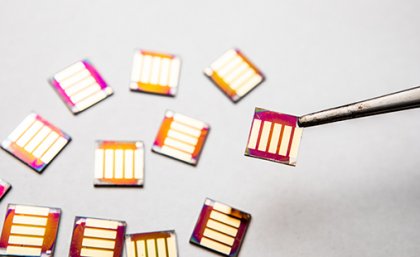
A UQ team have developed quantum dot solar cells that can be made into thin, flexible films and used to generate electricity even in low-light conditions

Researchers have set a world record for the conversion of solar energy to electricity via the use of tiny nanoparticles called ‘quantum dots’. The technology has a huge range of potential applications, including the possibility to use it as a flexible, transparent skin to power cars, planes, homes and wearable technology.

The development of next generation solar power technology that has potential to be used as a flexible ‘skin’ over hard surfaces has moved a step closer, thanks to a significant breakthrough at The University of Queensland.

UQ researchers set a world record for the conversion of solar energy to electricity via...

Read More

More Stable Light comes from intentionally ‘Squashed’ Quantum Dots

Novel colloidal quantum dots are formed of an emitting cadmium/selenium (Cd/Se) core enclosed into a compositionally graded CdxZn1-xSe shell wherein the fraction of zinc versus cadmium increases towards the dot’s periphery. Due to a directionally asymmetric lattice mismatch between CdSe and ZnSe, the core, at top right, is compressed more strongly perpendicular to the crystal axis than along it. This leads to modifications of the electronic structure of the CdSe core, which beneficially affects its light-emission properties. Bottom image: Experimental traces of emission intensity from a conventional quantum dot (upper panel) and a novel asymmetrically compressed quantum dot (lower panel) resolved spectrally and temporally...
Read More

Eco-friendly Nanoparticles for Artificial Photosynthesis

This is a schematic representation of photocatalytic hydrogen production with InP/ZnS quantum dots in a typical assay. Credit: Shan Yu

This is a schematic representation of photocatalytic hydrogen production with InP/ZnS quantum dots in a typical assay.
Credit: Shan Yu

Researchers at the University of Zurich have developed a nanoparticle type for novel use in artificial photosynthesis by adding zinc sulfide on the surface of indium-based quantum dots. These quantum dots produce clean hydrogen fuel from water and sunlight – a sustainable source of energy. They introduce new eco-friendly and powerful materials to solar photocatalysis.

Quantum dots are true all-rounders. These material structures, which are only a few nanometers in size, display a similar behavior to that of molecules or atoms, and their form, size and number of electrons can be modulated systematically...

Read More

Quantum Dots enhance Light-to-Current Conversion in layered Semiconductors

Single nanocrystal spectroscopy identifies the interaction between zero-dimensional CdSe/ZnS nano crystals (quantum dots) and two-dimensional layered tin disulfide as a non-radiative energy transfer, whose strength increases with increasing number of tin disulfide layers. Such hybrid materials could be used in optoelectronic devices such as photovoltaic solar cells, light sensors, and LEDs. Credit: Brookhaven National Laboratory

Single nanocrystal spectroscopy identifies the interaction between zero-dimensional CdSe/ZnS nano crystals (quantum dots) and two-dimensional layered tin disulfide as a non-radiative energy transfer, whose strength increases with increasing number of tin disulfide layers. Such hybrid materials could be used in optoelectronic devices such as photovoltaic solar cells, light sensors, and LEDs. Credit: Brookhaven National Laboratory

It paves the way for better optoelectronic apps eg energy-harvesting photovoltaics, light sensors, LEDs. Scientists combined excellent light-harvesting properties of quantum dots with the tunable electrical conductivity of a layered tin disulfide semiconductor...

Read More