
quantum gravity tagged posts

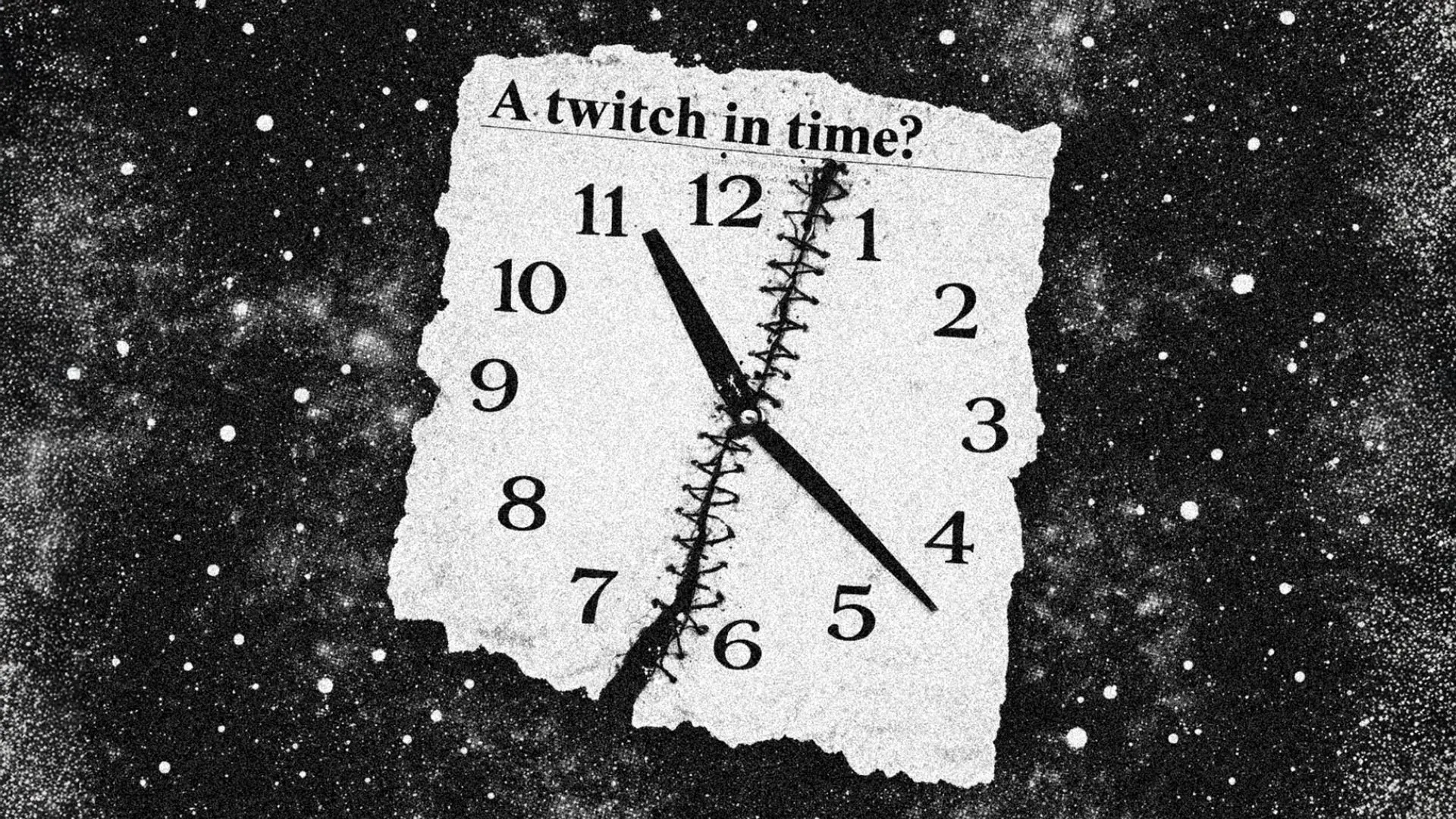
Physicists just found a tiny glitch in time itself

Quantum physics may place a fundamental limit on clock precision, hinting that time itself is not perfectly precise. Unconventional quantum theories may imply that time itself has a tiny fundamental uncertainty, placing an ultimate limit on how precisely any clock could measure it. The effect is far beyond current detection, but it could reveal a hidden connection between quantum mechanics, gravity, and spacetime.

Quantum mechanics has always challenged our everyday understanding of reality. In the quantum world, particles can exist in a superposition of states, meaning they can occupy multiple possible positions or configurations at the same time. Physicists describe these possibilities mathematically using a wavefunction.

That picture is very different from ordinary life, wher...

Read More

Our Brains use Quantum Computation

Scientists from Trinity believe our brains could use quantum computation after adapting an idea developed to prove the existence of quantum gravity to explore the human brain and its workings. The discovery may shed light on consciousness, the workings of which remain scientifically difficult to understand and explain. Quantum brain processes could also explain why we can still outperform supercomputers when it comes to unforeseen circumstances, decision-making, or learning something new.

The brain functions measured were also correlated to short-term memory performance and conscious awareness, suggesting quantum processes are also part of cognitive and conscious brain functions.

If the team’s results can be confirmed – likely requiring advanced multidisciplinary approaches -the...

Read More

New Math Bridges Holography and Twistor Theory

Yasha Neiman grapples with complex conundrums in quantum gravity on a daily basis. Credit: OIST

Yasha Neiman grapples with complex conundrums in quantum gravity on a daily basis. Credit: OIST

A new perspective bridges two approaches to understanding quantum gravity. “As we learn more, reality becomes ever more subtle; the absolute becomes relative, the fixed becomes dynamical, the definite is laden with uncertainty,” writes physicist Yasha Neiman. A professor and head of the Quantum Gravity Unit at the Okinawa Institute of Science and Technology Graduate University (OIST), he grapples with this conundrum on a daily basis. Quantum gravity, Neiman’s branch of physics, aims to unify quantum mechanics, which describes nature at the scale of atoms and subatomic particles, with Einstein’s theory of General Relativity – the modern theory of gravitation as curvature of space and time...

Read More

The Universe, where Space-Time becomes Discrete

Harmonic oscillator device is shown. Credit: LENS. Florence, Italy

Harmonic oscillator device is shown. Credit: LENS. Florence, Italy

Relativity and quantum mechanics: A non-local union? A theoretical study has analyzed a model that saves special relativity and reconciles it with granularity by introducing small-scale deviations from the principle of locality demonstrating that it can be experimentally tested with great precision.

Our experience of space-time is that of a continuous object, without gaps or discontinuities, just as it is described by classical physics. For some quantum gravity models however, the texture of space-time is “granular” at tiny scales (below the so-called Planck scale, 10-33 cm), as if it were a variable mesh of solids and voids (or a complex foam)...

Read More