

Quantum information is notoriously fragile. Internet traffic is anything but. Yet Northwestern University scientists have demonstrated they can peacefully coexist inside the same fiber-optic cable.
In a new...
Read More

July 23, 2026,
 Technology/Electronics, Physics
Quantum information is notoriously fragile. Internet traffic is anything but. Yet Northwestern University scientists have demonstrated they can peacefully coexist inside the same fiber-optic cable.
In a new...
Read More
May 11, 2026,
Physics, Technology/Electronics
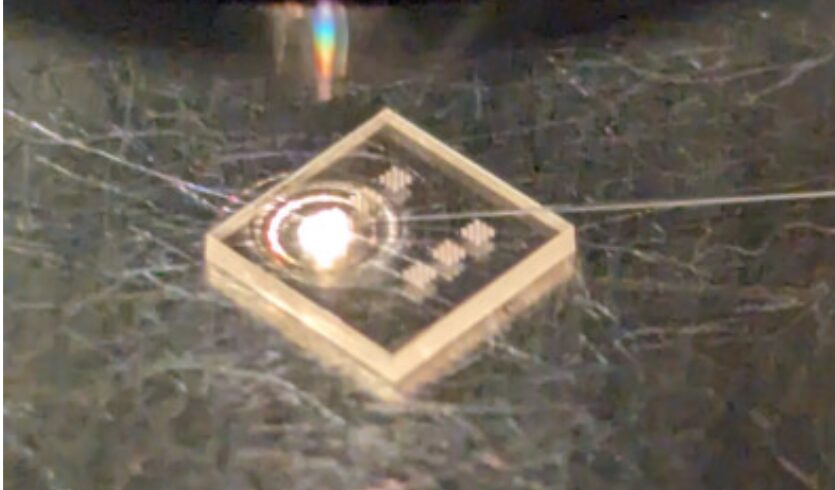
Researchers at the Harvard John A. Paulson School of Engineering and Applied Sciences (SEAS) have demonstrated, for the first time, a single quantum of vibrational energy interacting with a single atomic spin, seeding a pathway to quantum technologies that use sound as an information carrier, instead of light or electricity. The results are published in Nature.
Led by Marko Lončar, the Tiantsai Lin Professor of Electrical Engineering, the researchers engineered a nanometer-scale mechanical resonator around a single color-center spin qubit in diamond...
Read More
September 5, 2020,
Physics, Technology/Electronics
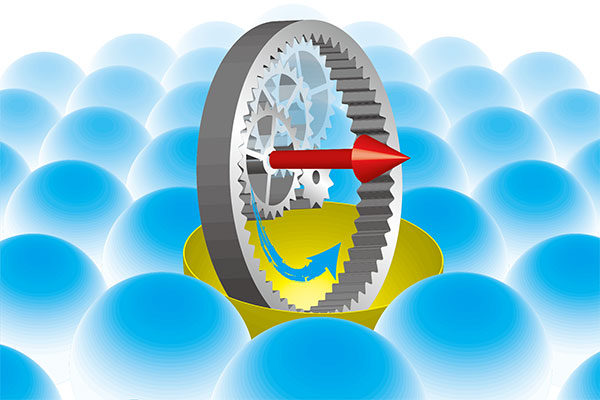
Quantum bits, or -qubits, can hold quantum information much longer now thanks to efforts by an international research team. The researchers have increased the retention time, or coherence time, to 10 milliseconds – 10,000 times longer than the previous record – by combining the orbital motion and spinning inside an atom...
Read More
July 11, 2019,
Physics, Technology/Electronics
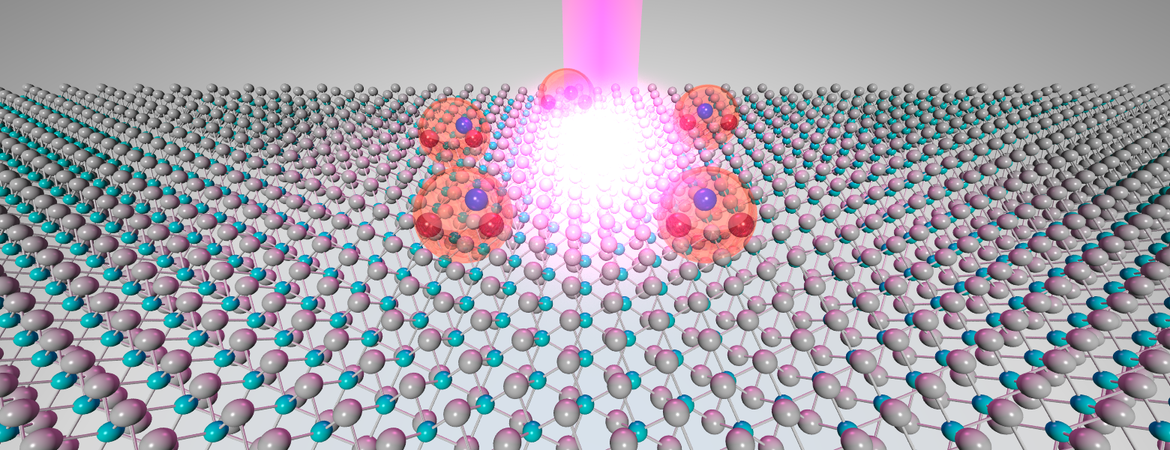
Team identifies dark trions as the next carrier of quantum information. Move aside, electrons; it’s time to make way for the trion. A research team led by physicists at the University of California, Riverside, has observed, characterized, and controlled dark trions in a semiconductor – ultraclean single-layer tungsten diselenide (WSe2) – a feat that could increase the capacity and alter the form of information transmission.
In a semiconductor, such as WSe2, a trion is a quantum bound state of three charged particles. A negative trion contains two electrons and one hole; a positive trion contains two holes and one electron...
Read More
Recent Comments