quantum mechanics. tagged posts

Light-matter hybrids form supersolid quantum state at room temperature

A new quantum state of matter works at room temperature
A supersolid is an extraordinary state of matter that combines superfluidity with the spontaneous formation of a periodic, crystal-like structure. Credit: Marcin Muszyński, Faculty of Physics, University of Warsaw

Researchers from the Faculty of Physics at the University of Warsaw, the Military University of Technology (Poland), IBM Research Zurich and the French National Centre for Scientific Research (CNRS) have observed a new quantum state of matter known as a supersolid in an exciton-polariton Bose-Einstein condensate. Remarkably, the phenomenon occurs not at temperatures close to absolute zero, but at room temperature. The results have been published in Science Advances.

How can a liquid also be a crystal?
At first glance, this seems impossible...
Read More

Rare ultra-magnetic star may be key to solving 90-year old quantum cold case

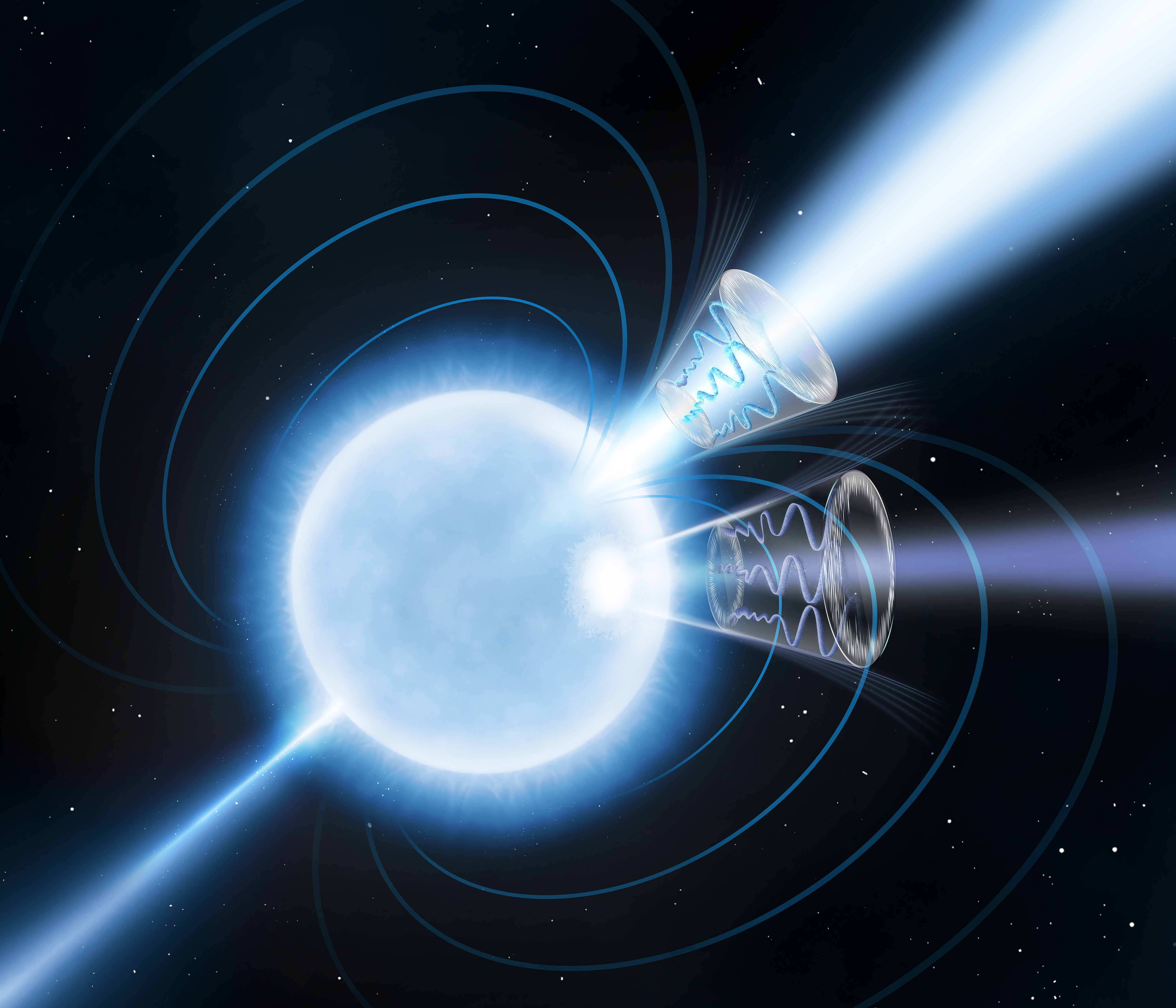
A Swinburne astronomer may have just confirmed one of the quirkiest aspects of quantum mechanics: that seemingly empty space can alter the behaviour of light. Image supplied via NASA.

Astronomers may have just confirmed one of the quirkiest aspects of quantum mechanics: that seemingly empty space can alter the behavior of light. This phenomenon, called “vacuum birefringence,” was first predicted nearly 90 years ago by Werner Heisenberg, one of the founding fathers of quantum mechanics. He suggested that even a perfect vacuum should be teeming with “virtual particles” that rapidly pop in and out of existence.

The astronomers, including Dr Marcus Lower from Swinburne University of Technology, used the properties of a magnetar—a rare type of neutron star with the strongest magnetic fie...

Read More

Research Breakthrough means Warp Speed ‘Unruh Effect’ can finally be Tested in Lab Settings

Discovery advances understanding of theory of relativity and quantum. A major hurdle for work at the forefront of fundamental physics is the inability to test cutting-edge theories in a laboratory setting. But a recent discovery opens the door for scientists to see ideas in action that were previously only understood in theory or represented in science fiction.

One such theory is on the Unruh effect. When astronauts in a spacecraft undergo super strong acceleration and see the light of stars stream by, then the Unruh effect is an additional warm glow on top of the streaming light. First predicted by Canadian physicist Bill Unruh, this effect is closely related to the glow from black holes predicted by Stephen Hawking...

Read More