quantum mechanics tagged posts

Physicists just found a tiny glitch in time itself

Quantum physics may place a fundamental limit on clock precision, hinting that time itself is not perfectly precise. Unconventional quantum theories may imply that time itself has a tiny fundamental uncertainty, placing an ultimate limit on how precisely any clock could measure it. The effect is far beyond current detection, but it could reveal a hidden connection between quantum mechanics, gravity, and spacetime.

Quantum mechanics has always challenged our everyday understanding of reality. In the quantum world, particles can exist in a superposition of states, meaning they can occupy multiple possible positions or configurations at the same time. Physicists describe these possibilities mathematically using a wavefunction.

That picture is very different from ordinary life, wher...

Read More

Physicists just found a way to make “something from nothing”

AI generated image of a pair of tornadoes
AI generated image of a pair of tornadoes. DeepAI.

Researchers at UBC have found a way to mimic the elusive Schwinger effect using superfluid helium, where vortex pairs appear out of thin films instead of electron-positron pairs in a vacuum. Their work not only offers a cosmic laboratory for otherwise unreachable phenomena, but also changes the way scientists understand vortices, superfluids, and even quantum tunneling.

In 1951, physicist Julian Schwinger theorized that by applying a uniform electrical field to a vacuum, electron-positron pairs would be spontaneously created out of nothing, through a phenomenon called quantum tunneling.

The problem with turning the matter-out-of-nowhere theory into Star Trek replicators or transporters? Enormously high electric fields would be re...

Read More

Discovery of New Class of Particles could take Quantum Mechanics One Step Further

Discovery of new of particles could take quantum mechanics one step further
Excitonic pairing and fractional quantum Hall effect in quantum Hall bilayer. Credit: Naiyuan J. Zhang et al,

Amid the many mysteries of quantum physics, subatomic particles don’t always follow the rules of the physical world. They can exist in two places at once, pass through solid barriers and even communicate across vast distances instantaneously. These behaviors may seem impossible, but in the quantum realm, scientists are exploring an array of properties once thought impossible.

In a new study, physicists at Brown University have now observed a novel class of quantum particles called fractional excitons, which behave in unexpected ways and could significantly expand scientists’ understanding of the quantum realm.

“Our findings point toward an entirely new class of quantum pa...

Read More

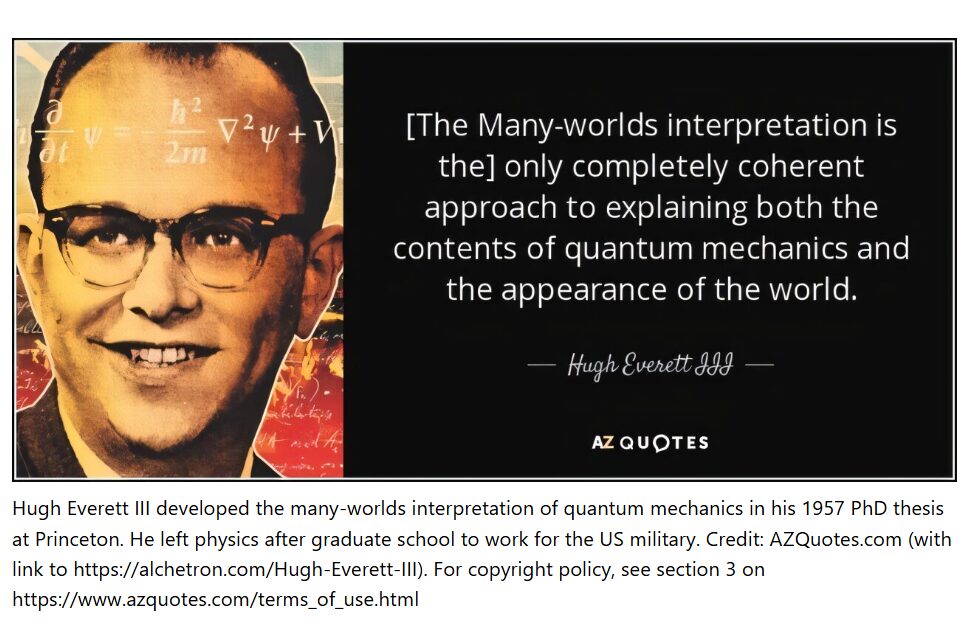
Numerical Simulations show how the Classical World might Emerge from the Many-Worlds Universes of Quantum Mechanics

Students learning quantum mechanics are taught the Schrodinger equation and how to solve it to obtain a wave function. But a crucial step is skipped because it has puzzled scientists since the earliest days—how does the real, classical world emerge from, often, a large number of solutions for the wave functions?

Each of these wave functions has its individual shape and associated energy level, but how does the wave function “collapse” into what we see as the classical world—atoms, cats and the pool noodles floating in the tepid swimming pool of a seedy hotel in Las Vegas hosting a convention of hungover businessmen trying to sell the world a better mousetrap?

At a high level, this is handled by the “Born rule”—the postulate that the probability density for finding an object ...

Read More