quantum processors tagged posts

Smart cable sharing gives quantum computers a big boost

An artist’s rendering of time multiplexing of control signals to a quantum computer.
The control signals for single-qubit gates (short blocks) and two-qubit gates (long blocks) travel through common cables (tunnels) to switches, which distribute them among the qubits (spheres) based on switching signals (diamonds). By ordering the control signals in a clever way, akin to playing Tetris, traffic jams in the flow of control signals can largely be avoided and programs on the quantum computer can be executed almost as fast as if each qubit had its own cable for control signals.
Credit: Chalmers University of Technology | Boid

A major obstacle in the development of powerful quantum computers is the growing number of cables required to control a computer as the number of qubits increases...

Read More

‘Toggle Switch’ Can Help Quantum Computers Cut Through the Noise

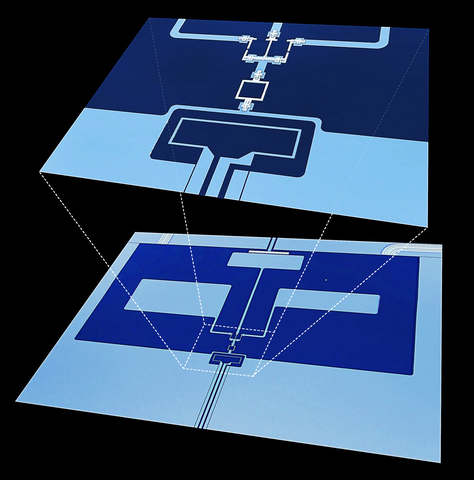
A blue-tinged drawing shows a schematic of the two qubits and resonator above a white rectangle, which represents the SQUID device that controls the connections and relationships among the qubits and resonator elements.
This photo shows the central working region of the device. In the lower section, the three large rectangles (light blue) represent the two quantum bits, or qubits, at right and left and the resonator in the center. In the upper, magnified section, driving microwaves through the antenna (large dark-blue rectangle at bottom) induces a magnetic field in the SQUID loop (smaller white square at center, whose sides are about 20 micrometers long). The magnetic field activates the toggle switch. The microwaves’ frequency and magnitude determine the switch’s position and strength of connection among the qubits and resonator.
Credit: R. Simmonds/NIST

The novel device could lead to more versatile quantum processors with clearer outputs...

Read More