
Quasars tagged posts

Hidden Supermassive Black Holes reveal their Secrets through Radio Signals

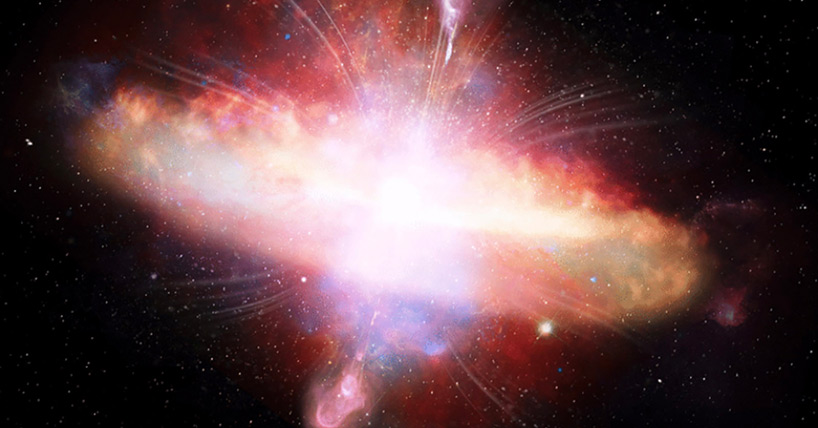
An artist’s impression of a red quasar. Red quasars are enshrouded by gas and dust, which may get blown away by outflows from the supermassive black hole, eventually revealing a typical blue quasar.
Credit: S. Munro & L. Klindt
Licence: Attribution (CC BY 4.0)
I think this is the strongest evidence so far that red quasars are a key element in how galaxies evolve
Dr Victoria Fawcett

Astronomers have found a striking link between the amount of dust surrounding a supermassive black hole and the strength of the radio emission produced in extremely bright galaxies. The findings are published in the Monthly Notices of the Royal Astronomical Society.

The team of international astronomers, led by Newcastle University and Durham University, UK, used new data from the Dark Energy Spectroscopic Instrument (DESI), which is conducting a five year survey of large scale structure in the universe that will include optical spectra for ~3 million quasars; extremely bright galaxies powered by supermassive black holes...

Read More
Cracking a Mystery of Massive Black Holes and Quasars with Supercomputer Simulations

Distribution of gas across scales, with the gas density increasing from purple to yellow. The top left panel shows a large region containing tens of galaxies (6 million light-years across). Subsequent panels zoom in progressively into the nuclear region of the most massive galaxy and down to the vicinity of the central supermassive black hole. Gas clumps and filaments fall from the inner edge of the central cavity occasionally feeding the black hole. Credit: Anglés-Alcázar et al. 2021, ApJ, 917, 53.
Distribution of gas across scales, with the gas density increasing from purple to yellow. The top left panel shows a large region containing tens of galaxies (6 million light-years across). Subsequent panels zoom in progressively into the nuclear region of the most massive galaxy and down to the vicinity of the central supermassive black hole. Gas clumps and filaments fall from the inner edge of the central cavity occasionally feeding the black hole.
(Credit: Anglés-Alcázar et al. 2021, ApJ, 917, 53.)

Cracking a mystery of massive black holes and quasars with supercomputer simulations. At the center of galaxies, like our own Milky Way, lie massive black holes surrounded by spinning gas...

Read More

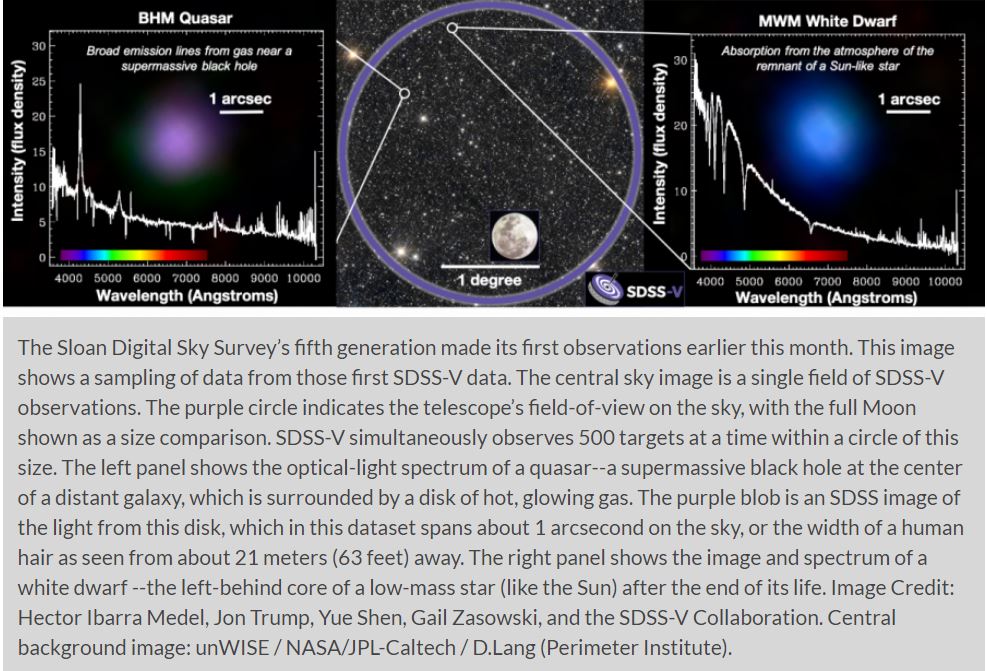
Digital Sky Survey maps the entire sky, providing new data to astronomers

The fifth generation of the Sloan Digital Sky Survey is collecting data about our universe for Vanderbilt University astronomers and other project members to use to explore the formation of distant galaxies and supermassive black holes, and to map the Milky Way.

The SDSS-V will make full use of existing satellites, including NASA’s Transiting Exoplanet Survey Satellite mission, to lead to new discoveries. Keivan Stassun, Stevenson Professor of Physics and Astronomy, is co-investigator of NASA TESS, which enabled the discovery of a newly formed exoplanet in June 2020. That discovery boosted the potential for a joint effort with SDSS data.

“SDSS-V will magnify the exoplanet discoveries from TESS, both retrospectively and prospectively,” Stassun said...

Read More

Feeding a Galaxy’s Nuclear Black Hole

A near-infrared Hubble image of the luminous, barred spiral galaxy ESO320-G030. Infrared observations and modeling of over a dozen molecular species at its center reveal massive inflows of gas to a nuclear region undergoing a burst of star formation and dominated by three-components, a small warm core, a disk, and an outer envelope.
NASA/HST; Alonso-Herrero et al.

A galactic bar is the approximately linear structure of stars and gas that stretches across the inner regions of some galaxies. The bar stretches from one inner spiral arm, across the nuclear region, to an arm on the other side...

Read More