During its April 20, 2025, encounter with the main-belt asteroid Donaldjohanson, NASA’s Lucy spacecraft discovered evidence for iron-rich clays on the surface using its infrared spectrometer. These clays, which are similar to those found in carbon-rich meteorites such as QUE 97990, indicate that water was briefly present in the asteroid during the distant past. NASA/Goddard/SwRI/Dan Gallagher
A bizarre wobbling asteroid revealed by NASA’s Lucy mission is exposing hidden clues about ancient water, cosmic collisions, and the origins of the solar system. NASA’s Lucy spacecraft discovered that asteroid Donaldjohanson is a wobbling, peanut-shaped relic born from a violent collision and slowly reshaped by the subtle force of sunlight...
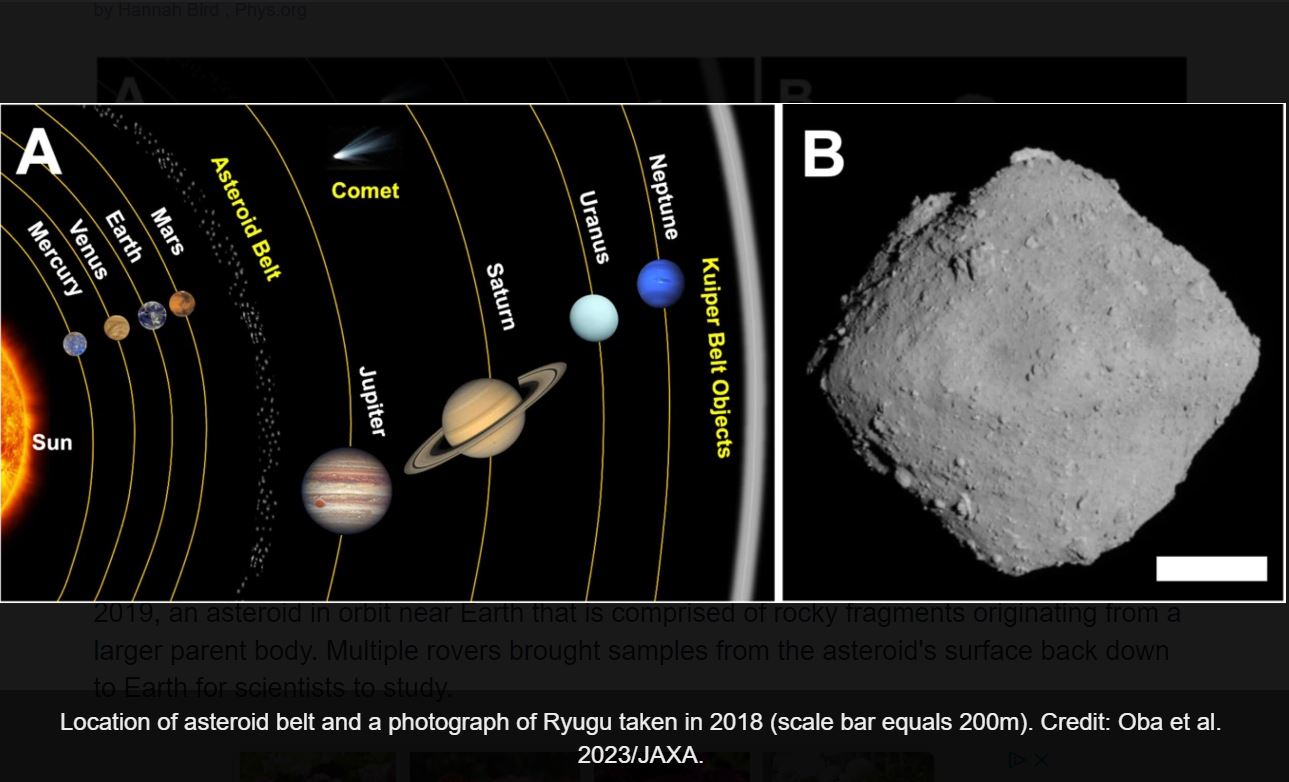
Japan’s Aerospace Exploration Agency sent the Hayabusa2 spacecraft to 162173 Ryugu in 2019, an asteroid in orbit near Earth that is comprised of rocky fragments originating from a larger parent body. Multiple rovers brought samples from the asteroid’s surface back down to Earth for scientists to study.
The samples are indicative of chemically primitive meteorites, similar to Ivuna-type chondrites, and contain particular chemical compounds that suggest the presence of water. In particular, alterations of the asteroid’s surface by water on the parent body, at estimated temperatures up to 150°C, produced secondary minerals (including phyllosilicates, carbonates, sulfides and oxides) and the researchers aimed to understand the timescale and conditions over which these changes occurred...
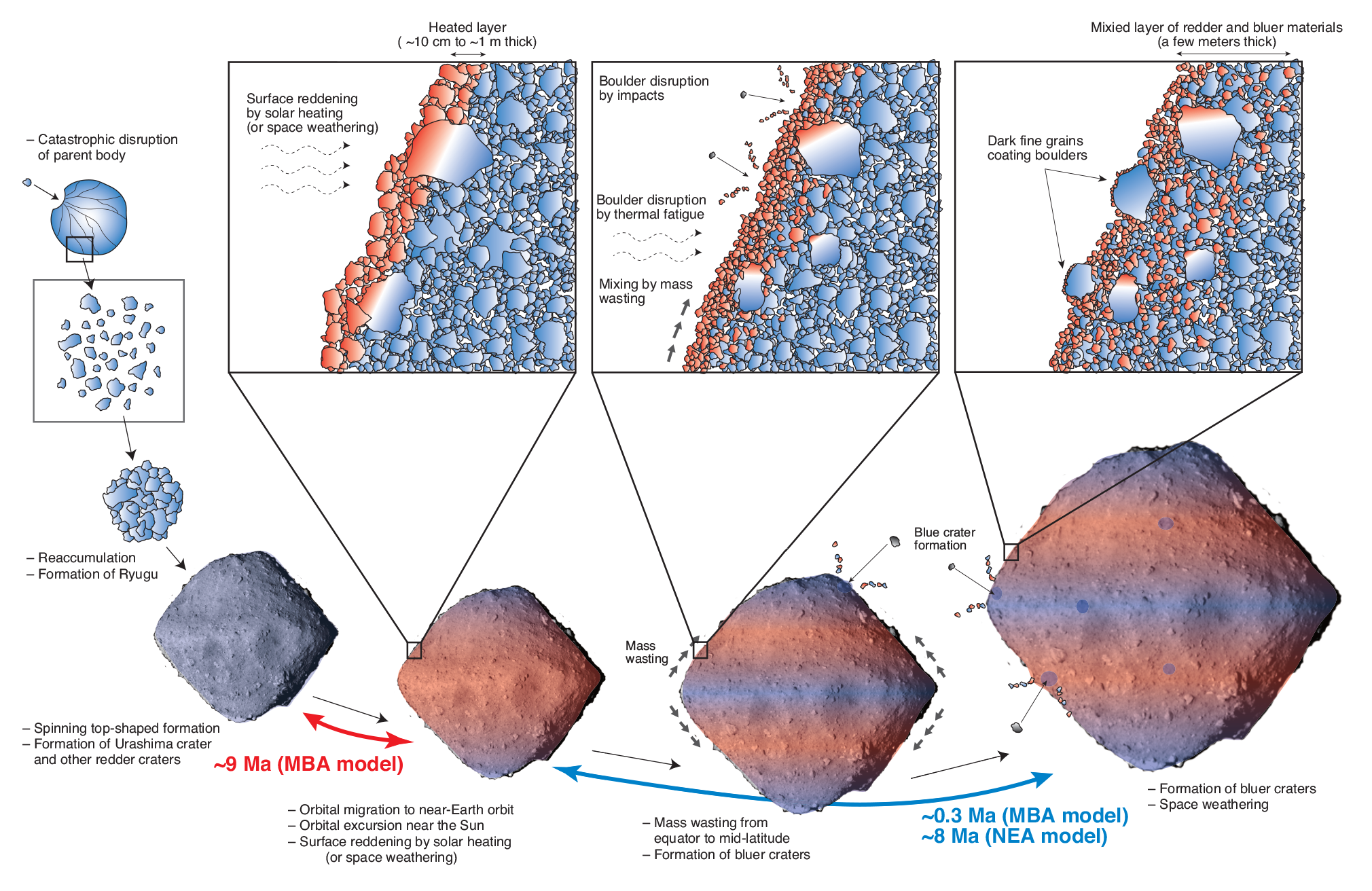
Ryugu’s interaction with the sun changes what we know about asteroid history. In February and July of 2019, the Hayabusa2 spacecraft briefly touched down on the surface of near-Earth asteroid Ryugu. The readings it took with various instruments at those times have given researchers insight into the physical and chemical properties of 1-kilometer-wide asteroid. These findings could help explain the history of Ryugu and other asteroids, as well as the solar system at large.
When our solar system formed around 5 billion years ago, most of the material it formed from became the sun, and a fraction of a percent became the planets and solid bodies, including asteroids...





Recent Comments