A huge storm dominates the rather featureless surface of Saturn in an image taken by the Cassini spacecraft on Feb. 25, 2011, about 12 weeks after the powerful storm was first detected in the planet’s northern hemisphere. The megastorm is seen overtaking itself as it encircles the entire planet. Astronomers have found deep in the atmosphere the aftereffects of megastorms that occurred hundreds of years ago. The dark stripes are the shadows of Saturn’s rings. NASA/JPL/Space Science Institute
Megastorms leave marks on Saturn’s atmosphere for centuries. They regularly appear on Saturn, marring the relatively bland surface before disappearing. But radio observations show that the storms have long-lasting effects deeper in the atmosphere, in particular in the distribution of ammonia...
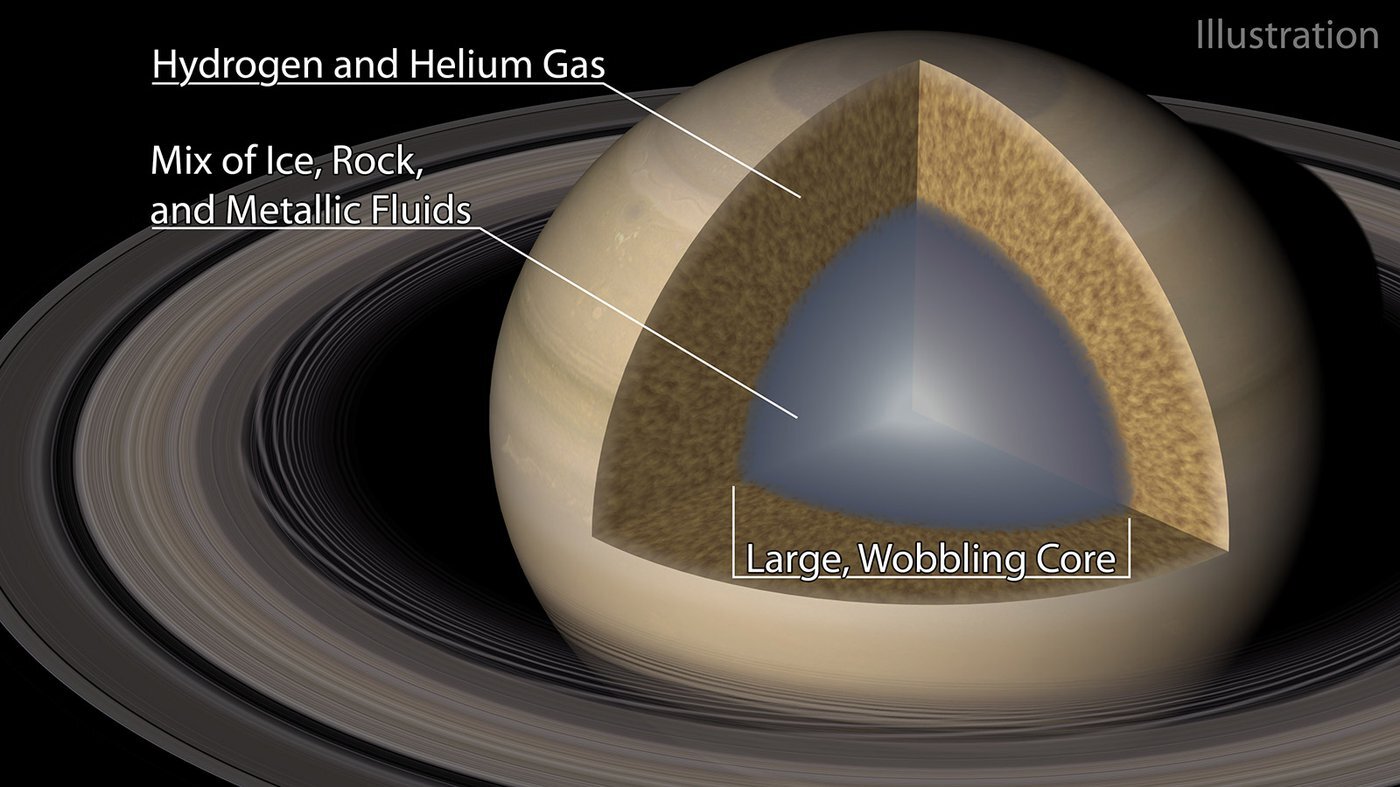
An illustration of Saturn and its “fuzzy” core. Credit: Caltech/R. Hurt (IPAC)
In the same way that earthquakes cause our planet to rumble, oscillations in the interior of Saturn make the gas giant jiggle around ever so slightly. Those motions, in turn, cause ripples in Saturn’s rings.
In a new study accepted in the journal Nature Astronomy, two Caltech astronomers have analyzed those rippling rings to reveal new information about the core of Saturn. For their study, they used older data captured by NASA’s Cassini, a spacecraft that orbited the ringed giant for 13 years before it dove into the planet’s atmosphere and disintegrated in 2017.
The findings suggest that the planet’s core is not a hard ball of rock, as some previous theories had proposed, but a diffuse soup of ice, roc...
Latest data on Jupiter and Saturn from Juno and Cassini missions challenge current theories of planetary formation. The latest data sent back by the Juno and Cassini spacecraft from giant gas planets Jupiter and Saturn have challenged a lot of current theories about how planets in our solar system form and behave.
The detailed magnetic and gravity data have been “invaluable but also confounding,” said David Stevenson from Caltech, who will present an update of both missions this week at the 2019 American Physical Society March Meeting in Boston.
“Although there are puzzles yet to be explained, this is already clarifying some of our ideas about how planets form, how they make magnetic fields and how the winds blow,” Stevenson said.
Scientists have shown that water is likely to be a major component of those exoplanets (planets orbiting other stars) which are between 2 to 4X the size of Earth. It will have implications for the search of life in our Galaxy. The work is presented at the Goldschmidt conference in Boston.
The 1992 discovery of exoplanets orbiting other stars has sparked interest in understanding the composition of these planets to determine, among other goals, whether they are suitable for the development of life. Now a new evaluation of data from the exoplanet-hunting Kepler Space Telescope and the Gaia mission indicates that many of the known planets may contain as much as 50% water. This is much more than the Earth’s 0.02% (by weight) water content...






Recent Comments