
shock wave tagged posts

More than 120 molecular species found in giant cloud near Milky Way’s center

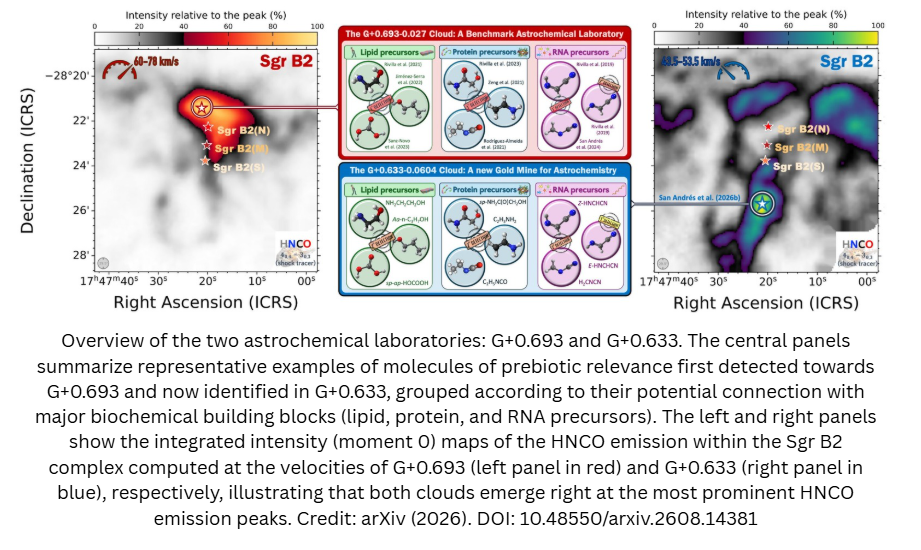
Astronomers have discovered a second interstellar cloud near the center of the Milky Way that is extraordinarily rich in complex molecules, including several molecules associated with prebiotic chemistry. The newly studied cloud, G+0.633-0.0604, or G+0.633, contains more than 120 identified molecular species and is the first confirmed chemical twin of another famous molecule-rich cloud. Their paper, posted to the arXiv preprint server on Aug. 14, outlines the chemistry of the newfound cloud.

Under the right conditions
Finding molecules in space isn’t new. So far, astronomers have found almost 350 different molecules in interstellar space...

Read More

Second Strongest Shock Wave found in Merging Galaxy Clusters

On our star, the Sun, the sunspots are seen in a belt around the equator. Sunspots are cool areas caused by the strong magnetic fields where the flow of heat is slowed. Credit: NASA

On our star, the Sun, the sunspots are seen in a belt around the equator. Sunspots are cool areas caused by the strong magnetic fields where the flow of heat is slowed. Credit: NASA

The discovery by a physics doctoral student at The University of Alabama in Huntsville (UAH) of the 2nd-strongest merger shock in clusters of galaxies ever observed has generated excitement that is opening doors to further scientific exploration. Sarthak Dasadia discovered the very strong shock in the merging galaxy cluster Abell 655 using observations from the Chandra X-ray Observatory. The shock to the north of this cluster is second in strength only to the Bullet Cluster shock.

A distant star has been seen to spin so fast that its magnetic field erupts from its poles rather than around its equator (marked in dark red). This fast spin is an expected feature of binary stars, but its strange magnetic field has not been seen before on such a star as Zeta Andromeda

A distant star has been seen to spin so fast that its magnetic field erupts from its poles rather than around its equator (marked i...

Read More

Second Strongest Shock Wave found in Merging Galaxy Clusters

The RGB (Red Green Blue image) of the cluster. Red color shows optical radiation, Green shows Radio and Blue color shows X-rays emission. Credit: Chandra X-Ray Observatory

The RGB (Red Green Blue image) of the cluster. Red color shows optical radiation, Green shows Radio and Blue color shows X-rays emission. Credit: Chandra X-Ray Observatory

The discovery by a physics doctoral student at The University of Alabama in Huntsville (UAH) of the 2nd-strongest merger shock in clusters of galaxies ever observed has generated excitement that is opening doors to further scientific exploration. Sarthak Dasadia discovered the very strong shock in the merging galaxy cluster Abell 655 using observations from the Chandra X-ray Observatory. The shock to the north of this cluster is second in strength only to the Bullet Cluster shock.

The shock is traveling with an astonishing speed of 2,700km/s, 3X the local speed of sound in the cluster...

Read More