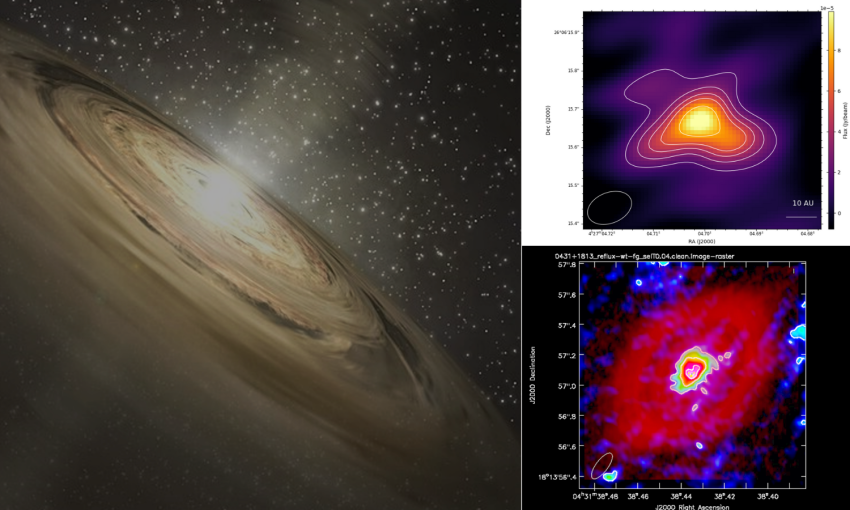
An artist’s impression of dust and tiny grains in a protoplanetary disc surrounding a young star (left) alongside an e-MERLIN map showing the tilted disc structure around the young star DG Tauri (top right) and the HL Tau disc captured by e-MERLIN is shown overlaid on an ALMA image, revealing both the compact emission from the central region of the disc and the larger scale dust rings (bottom right).
Credit NASA/JPL-Caltech/Hesterly, Drabek-Maunder, Greaves, Richards, et al./Greaves, Hesterly, Richards, and et al./ALMA partnership et al. Licence type Attribution (CC BY 4.0)
Astronomers have spotted centimeter-sized “pebbles” swirling around two infant stars 450 light-years away, revealing the raw ingredients of planets already stretching to Neptune-like orbits...
This stunning image reveals a distant galaxy cluster teeming with energy: galaxies shine in visible light (white), ghostly red clouds unveil a newly discovered radio mini-halo—the most distant ever detected—and blue wisps trace the hot gas glowing in X-rays. Credit: Chandra X-ray Center (X-ray: NASA/CXC/SAO; Optical: NASA/ESA/STScI; Radio: ASTRON/LOFAR; Image Processing: NASA/CXC/SAO/N. Wolk)
Astronomers have uncovered a vast cloud of energetic particles—a “mini halo”—surrounding one of the most distant galaxy clusters ever observed, marking a major step forward in understanding the hidden forces that shape the cosmos.
The mini-halo is at a distance so great that it takes light 10 billion years to reach Earth, making it the most distant ever found, doubling the previous dista...
Understanding how the universe transitioned from darkness to light with the formation of the first stars and galaxies is a key turning point in the universe’s development, known as the Cosmic Dawn. However, even with the most powerful telescopes, we can’t directly observe these earliest stars, so determining their properties is one of the biggest challenges in astronomy.
Now, an international group of astronomers led by the University of Cambridge has shown that we will be able to learn about the masses of the earliest stars by studying a specific radio signal—created by hydrogen atoms filling the gaps between star-forming regions—originating just a hundred million years after the Big Bang.
By studying how the first stars and their remnants affected this signal, called the 2...
A composite image of the Phantom Galaxy and (inset) a high-resolution simulation of galactic turbulence with magnetic field lines in white. Photo: ESA/Webb, NASA & CSA, J. Lee and the PHANGS-JWST Team; Acknowledgement: J. Schmidt; Simulation: J. Beattie.
“Turbulence remains one of the greatest unsolved problems in classical mechanics,” says James Beattie, a postdoctoral researcher at the Canadian Institute for Theoretical Astrophysics (CITA) in the Faculty of Arts & Science at the University of Toronto, who also holds a joint appointment at Princeton University.
“This despite the fact that turbulence is ubiquitous: from swirling milk in our coffee to chaotic flows in the oceans, solar wind, interstellar medium, even the plasma between galaxies.







Recent Comments