
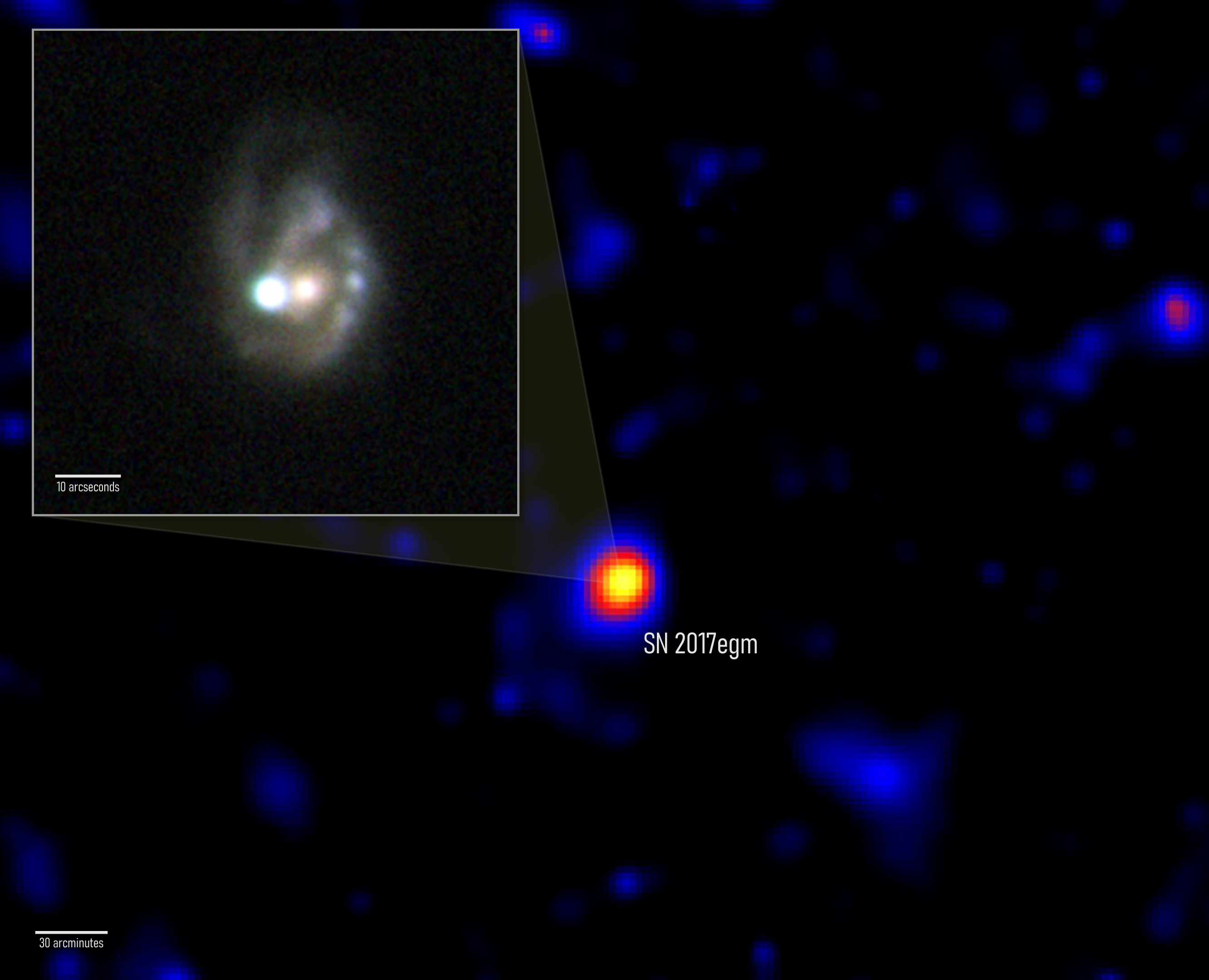
Background, NASA/DOE/Fermi LAT Collaboration and Acero et. al. 2026; inset, NOT+ALFSOC/Bose et al. 2020
NASA’s Fermi telescope has detected what may be the first confirmed gamma-ray signal from a superluminous su...
Read More

May 28, 2026,
 Astronomy/Space
NASA’s Fermi telescope has detected what may be the first confirmed gamma-ray signal from a superluminous su...
Read More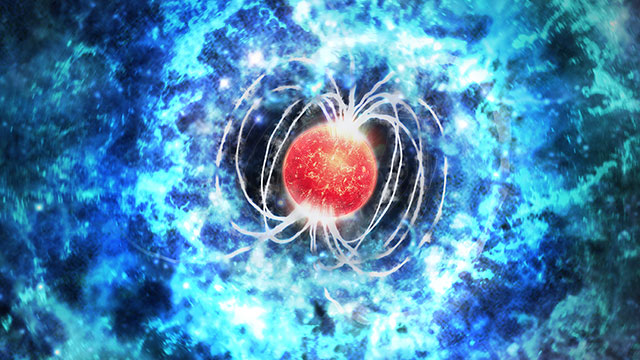
This artist’s impression of SN 2017egm shows the power source for this extraordinarily bright supernova. The explosion was triggered by a massive star that collapsed to form a neutron star with an extremely strong magnetic field and rapid spin, called a magnetar. Debris from the supernova explosion is shown in blue, and the magnetar is shown in red. (Credit: M. Weiss/CfA)
Many rock stars don’t like to play by the rules, and a cosmic one is no exception. A team of astronomers has discovered that an extraordinarily bright supernova occurred in a surprising location. This “heavy metal” supernova discovery challenges current ideas of how and where such super-charged supernovas occur. Supernovas are some of the most energetic events in the Universe...
Read More
Recent Comments