
soft robots tagged posts

Engineers discover new process for Synthetic Material Growth, enabling Soft Robots that Grow like Plants

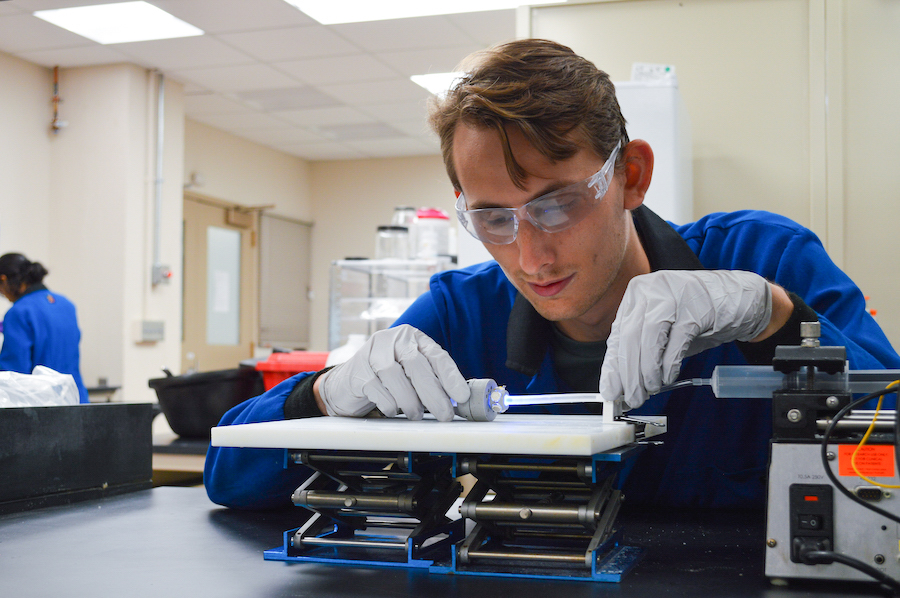
Ph.D. student Matt Hausladen with a soft robot in the lab
University of Minnesota Twin Cities researchers have developed a plant-inspired extrusion process that allows soft robots to build their own solid bodies from liquid to navigate hard-to-reach places and complicated terrain.

Soft robots can navigate hard-to-reach places like pipes or inside the human body. An interdisciplinary team of University of Minnesota Twin Cities scientists and engineers has developed a first-of-its-kind, plant-inspired extrusion process that enables synthetic material growth. The new approach will allow researchers to build better soft robots that can navigate hard-to-reach places, complicated terrain, and potentially areas within the human body.

The paper is published in the Proceedings of the National Academy of Sciences (PNAS).

“This is the first time t...

Read More

Mighty Morphing materials take complex shapes

A face made of a unique polymer at Rice University takes shape when cooled and flattens when heated. The material may be useful in the creation of soft robots and for biomedical applications.
Credit: Jeff Fitlow/Rice University

Sophisticated shape-shifters for soft robots, biomedical applications. Rice University scientists have created a rubbery, shape-shifting material that morphs from one sophisticated form to another on demand.

The shapes programmed into a polymer by materials scientist Rafael Verduzco and graduate student Morgan Barnes appear in ambient conditions and melt away when heat is applied. The process also works in reverse.

The smooth operation belies a battle at the nanoscale, where liquid crystals and the elastomer in which they’re embedded fight for control...

Read More

Novel 3D Printing method embeds sensing capabilities within Robotic Actuators

Novel 3D Printing method embeds sensing capabilities within Robotic Actuators

Novel 3D Printing method embeds sensing capabilities within Robotic Actuators

Soft robots that can sense touch, pressure, movement and temperature. Inspired by our bodies’ sensory capabilities, researchers have developed a platform for creating soft robots with embedded sensors that can sense movement, pressure, touch, and even temperature. Researchers at Harvard University have built soft robots inspired by nature that can crawl, swim, grasp delicate objects and even assist a beating heart, but none of these devices has been able to sense and respond to the world around them.

Inspired by our bodies’ sensory capabilities, researchers at the Harvard John A...

Read More

A Self-Healing Structural Color Hydrogel Inspired by Nature

A self-healing structural color hydrogel inspired by nature A set of self-healing hydrogel films with different structural colors. Credit: Yuanjin Zhao.

A self-healing structural color hydrogel inspired by nature A set of self-healing hydrogel films with different structural colors. Credit: Yuanjin Zhao.

A team of researchers at Southeast University in China has developed a self-healing structural hydrogel with a wide variety of applications. It has been noted for several years that one area where humanoid robots are lacking is skin tone—most robots have a pasty white complexion, which is both disturbing and likely to lead to social problems once robots become mainstream. Most artificial skin is not able to heal itself, which means that robots need skin replacement if it gets damaged or accidentally colored in undesirable ways. There is also the issue of colors fading...

Read More