solar cells tagged posts

Water-based zinc batteries tackle a barrier that has long blocked cheap, stable renewable energy storage

New aqueous electrolytes boost the efficiency and stability of zinc metal batteries
Dejian Dong, the first author of the article, examines a freshly prepared electrolyte sample in the laboratory. Credit: Dong et al.

Renewable energy technologies, such as solar cells and wind turbines, are becoming increasingly widespread in many countries worldwide. Reliably storing the electricity produced by these devices, so that it can be used later at times when sunlight or wind are scarce, would further improve their effectiveness as sustainable energy solutions.

A promising solution to store solar and wind energy entails the use of aqueous zinc (Zn) metal batteries. These are low-cost, safe and environmentally friendly batteries that store and release energy, leveraging water-based solutions and Zn anodes.

Despite their potential, Zn batteries have not yet achieved the de...

Read More

Solar cells made of moon dust could power future space exploration

 Overview over lunar solar energy provision strategies

The same dirt that clings to astronauts’ boots may one day keep their lights on. In a study publishing April 3 in the Cell Press journal Device, researchers created solar cells made out of simulated Moon dust. The cells convert sunlight into energy efficiently, withstand radiation damage, and mitigate the need for transporting heavy materials into space, offering a potential solution to one of space exploration’s biggest challenges: reliable energy sources.

“The solar cells used in space now are amazing, reaching efficiencies of 30% to even 40%, but that efficiency comes with a price,” says lead researcher Felix Lang of the University of Potsdam, Germany...

Read More

Researchers fabricate Phase-Heterojunction All-Inorganic Perovskite Solar Cells with an Efficiency Above 21.5%

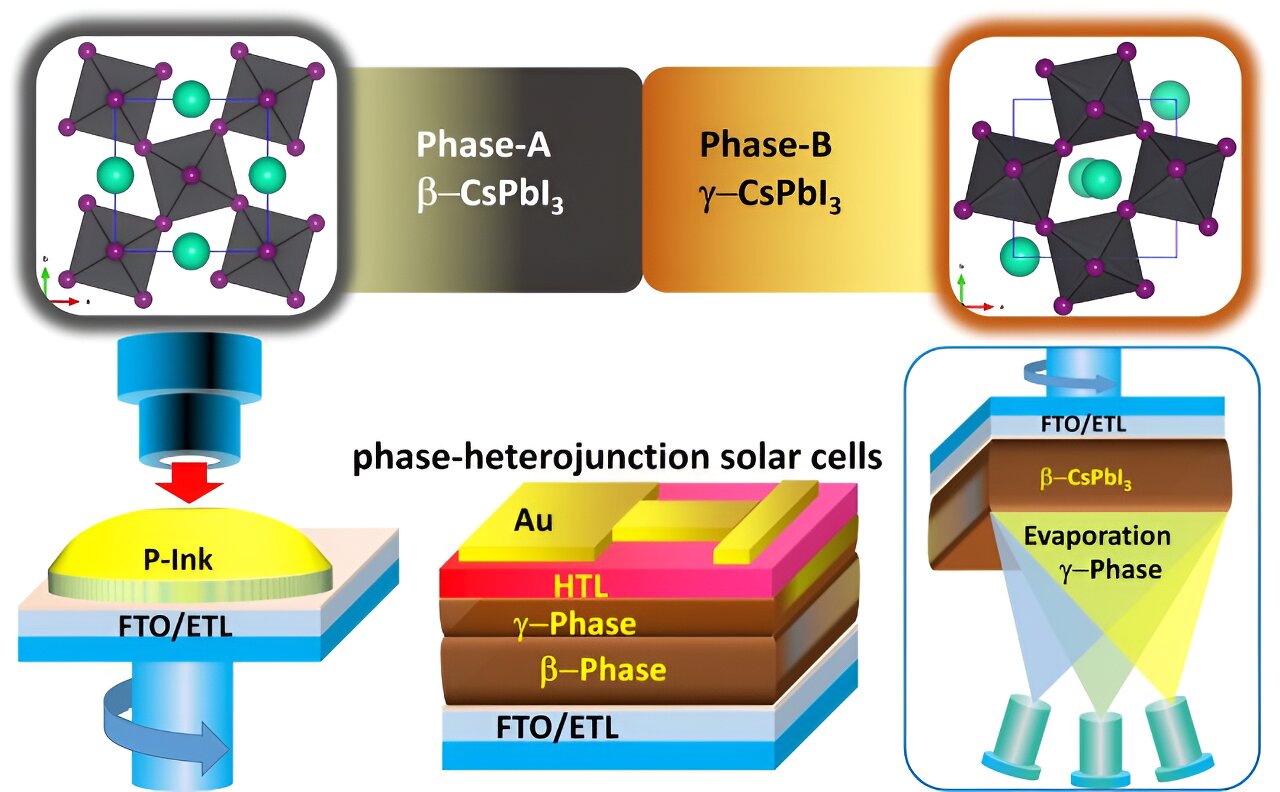
Phase-heterojunction all-inorganic perovskite solar cells with an efficiency above 21.5%
Schematic representation of fabrication of phase-heterojunction perovskite solar cells. Credit: Mali et al.

Solar technologies have become increasingly advanced over the years, with the discovery of new photovoltaic materials and designs. While solar cells based on a mixture of organic and inorganic halide perovskite materials have been the topic of numerous research studies and achieved promising performances, these cells are often difficult to fabricate on a large-scale.

Researchers at Chonnam University in South Korea recently introduced an alternative solar cell design fully based on inorganic perovskites. Their solar cells, introduced in Nature Energy, could be easier to fabricate on a large-scale, while nonetheless achieving promising power conversion efficiencies (PCEs).

“...

Read More

Solar Energy breakthrough: Perovskite cell with Greater Stability, Efficiency

Photo shows the new perovskite solar cell.
The inverted architecture of this perovskite solar cell, coupled with surface engineering, enabled researchers to improve efficiency and stability. Photo from NREL

Researchers at the U.S. Department of Energy’s (DOE’s) National Renewable Energy Laboratory (NREL) made a technological breakthrough and constructed a perovskite solar cell with the dual benefits of being both highly efficient and highly stable.

The work was done in collaboration with scientists from the University of Toledo, the University of Colorado-Boulder, and the University of California-San Diego.

A unique architectural structure enabled the researchers to record a certified stabilized efficiency of 24% under 1-sun illumination, making it the highest reported of its kind...

Read More