
solar storms tagged posts

Risks of solar storms may be underestimated, warn researchers

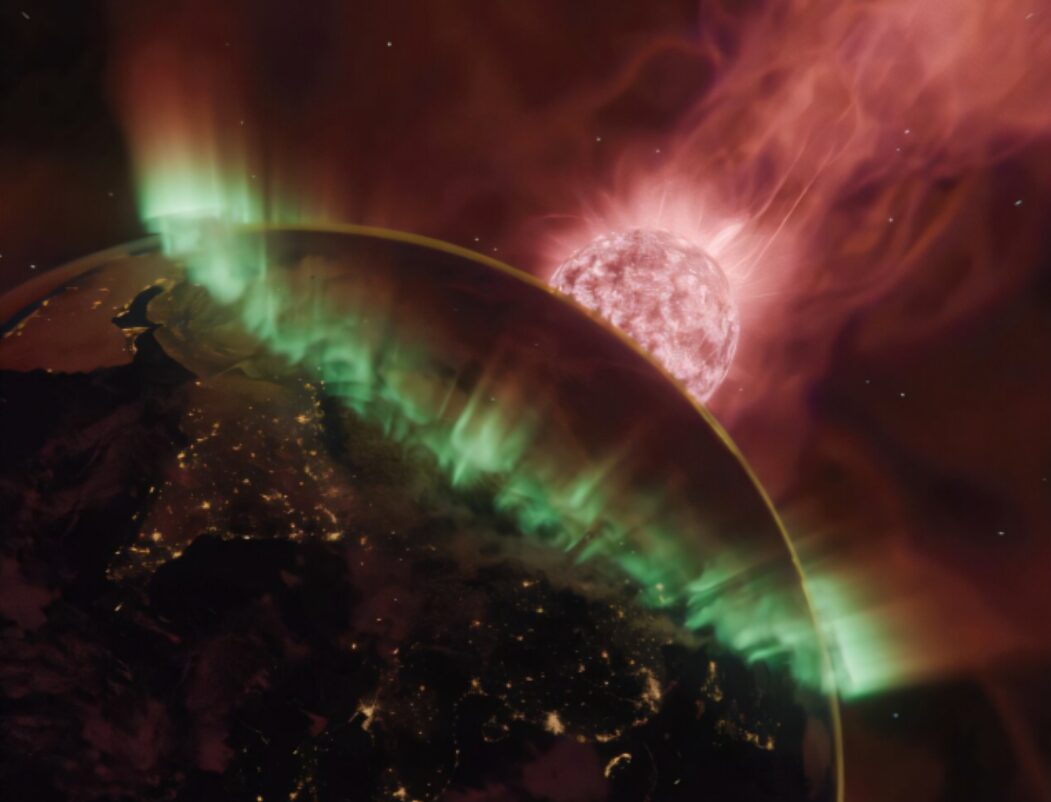
Illustration of solar wind streaming from a fuming sun drives auroras bright enough to be seen far from the poles, a dazzling signature of an extreme geomagnetic storm. Credit: Nithin Sivadas NASA Goddard Space Flight Center

The effects of extreme space weather may be larger than previously thought, research in the journal Nature reveals. The paper, titled “Regression to the mean can explain saturation of geomagnetic storms,” is led by Dr. Nithin Sivadas of NASA’s Goddard Space Flight Center and co-authored by Dr. Maria Walach from Lancaster University.

Space weather—caused by fluctuating electric fields in Earth’s magnetic field and upper atmosphere—can affect technologies on and around Earth in several ways...

Read More

Could permanent magnets protect astronauts from solar storms?

Could permanent magnets protect astronauts from solar storms?
The Orion capsule, which could have a protective magnetic field around it. Credit: NASA

Shielding astronauts from the deadly radiation they face is a central challenge for any designer of a deep-space crewed mission. Even relatively low levels of exposure over long periods can lead to everything from central nervous system damage to cancer. But current solutions, such as passive water shells or active superconducting magnets, have their own limitations. To get around those, a new paper, available in preprint on arXiv by Valerio Parisi and a team of researchers from Italy and Germany, looks at the feasibility of using a permanent magnet (and its associated permanent magnetic field) to potentially block some of that radiation without the costs of competing technologies.

First, let’s l...

Read More

New 3D map of the sun’s magnetic interior could improve predictions of disruptive solar flares

New 3D map of the sun's magnetic interior could improve predictions of disruptive solar flares
Panels (a), (b), and (c) show the 3D evolution of the toroidal field during Cycle 23 at three different times. (d) Time–latitude plot of the azimuthally averaged toroidal field that shows the equatorward migration. (e) Here, we show the contribution of the nonaxisymmetric toroidal field at different depths of the convection zone. Credit: The Astrophysical Journal Letters (2026). DOI: 10.3847/2041-8213/ae3138

For the first time, scientists have used satellite data to create a 3D map of the sun’s interior magnetic field, the fundamental driver of solar activity. The research, published in The Astrophysical Journal Letters, should enable more accurate predictions of solar cycles and space weather that affects satellites and power grids.

Magnetic star
The sun is more than just a fier...

Read More

NASA’s Parker Solar Probe aims to Fly Closer to the Sun like never before

NASA's Parker Solar Probe aims to fly closer to the sun like never before
This image made available by NASA shows an artist’s rendering of the Parker Solar Probe approaching the Sun. It’s designed to take solar punishment like never before, thanks to its revolutionary heat shield that’s capable of withstanding 2,500 degrees Fahrenheit (1,370 degrees Celsius). Credit: Steve Gribben/Johns Hopkins APL/NASA via AP, File

A NASA spacecraft aims to fly closer to the sun than any object sent before. The Parker Solar Probe was launched in 2018 to get a close-up look at the sun. Since then, it has flown straight through the sun’s corona: the outer atmosphere visible during a total solar eclipse.

The next milestone: closest approach to the sun. Plans call for Parker on Tuesday to hurtle through the sizzling solar atmosphere and pass within a record-breaking 3...

Read More