solar system tagged posts

The Collective Power of the Solar System’s Dark, Icy Bodies

Image:
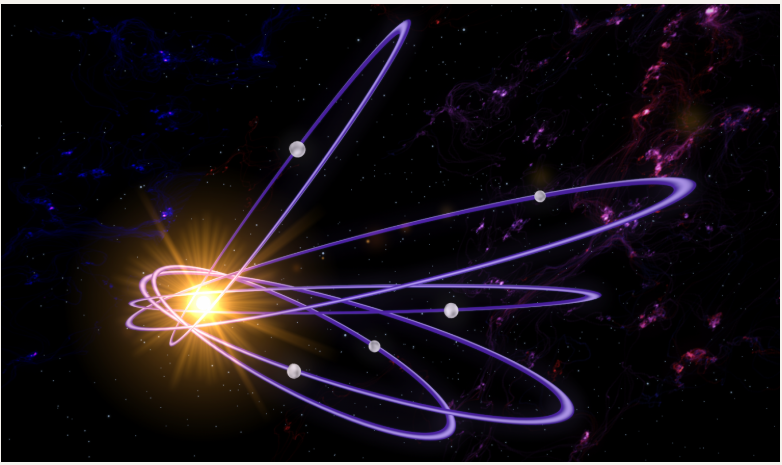
Scientists have long struggled to explain the existence of the solar system’s “detached objects,” which have orbits that tilt like seesaws and often cluster in one part of the night sky. (Credit: Steven Burrows/JILA)

Two new studies by researchers at the University of Colorado Boulder may help to solve one of the biggest mysteries about the dark, icy bodies of the outer solar system: why so many of them don’t circle the sun the way they should.

The outermost reaches of our solar system are a strange place – filled with dark and icy bodies with nicknames like Sedna, Biden and The Goblin, each of which span several hundred miles across.

The orbits of these planetary oddities, which scientists call “detached objects,” tilt and buckle out of the plane of the solar system, amon...

Read More

How the Solar System got its ‘Great Divide,’ and why it matters for Life on Earth

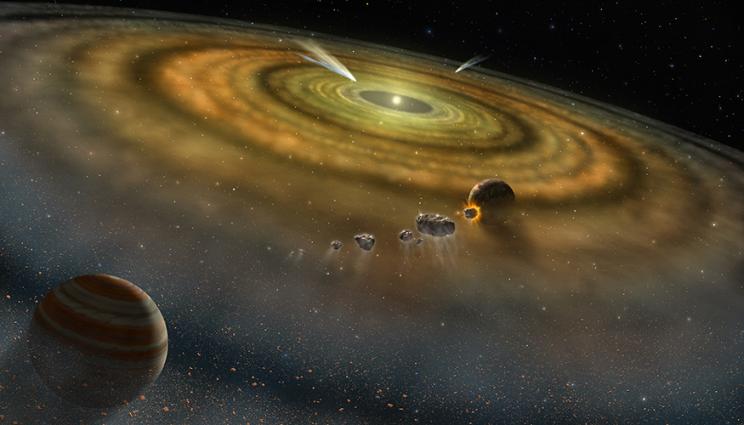
An orrery, a type of device once used to track the movements of the planets, sitting above an infrared image of a hypothetical "protoplanetary" disk that may have divided the solar system early in its history.
An orrery, a type of device once used to track the movements of the planets, sitting above an infrared image of a hypothetical “protoplanetary” disk that may have divided the solar system early in its history. (Credit: K. Ebert/Innovative Ideas & Methods)

Scientists, including those from the University of Colorado Boulder, have finally scaled the solar system’s equivalent of the Rocky Mountain range. In a study published in Nature Astronomy, researchers from the United States and Japan unveil the possible origins of our cosmic neighborhood’s “Great Divide.” This well-known schism may have separated the solar system just after the sun first formed.

The phenomenon is a bit like how the Rocky Mountains divide North America into east and west...

Read More

New Evidence on the Formation of the Solar System

Supercomputer model of a low-mass supernova. Credit: Bernhard Mueller, MNRAS 453, 287-310 (2015)

Supercomputer model of a low-mass supernova. Credit: Bernhard Mueller, MNRAS 453, 287-310 (2015)

International research is using new computer models and evidence from meteorites to show that a low-mass supernova triggered the formation of our solar system. The research is published in the most recent issue of leading scientific journal Nature Communications.About 4.6 billion years ago, a cloud of gas and dust that eventually formed our solar system was disturbed. The ensuing gravitational collapse formed the proto-Sun with a surrounding disc where the planets were born. A supernova – a star exploding at the end of its life-cycle –would have enough energy to induce the collapse of such a gas cloud.

“Before this model there was only inconclusive evidence to support this theory,” said Prof Al...

Read More