
Star clusters tagged posts

Self-regulating process governs cosmic order inside star clusters

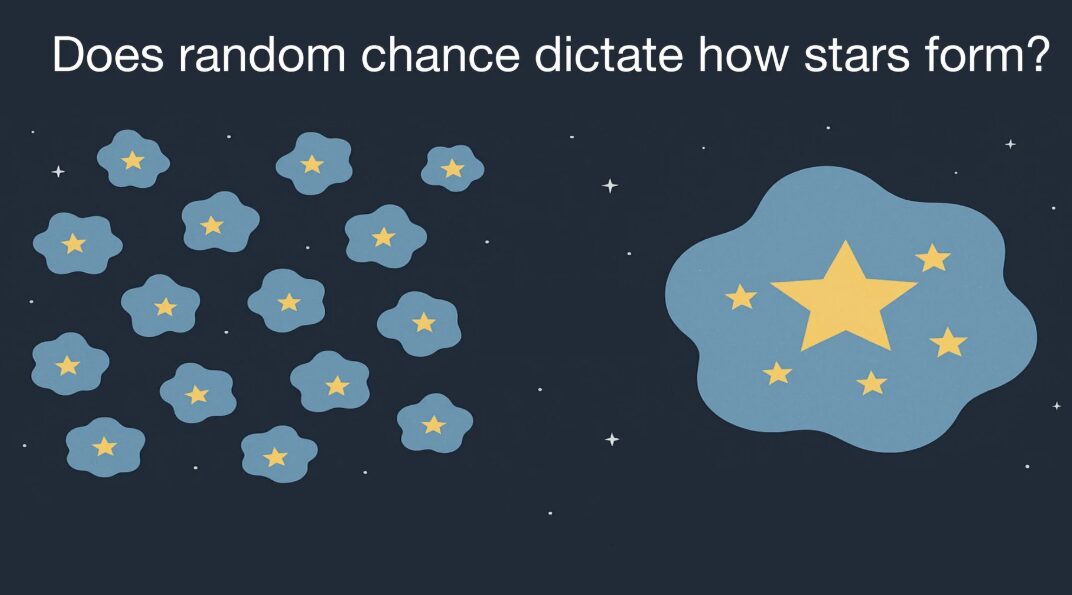
A large number of small molecular clouds (left) cannot form the same population of stars as one very large cloud (right). – This has a significant influence on the evolution of galaxies. © Copyright: Eda Gjergo

A team of astrophysicists from Nanjing University and University of Bonn have demonstrated that, rather than being random, the mass of new stars born inside a star cluster is actually governed by a defined process of self-regulation. Their work has been published in the journal Research in Astronomy and Astrophysics.

How galaxy size shapes newborn stars
When a galaxy welcomes new stars, they are usually formed in star clusters inside vast gas clouds...
Read More

Black Hole Billiards in the Centers of Galaxies

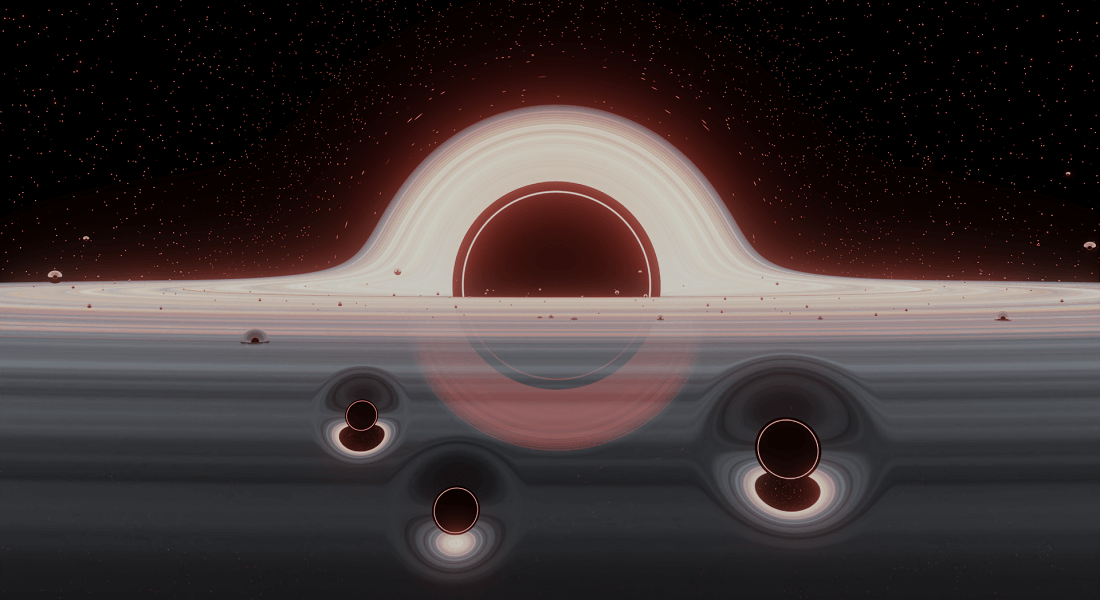
Illustration of a swarm of smaller black holes in a gas disk rotating around a giant black hole . Interactions between three black holes, such as those shown in the foreground, occur relatively often and will with high probability result in a merger on a non-circular orbit (credit: J. Samsing/Niels Bohr Institute)

Researchers provide the first plausible explanation to why one of the most massive black hole pairs observed to date by gravitational waves also seemed to merge on a non-circular orbit. Their suggested solution, now published in Nature, involves a chaotic triple drama inside a giant disk of gas around a super massive black hole in a galaxy far, far away.

Black holes are one of the most fascinating objects in the Universe, but our knowledge of them is still limited — especi...

Read More

Star Clusters are only the Tip of the Iceberg

Alpha Persei star cluster
A panoramic view of the nearby Alpha Persei star cluster and its corona. The member stars in the corona are invisible. These are only revealed thanks to the combination of precise measurements with the ESA Gaia satellite and innovative machine learning tools (© Stefan Meingast, made with Gaia Sky)

Finding lost star siblings. Star clusters have been part of the Imaginarium of human civilization for millennia. The brightest star clusters to Earth, like the Pleiades, are readily visible to the naked eye. A team has now revealed the existence of massive stellar halos, termed coronae, surrounding local star clusters.

“Clusters form big families of stars that can stay together for large parts of their lifetime...

Read More

Aging a Flock of Stars in the Wild Duck Cluster

An image of the Wild Duck Cluster was captured by the MPG/ESO 2.2-metre telescope at the La Silla Observatory in Chile. The blue stars at the center of the image are the stars of the cluster. Every star in the Wild Duck Cluster is roughly 250 million years old. Older, redder stars surround the cluster. Credit: European Southern Observatory

An image of the Wild Duck Cluster was captured by the MPG/ESO 2.2-metre telescope at the La Silla Observatory in Chile. The blue stars at the center of the image are the stars of the cluster. Every star in the Wild Duck Cluster is roughly 250 million years old. Older, redder stars surround the cluster.
Credit: European Southern Observatory

Do star clusters harbor many generations of stars or just one? Scientists have long searched for an answer and, thanks to the University of Arizona’s MMT telescope, found one in the Wild Duck Cluster, where stars spin at different speeds, disguising their common age.

In a partnership between the UA and the Korean Astronomy and Space Science Institute, a team of Korean and Belgian astronomers used UA instruments to solve a puzzle about flocks of stars call...

Read More